
Vetted Contractors in Israel: How Owners Find People They Can Trust

Updated: 4 days ago
Imagine receiving a WhatsApp photo of your Tel Aviv renovation from 6,000 miles away, only to realize the plumbing layout is wrong and the contractor has stopped answering your calls. For many overseas property owners, locating vetted contractors israel trusts is the most significant hurdle to a successful project. The dream of an Israeli home often collides with the reality of complex Hebrew contracts, the "foreigner price" markup, and the inability to oversee daily progress. It's frustrating to feel like an outsider in your own investment when you can't easily verify if a local professional is actually licensed or insured.
We understand that managing a high-stakes project from across the globe feels like a gamble. You deserve a renovation that meets Western standards on a predictable schedule and budget. This 2026 guide teaches you how to identify the right team to protect your assets. We'll show you how to verify a Kablan Rashum registration, confirm a contractor's Osek Murshe tax status, and implement a communication framework that keeps you in control without needing to board a flight. By the end of this article, you'll have a clear, step-by-step roadmap to navigate the local market with the confidence of a seasoned local.
Table of Contents
The Challenge of Finding Vetted Contractors in Israel from Abroad
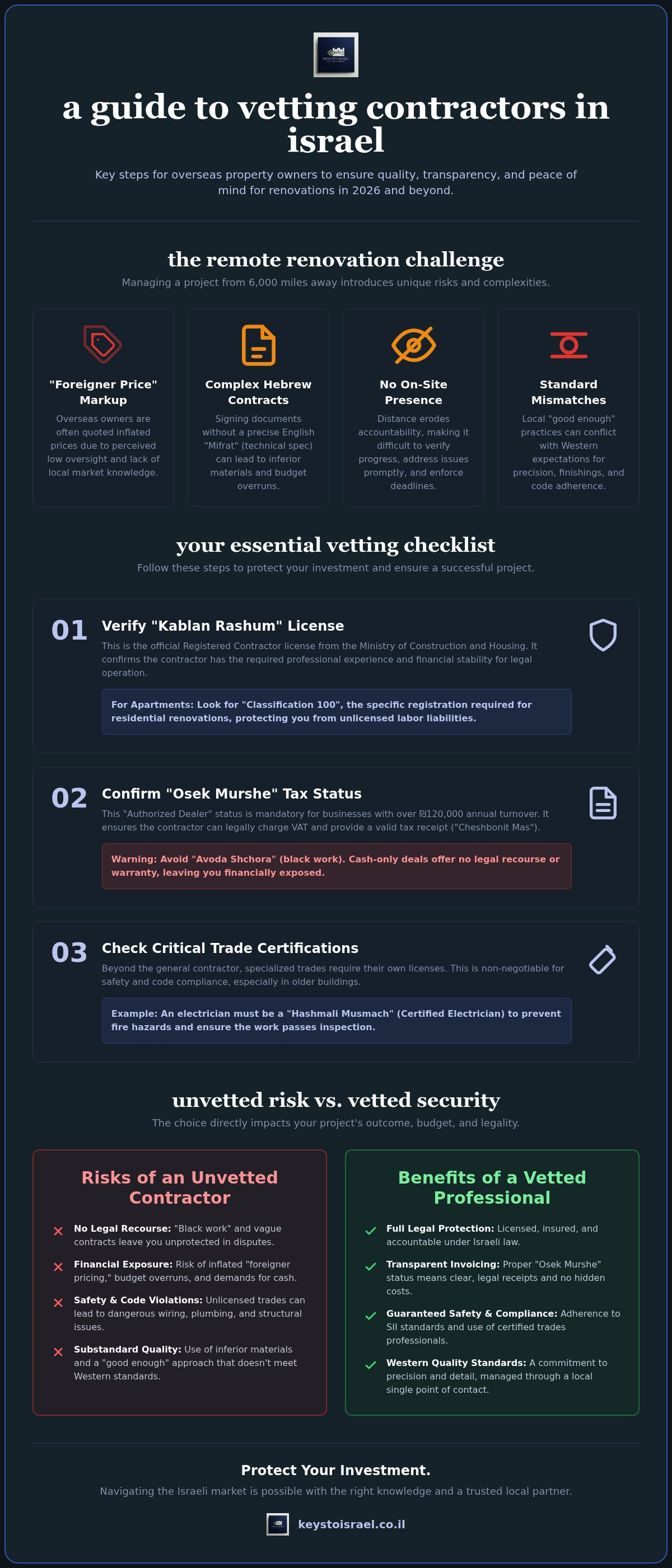
If you're managing a property from New York, Toronto, or Miami, the physical distance between you and your project is your biggest liability. Finding vetted contractors israel relies on goes beyond reading a few reviews; it requires an understanding of a market where non-resident owners are often viewed as high-budget, low-oversight targets. This dynamic leads to the "Israeli price," where quotes are inflated simply because the owner isn't there to negotiate with local knowledge. You aren't just paying more for the same work; you're often paying a premium for less accountability.
Cultural differences also play a significant role. While Western owners expect precision in finishings and strict adherence to architectural plans, local standards can sometimes prioritize speed or "good enough" functionality. Without a professional on-site, these discrepancies often remain hidden until the final walkthrough. Many owners try to bypass this by hiring through social media groups. These unverified recommendations lack the legal and technical vetting required to protect a high-stakes investment.
The Language Barrier in Construction Contracts
Signing a Hebrew contract you can't read is a recipe for financial disaster. Israeli construction projects rely on a Mifrat, a detailed technical specification that outlines every material and method used. If your contract doesn't include a translated, granular Mifrat, you're essentially giving the contractor a blank check to use inferior materials. Language gaps don't just cause confusion; they lead to expensive budget overruns when you realize "standard" in Hebrew doesn't match your definition of quality. Clear documentation in English is the only way to ensure both parties are on the same page.
Accountability Without Physical Presence
Distance erodes accountability. When deadlines are missed, a contractor might offer vague excuses that are impossible to verify from abroad. True vetted contractors israel professionals must have a proven track record of working with overseas clients who require digital documentation and frequent video updates. Because Israel's Ministry of Construction and Housing sets specific regulations for the industry, having a local representative who understands these codes ensures the team stays on schedule. A local ally acts as your eyes and ears, maintaining project momentum and ensuring that "done" actually means meeting your standards.
Essential Vetting Criteria for Israeli Renovation Professionals
Identifying vetted contractors israel relies on requires looking past a glossy Instagram portfolio. For an overseas owner, vetting is a three pillar process involving legal registration, fiscal transparency, and physical verification. You shouldn't settle for a contractor who simply "comes recommended" by a neighbor. You need a professional whose credentials stand up to the scrutiny of the Ministry of Construction and Housing. This begins with the Kablan Rashum (Registered Contractor) license. This registration confirms the contractor has the professional experience and financial stability required by law to handle significant structural or engineering works.
Quality control is the next hurdle. To ensure your project uses compliant materials and safe construction methods, verify that your contractor adheres to the guidelines set by the Standards Institution of Israel (SII). This is particularly important for plumbing and electrical systems in older buildings where shortcuts are common. If you aren't physically present to inspect the grade of pipes or the thickness of wiring, these technical standards are your only defense against future structural failures.
Fiscal Transparency and Invoicing
In the Israeli market, you'll encounter two types of business statuses: Osek Patur and Osek Murshe. For any substantial renovation, you must hire an Osek Murshe. This status is required for businesses with an annual turnover exceeding ₪120,000. It ensures the contractor is registered to charge the standard 18% VAT and can provide valid tax receipts (Cheshbonit Mas). Avoid "black" work (Avoda Shchora) at all costs. While cash-only deals might seem cheaper, they leave you with no legal recourse, no warranty, and a massive red flag for tax authorities. Valid invoices are the only way to document your investment and protect your capital.
Insurance and Liability from a Distance
If a worker is injured in your Jerusalem or Tel Aviv apartment, the legal liability can fall on you as the property owner. You must verify that your contractor carries active Employer Liability (Bituach Chavit Ma'avidim) and Third-Party Liability insurance. The latter is vital for protecting your neighbors. Renovation accidents, such as water leaks or structural cracks in the apartment below, can lead to aggressive legal claims. If you're feeling overwhelmed by these technical requirements, renovation management services can handle the verification of these policies for you, ensuring they're active and specific to your project site.
Finally, never rely on photos alone. A portfolio can be curated or even fabricated. To truly find vetted contractors israel professionals trust, you need a physical walkthrough of a current or recently completed project. Look for the details that photos hide:
The cleanliness of the job site and organization of materials.
The precision of tile grout lines and silicone seals in bathrooms.
The quality of internal paint finishes and door alignments.
How the contractor interacts with their sub-contractors on-site.
Kablan Rashum vs. Unlicensed Workers: Understanding the Risks
When you begin your search for vetted contractors israel, the term "Kablan Rashum" will appear frequently. It's not just a professional title; it's a legal designation. A Kablan Rashum is the legally recognized standard for construction safety and professionalism in Israel. This registration, managed by the Ministry of Construction and Housing, ensures that a contractor has undergone rigorous background checks, possesses the necessary engineering qualifications, and maintains a clean financial record. Hiring an unregistered worker might save you a few shekels upfront, but it exposes you to liabilities that can cost hundreds of thousands in the long run.
For most apartment owners, "Classification 100" is the specific registry code you need to verify. This classification covers general construction and renovation works. It's the gold standard for anyone stripping an apartment to its shell or moving internal walls. Israeli law actually limits what an unlicensed contractor can legally perform. If a project exceeds a certain financial threshold or involves structural changes, an unregistered contractor is technically breaking the law by accepting the job. This puts the property owner in a precarious legal position before the first hammer even swings.
How to Check the Contractor Registry
Verifying a license is a straightforward process, even if you don't speak Hebrew. You can access the "Pinkas HaKablanim," the official online database of the Ministry of Construction and Housing. To perform an accurate search, ask your contractor for their business ID number (H.P. for companies or I.D. for individuals). Once you enter this into the registry, look for their active status and their specific trade codes. Beyond Classification 100 for renovations, you might see codes for plumbing or skeleton work. If a contractor makes excuses about why they aren't listed, it's a sign they haven't met the state's professional or financial requirements.
The Consequences of Using Unlicensed Labor
The risks of using unlicensed labor extend far beyond poor craftsmanship. Most Israeli property insurance policies contain clauses that invalidate coverage if major work is performed by unregistered entities. If a fire or flood occurs during the renovation, your claim could be denied entirely. Additionally, for new builds or major additions, an unlicensed contractor cannot provide the necessary signatures for a "Tofes 4" (Occupancy Permit). This effectively makes your property illegal to live in or sell. Finally, pursuing legal recourse against an unregistered contractor is notoriously difficult. Without a formal business registration, these "ghost" contractors often disappear when a project fails, leaving you with a half-finished apartment and no way to recover your funds.
Critical Trades for Your Israel Apartment Renovation
A successful renovation is a collection of specialized victories. While a general contractor oversees the project, your home's longevity depends on the specific certifications of your tradespeople. To secure vetted contractors israel depends on, you must look beyond the general license and verify trade-specific credentials. This is where the gap between a "standard" local renovation and a high-quality Western finish becomes most apparent. If you're managing this from abroad, you need to know exactly which certifications to demand for each critical system.
The electrician is your most critical hire for safety. You must verify that they hold a "Hashmali Musmach" (Certified Electrician) license. Israeli electrical codes are specific about grounding and the number of circuit breakers required for modern appliances. If your home is in an older building, the wiring likely won't support a modern kitchen without a significant three-phase upgrade. Hiring a general laborer to touch your fuse box is a risk that can invalidate your property insurance.
Electrical and Plumbing Standards
Plumbing, or "Instalatzia," is the most common source of post-renovation headaches. In older Jerusalem or Tel Aviv apartments, you'll often find decaying lead or galvanized iron pipes. We recommend a full transition to modern SP or PEX systems, which offer better durability and easier maintenance. For a detailed breakdown of compliance requirements, consult our guide on Renovation Rules and Building Codes in Israel. Ensuring these systems are installed correctly from the start prevents the nightmare of ripping up new flooring to fix a leak six months later.
Finishing and Aesthetic Quality
Achieving a "Western finish" requires meticulous oversight of the "Spackel" (plastering) process. Without specific instructions, local teams might leave walls with slight waves that become painfully visible under modern LED lighting. Similarly, flooring and tiling specialists must be vetted for their ability to achieve perfectly level surfaces and tight grout lines. This is especially true for large-format tiles which are popular in 2026 but notoriously difficult to lay correctly.
HVAC systems in Israel also require specialized knowledge. Navigating the country's unique VRF (Variable Refrigerant Flow) and mini-central systems is essential for effective climate control. If you're coordinating these trades from abroad, our renovation management oversight ensures every specialist meets these exacting standards before they set foot on your property. This physical presence on your behalf is the only way to guarantee that the materials used, including custom cabinetry and kitchen installations, can withstand the local climate and meet your expectations.
Managing Your Renovation Team via Keys to Israel
Managing a renovation from thousands of miles away requires more than just a good contractor; it requires a system of oversight that ensures your interests are protected at every stage. We act as your single point of contact (SPOC), removing the burden of coordinating multiple trades and navigating local bureaucracy yourself. Our role is to bridge the gap between your Western expectations and the local team's output. We don't just hope for progress; we verify it through regular video reporting and high-resolution photographic documentation that brings the job site to your screen, no matter your time zone.
One of the biggest anxieties for overseas owners is the release of funds. We implement a strict financial oversight model where payments are released to the team only upon reaching verified, specific milestones. This keeps the contractor motivated and ensures your capital stays secure until the work is completed to the required standard. By maintaining a physical presence on-site, we catch potential issues before they become expensive mistakes, providing the steady hand you need in a complex foreign market.
The Keys to Israel Vetting Process
Our criteria for selecting the contractors we work with are rigorous. We don't just check for a license; we look for a history of reliability, fiscal transparency, and an understanding of the high-finish standards our clients demand. If a conflict arises, we handle dispute resolution on your behalf, using our local standing to ensure the project stays on track. This meticulous management is how we keep Israel Apartment Renovation Costs within your agreed budget, preventing the "scope creep" that often plagues unmanaged projects.
Starting Your Remote Renovation
Your journey begins with an initial consultation where we define the scope of work and align on Western quality standards. Once the goals are clear, we facilitate a comprehensive quote from a team of vetted contractors israel professionals trust. This ensures you start with a realistic, transparent roadmap rather than a vague estimate. For those looking for the full operational framework, our guide on Renovating in Israel from Abroad provides the complete strategy for successful remote ownership. We represent your interests on the ground so you can focus on the long-term value of your investment.
Protecting Your Israeli Investment from Afar
Renovating a property from abroad is a significant financial commitment that requires more than just hope; it demands a rigorous, professional framework. By prioritizing vetted contractors israel relies on, you move from a position of vulnerability to one of informed control. Verifying trade-specific licenses and ensuring fiscal transparency through Osek Murshe status are the foundations of a secure project. Implementing milestone-based payments and maintaining a physical presence on-site are the only ways to bridge the geographical gap effectively.
Keys to Israel brings decades of local expertise to your project, offering a trusted network of licensed and insured professionals. We provide personalized oversight for clients in New York, Toronto, and beyond, acting as your protective advocate on the ground. You don't have to navigate this complex landscape alone. Secure your Israel renovation with a vetted team today and turn your property vision into a high-quality reality. Your investment is in steady hands.
Frequently Asked Questions
How do I verify if a contractor in Israel is officially licensed?
You can verify a contractor's status by searching the "Pinkas HaKablanim" database maintained by the Ministry of Construction and Housing. Ask for their business ID (H.P.) or personal ID number to perform the search. Look for an active "Kablan Rashum" status and specific classification codes like "100" for apartment renovations. This step is non-negotiable for finding vetted contractors israel homeowners can legally rely on for structural work and insurance compliance.
Can I hire a contractor in Israel without a written contract?
You should never hire a professional without a detailed written contract. For non-residents in New York or Miami, a verbal agreement offers zero protection in an Israeli court. A robust contract must include a Mifrat (technical specification) in a language you understand. This document outlines materials, timelines, and payment milestones. Without it, you lack the legal leverage needed to resolve disputes or enforce quality standards from thousands of miles away.
What is the difference between an Osek Murshe and an Osek Patur for renovation?
An Osek Murshe is an authorized dealer required for businesses with an annual turnover exceeding ₪120,000, which includes most legitimate renovation firms. They charge 18% VAT and provide official tax receipts. An Osek Patur is a small business exempt from VAT but limited in turnover. For a professional renovation, hiring an Osek Murshe is essential. It ensures the contractor is fiscally transparent and capable of handling the financial scale of a full apartment overhaul.
Do contractors in Israel provide a warranty (Arvut) on their work?
Legitimate vetted contractors israel professionals typically provide a warranty, known as "Arvut," for their work. While the Sale Law provides statutory protections for new construction, renovation warranties are usually defined within your specific contract. This should cover plumbing, electrical systems, and structural work for several years. Ensure these terms are explicitly written in your agreement. A warranty is only as good as the contractor's reputation and their willingness to return for repairs.
Is it common to pay contractors in Israel in cash?
While some local tradespeople may request cash, paying "under the table" is a significant risk for foreign investors. Cash payments leave no paper trail, making it impossible to document your investment for tax purposes or prove payment in a dispute. Furthermore, "black" work often invalidates your property insurance and lacks any formal warranty. Always insist on bank transfers or checks accompanied by a legal invoice (Cheshbonit Mas) to protect your capital and legal standing.
How much should I pay as a deposit to a contractor in Israel?
A standard deposit is generally between 10% and 15% of the total project cost. This amount secures the contractor's schedule and covers initial material orders. You shouldn't pay more than this before work actually commences on-site. The remaining balance should be divided into milestone-based installments. By releasing funds only after specific stages of the renovation are inspected and approved, you maintain financial leverage and ensure the project continues to move forward as planned.
What happens if a contractor fails to finish the project on time?
If your contract includes a "penalty clause," you can deduct a pre-agreed daily amount from the final payment for every day the project exceeds the deadline. Without this clause, your options are limited to negotiation or legal action. This is why milestone payments are critical; they allow you to withhold funds if progress stalls. Having a local representative oversee the project helps prevent these delays by maintaining constant pressure on the team to stay on schedule.
Can Keys to Israel help me find a vetted contractor if I already own a property?
Yes, Keys to Israel provides renovation management for properties you already own, as well as newly purchased ones. Whether your apartment is in Los Angeles or Toronto, we act as your local representative in Israel. We manage a vetted team of contractors and specialists to ensure your project meets Western standards. Our service includes coordinating with all trades, releasing payments only upon milestone completion, and providing regular progress reports to keep you fully informed.


Comments