
Renovation Rules and Building Codes in Israel: The Owner’s Guide

Updated: 5 days ago

What if the most expensive part of your Israeli apartment renovation isn't the high-end finishes, but a single "stop-work" order from the local Iriya? For many overseas owners, the excitement of transforming a property often clashes with the reality of complex renovation rules and building codes in israel. You likely recognize that a modern renovation is the smartest way to increase your asset's value, yet the fear of hitting a wall of red tape or facing municipal fines can be paralyzing. It's difficult to feel confident when you're unsure if a simple wall removal requires a full permit or just a contractor's nod.
This guide provides the clarity you need to ensure your project remains legal, safe, and on schedule for 2026. We'll help you distinguish between minor cosmetic updates and structural changes that demand official oversight. By understanding these boundaries, you'll gain a clear roadmap for managing everything from the Va'ad Bayit's rights to the latest safety standards. You'll learn exactly how to navigate the system like a local, protecting your investment from avoidable delays and ensuring your renovation adds the lasting value you expect.
Free download: Want the practical version to keep open for your whole project? Our free playbook, Renovating in Israel from Abroad, gives you the work-by-work permit table, real cost ranges per sqm, 10 questions to ask any contractor, and a payment schedule that protects you. Get your free copy here.
Table of Contents
Understanding the Israeli Regulatory Landscape for Renovations
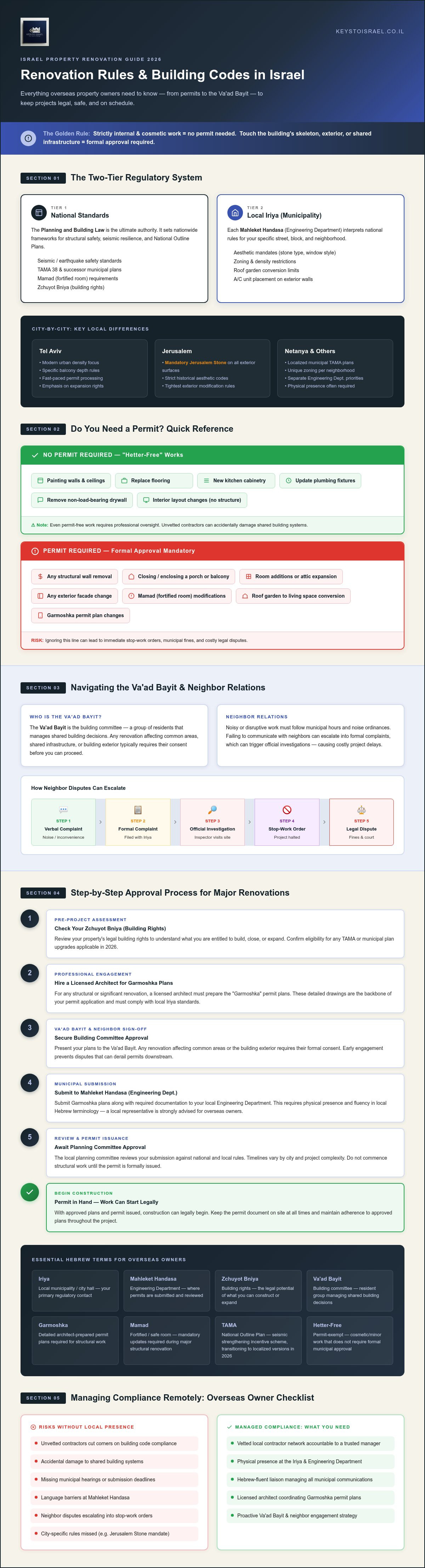
The Israeli regulatory environment is often perceived as a labyrinth, but it operates on a logical, two-tiered system. At the top, national standards ensure safety and structural integrity across the country. Below that, local municipalities (the Iriya) dictate the specific aesthetics, density, and usage of their neighborhoods. Understanding how renovation rules and building codes in israel function requires looking at both levels simultaneously to avoid costly legal friction.
If you own a property in Tel Aviv, your experience with the Iriya will differ vastly from an owner in Jerusalem or Netanya. While Tel Aviv might prioritize modern urban density and specific balcony depths, Jerusalem enforces strict aesthetic codes, most notably the mandatory use of Jerusalem Stone on all exterior surfaces. These local nuances aren't suggestions; they're rigid requirements that can halt a project if ignored.
Your "Zchuyot Bniya," or building rights, represent the legal potential of your property. These rights determine whether you can close a porch, add a room, or expand into an attic. In 2026, we see a significant shift in how these rights are allocated. The focus has moved toward seismic resilience, ensuring that older apartment blocks are updated to meet modern earthquake safety standards. This means that while some older "TAMA" regulations are changing, the emphasis on structural safety is stricter than ever. If you haven't bought yet, see how older apartments stack up in our guide to buying new vs second-hand in Israel.
The Planning and Building Law
The Planning and Building Law serves as the ultimate authority for structural changes in the country. This primary legislation provides the framework for "National Outline Plans," which are designed to encourage owners to strengthen their buildings against seismic activity in exchange for additional building rights. As we move through 2026, many cities are transitioning from national TAMA 38 plans to localized municipal versions. These new plans often provide more clarity on what you can build, but they require meticulous local navigation to ensure your specific apartment qualifies for upgrades.
Municipal vs. National Rules
Your local "Mahleket Handasa" (Engineering Department) is your most vital point of contact during any significant project. While national laws set the baseline, the local department interprets how those rules apply to your specific street or block. Local zoning affects everything from expansion possibilities to the type of air conditioning units you can install on an exterior wall.
Aesthetic mandates: Specific stone types or window styles required to maintain a city's historical character.
Zoning restrictions: Strict limits on how much of a "roof garden" can be converted into living space.
Safety requirements: Mandatory updates to the "Mamad" (fortified room) during major structural renovations.
Navigating these departments requires a physical presence and an understanding of local Hebrew terminology. It's rarely enough to simply follow a checklist; you must understand the current priorities of your specific municipality's planning committee.
Internal vs. Structural Work: When Do You Need a Permit?
Understanding where the line is drawn between simple updates and regulated construction is the first step in protecting your investment. The golden rule of the Israeli system is straightforward. If your work is strictly internal and cosmetic, you generally don't need a permit. If you touch the building's skeleton, its exterior, or shared infrastructure, you must comply with the formal renovation rules and building codes in israel. Crossing this line without approval can lead to immediate stop-work orders and significant legal headaches.
Cosmetic Renovations: The Fast Track
Israeli law classifies standard maintenance as "Hetter-free," meaning it's exempt from the lengthy permit application process. This category covers the vast majority of apartment refreshes. You can paint walls, replace flooring, install new kitchen cabinetry, or update standard plumbing fixtures without municipal intervention. You can even change internal layouts, such as removing a non-load-bearing drywall to enlarge a bedroom, as long as you stay within existing plumbing and electrical columns.
While these projects don't require a permit, they still require professional oversight. Working with unvetted contractors can lead to accidental damage to shared building systems. Our renovation management services bridge this gap by providing the local presence needed to ensure your contractor adheres to high standards while you're overseas. Even a "simple" flooring job requires careful coordination to avoid neighbor complaints or damage to the building's infrastructure.
Structural and External Alterations
Any change visible from the street is a red line that triggers a permit requirement. This includes changing window sizes, enclosing a porch, or adding a "Sukkah Balcony." Internally, the most common red line involves load-bearing walls. You cannot remove or significantly alter these without a "Konstruktor" (Structural Engineer) verifying the plans and the municipality issuing a permit. Adding a bathroom is another common trigger. Because new bathrooms often require tapping into the building's shared sewage lines in ways not originally planned, the Iriya usually demands a formal review.
A critical factor for 2026 is the "Mamad" (security room) requirement. If your renovation increases the apartment's footprint or involves significant structural reinforcement, the municipality may mandate the installation of a reinforced room. This isn't just a building code; it's a national security standard. Failing to account for this can derail your budget and timeline. Mastering the renovation rules and building codes in israel means knowing when these safety triggers apply to your specific floor plan before you sign a contract.
Navigating the "Va’ad Bayit" and Neighbor Relations
In Israel, your apartment doesn't exist in a vacuum. The Va’ad Bayit, or building committee, is an elected body with significant legal authority over shared spaces and communal infrastructure. While they don't control the interior design of your living room, they act as the gatekeepers for the building’s structural integrity and aesthetic uniformity. If your project involves structural changes, the Iriya often requires signatures from a specific percentage of your neighbors before granting a permit. Recognizing that the renovation rules and building codes in israel extend to these communal relationships is vital for any owner who wants to avoid costly litigation or project freezes.
A formal "Neighbor Objection" process exists within the municipal planning system. If a neighbor feels your renovation encroaches on their rights or the building's safety, they can file a formal complaint through the Iriya. This can trigger a mandatory hearing, potentially delaying your timeline by months. Managing these relationships isn't just about being polite; it's a strategic necessity to keep your project on track.
Communal Infrastructure Rules
The line between private property and communal assets is often thinner than owners realize. Central plumbing stacks, electrical mains, and the building's facade are considered shared property. You cannot unilaterally move a drainage pipe on an external wall or relocate an air conditioning unit if it disrupts the building’s uniform appearance. If your renovation requires tapping into these central systems, you have a legal obligation to ensure the work doesn't degrade service for other residents. Additionally, most buildings require you to carry specific insurance for any work performed in shared spaces, such as the stairwell or roof, to protect the collective from liability.
The Art of Neighbor Diplomacy
Proactive communication is the standard practice for successful renovations in Israel. It's common to distribute a "pre-renovation" letter to every neighbor, outlining the project duration and providing contact information for the project manager. This simple gesture can prevent many complaints before they reach the municipality. You must also adhere strictly to noise ordinances; construction noise is typically restricted between 8:00 PM and 7:00 AM, with additional limitations on Friday afternoons and Saturdays.
For overseas owners, managing these nuances is nearly impossible from a distance. Having a local representative from Keys to Israel handles these interactions on your behalf. We act as your advocate, mediating disputes with the Va’ad Bayit and ensuring your contractors respect the building’s rules. This physical presence prevents minor misunderstandings from escalating into legal hurdles that could jeopardize your investment.
The Step-by-Step Approval Process for Major Renovations
Executing a major project requires following a strict municipal lifecycle. While cosmetic work moves quickly, any structural change necessitates a formal application. Compliance is your best insurance. Ignoring these steps puts your investment at risk of legal action or demolition orders. Following the renovation rules and building codes in israel means moving through five distinct stages of approval.
The process begins with hiring an architect or engineer to draft the "Garmoshka," a comprehensive folded permit plan that details every technical aspect of the proposed work. Once finalized, this plan is submitted to the local planning committee for review. If approved, you'll be required to pay various municipal fees, most notably the "Heitel Hashbacha," or Improvement Levy. After these payments are cleared, the municipality issues the physical "Hetter Bniya" (Building Permit), which must be posted prominently at the construction site. For projects involving expansions, a final inspection is mandatory to receive "Tofes 4," the occupancy permit that confirms the work meets all safety standards.
The Role of Professional Coordination
A successful renovation depends on syncing the efforts of your architect, structural engineer, and contractor. In 2026, the timeline for obtaining a Hetter Bniya remains a significant variable, often taking several months depending on the municipality's backlog. A project manager acts as your local advocate, ensuring that technical reports are submitted correctly and deadlines are met. Falling into the "illegal construction" trap, where work begins before the final permit is issued, is a common error that leads to heavy fines and project freezes. We provide the renovation management expertise needed to keep your project compliant and moving forward.
Financial Considerations: Levies and Taxes
Budgeting for a renovation involves more than just material and labor costs. You must account for the Heitel Hashbacha, a tax triggered when the municipality determines that your renovation significantly increases the property's value. This levy can be substantial, and it's often a surprise to overseas owners. You'll also face technical report costs and application fees that vary by city. For a clearer picture of these expenses, you can refer to our guide on Estimating Israel Apartment Renovation Costs. Understanding these financial triggers early allows you to build a realistic contingency fund and avoid mid-project funding gaps.
Managing Compliance Remotely: The Keys to Israel Advantage
Managing a high-stakes construction project from thousands of miles away is a logistical challenge that many owners find overwhelming. Without a physical presence on the ground, you're forced to rely on filtered information from contractors who might prioritize speed over strict compliance. We bridge this geographical gap by acting as your eyes and ears on-site. Our team ensures that every stage of the project adheres to the renovation rules and building codes in israel, protecting you from the legal and financial fallout of non-compliant work.
Vetting contractors is only the first step. We provide continuous oversight to ensure the work remains within the boundaries of your "Hetter" or permit. If a contractor suggests a shortcut that violates municipal standards, we intervene immediately. To keep you informed, we provide transparent reporting through regular photo and video updates. Whether you're in New York, Miami, or Toronto, you'll see the progress of your renovation in real-time, allowing you to make decisions with the same confidence as if you were standing in the apartment yourself.
The project ends with a meticulous final handover. We don't just check the finishes; we ensure the site is clean, fully compliant with the original plans, and ready for immediate occupancy or rental. This thoroughness prevents the "lingering punch list" that often plagues unsupervised renovations. We solve the problem of distance by providing professional accountability throughout the construction lifecycle.
Your Local Ally in the Iriya
Navigating the municipal bureaucracy of the Iriya requires local knowledge and persistence. David Bitton and the Keys to Israel team handle the complex interactions with the engineering department and planning committees so you don't have to. Understanding the renovation rules and building codes in israel is only half the battle; the other half is knowing how to communicate with the officials who enforce them. We coordinate directly with legal professionals to ensure all necessary paperwork is filed correctly and that your building rights are fully protected. Our single point of contact model means you never have to juggle calls between architects, lawyers, and foremen.
Post-Renovation Property Management
Once the dust settles, your focus should shift to protecting your newly enhanced asset. Transitioning from construction to Property Management for Overseas Owners ensures that your investment remains in top condition. Long-term maintenance is essential to preserve the value added by your renovation, especially in Israel’s coastal climate. We provide the continuity of care needed to manage tenants and maintain the property’s high standards for years to come. This steady hand protects your assets from the wear and tear of long-distance ownership.
Ready to modernize your Israeli home? Book a Renovation Consultation with Keys to Israel today.
Securing Your Property’s Future Value
A successful renovation in Israel is built on a foundation of legal compliance and strategic planning. You now understand that while cosmetic updates offer a fast track to modernization, any structural change requires a meticulous approach to municipal permits and neighbor relations. By distinguishing between "Hetter-free" work and regulated alterations, you can avoid the common pitfalls of stop-work orders and municipal fines that often plague unsupervised projects. Mastering the renovation rules and building codes in israel isn't just about following the law; it's about ensuring your property remains a safe, high-value asset for years to come.
If you're managing this process from North America, you don't have to navigate the Iriya or vet contractors alone. We provide a steady hand on the ground, offering deep expertise in local codes and a vetted network of licensed contractors. We act as your protective advocate, ensuring every detail meets 2026 safety standards while you remain focused on your goals abroad. Your vision for a modernized Israeli home is achievable with the right local ally by your side. Schedule a Renovation Management Discovery Call today and take the first step toward a seamless, compliant transformation.
Before you call an architect: download Renovating in Israel from Abroad, our free playbook for overseas owners. It covers permits, the betterment levy, real costs, hiring a contractor you can trust, and the 7 costly mistakes we see most. Download the free playbook.
Frequently Asked Questions
Do I need a permit to renovate a kitchen or bathroom in Israel?
You don't usually need a permit for cosmetic kitchen or bathroom updates like replacing cabinetry, tiles, or fixtures. However, if your plan involves relocating central plumbing stacks or enlarging windows, you'll need municipal approval. These changes affect the building's shared infrastructure and external facade, triggering strict oversight. It's best to verify your specific floor plan with a local expert to ensure you don't accidentally cross the line into regulated territory.
How long does it take to get a building permit for an apartment expansion?
Obtaining a permit for an apartment expansion typically takes between six to twelve months, though this varies significantly by municipality. In cities with high demand like Tel Aviv, the backlog in the engineering department can extend timelines. Factors such as neighbor objections or the complexity of your technical reports also play a role. Starting the process early with a professional architect is essential to keep your 2026 project on schedule.
What is the "Mamad" requirement and does it apply to my renovation?
The "Mamad" is a reinforced security room required by national safety standards for modern apartments. If your renovation increases the apartment's square footage or involves significant structural reinforcement, the municipality will likely mandate the installation of one. This requirement ensures that older buildings are brought up to modern safety codes. Because adding a Mamad is a major structural and financial undertaking, you should determine if it's triggered before finalizing your budget.
Can my neighbors stop me from renovating my apartment?
Neighbors cannot stop internal cosmetic work, but they have the legal right to object to structural or external changes. During the permit application process, the Iriya notifies neighbors of your plans. If they believe the work encroaches on their rights or the building’s safety, they can file a formal objection. This may lead to a municipal hearing. Proactive communication and neighbor diplomacy are the most effective ways to prevent these costly delays.
What happens if I renovate without a permit in Israel?
Renovating without a permit can lead to immediate stop-work orders, heavy municipal fines, and even court-ordered demolition of the non-compliant work. Beyond the legal risks, illegal construction can make it difficult to sell the property later, as the "Tabu" (land registry) won't match the physical structure. Adhering to the renovation rules and building codes in israel protects your investment and ensures your property remains legally marketable and safe for future residents.
Do I need to hire a structural engineer for internal wall removal?
You must hire a structural engineer, known as a "Konstruktor," if you plan to remove any wall that isn't a simple drywall partition. In Israeli apartment blocks, many internal walls are load-bearing or provide seismic stability. Removing them without a professional assessment risks the integrity of the entire building. The engineer will provide a technical report and reinforcement plan, which is often a prerequisite for obtaining the necessary municipal permits for structural work.
Is there a difference in building codes between Tel Aviv and Jerusalem?
Yes, while national safety standards are consistent, municipal bylaws differ greatly. Jerusalem enforces strict aesthetic codes, such as the mandatory use of Jerusalem Stone on all exterior surfaces. Tel Aviv has different priorities, often focusing on urban density, balcony depths, and specific preservation rules for historical buildings. Understanding these local nuances is critical because what's permissible in one city might be strictly prohibited in another, directly impacting your project's feasibility and design.
How do I ensure my contractor is following Israeli building codes?
The best way to ensure compliance is to hire licensed contractors and maintain constant local oversight. You should verify their credentials and ensure they have experience with the specific renovation rules and building codes in israel applicable to your city. For overseas owners, having a local representative perform regular site visits and review the work against the approved permit plans is essential. This physical presence holds contractors accountable and prevents non-compliant shortcuts.


Comments