
Managing Vacant Property in Israel: The Security & Maintenance Checklist

Updated: 4 days ago
You might be relieved to hear that the proposed 1.5% "Ghost Tax" was officially dropped from the final 2026 budget, but that doesn't mean your israel vacant property security is guaranteed. Owning property in Israel from thousands of miles away often feels like a constant exercise in "what if." You worry about a silent pipe burst in Jerusalem or an administrative error with your Arnona bill that leads to unnecessary fines. It's a heavy burden to carry when you aren't there to walk through the front door yourself.
We understand that distance creates a vulnerability that technology alone can't fix. This guide provides the exact framework you need to protect your Israeli investment, ensuring it remains a source of pride rather than a source of stress. We'll walk through the essential 2026 maintenance protocols, the 1.626% baseline Arnona increase, and the local coordination strategies that keep your home secure and compliant while you're abroad. By the end of this checklist, you'll have a clear path to bulletproofing your assets against the unique challenges of the local market.
Table of Contents
Physical Security: Hardening the Entry Points of Your Israeli Property
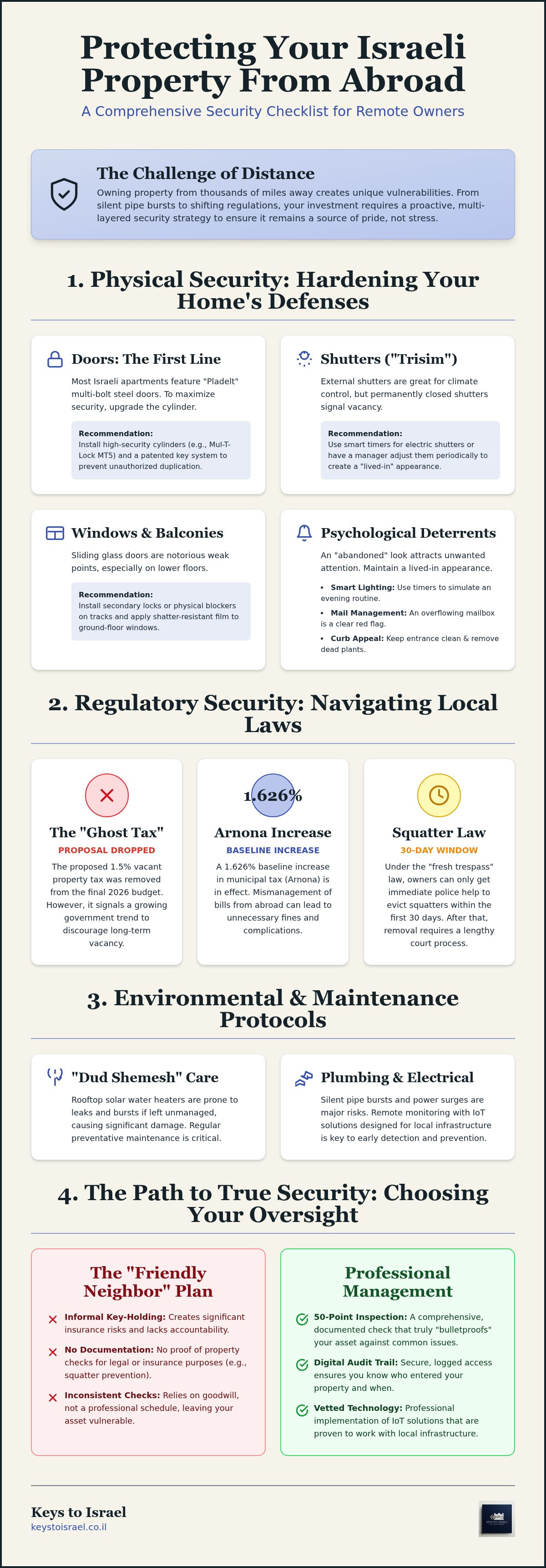
Securing a home from thousands of miles away requires more than just a sturdy lock. It demands a layered approach that accounts for the specific architectural standards found in Israel. If you are an absentee landlord, your first line of defense is the front door. Most Israeli apartments use the "Pladelt" standard. These are multi-bolt steel doors that lock into the frame at several points. However, a door is only as strong as its cylinder. We often recommend upgrading to high-security cylinders like the Mul-T-Lock MT5 to ensure your israel vacant property security remains uncompromised.
Beyond the door, your "Trisim" or external shutters play a vital role. While they are excellent for climate control and protecting furniture from the intense Mediterranean sun, they also signal whether a home is occupied. If shutters remain closed for months, it's a clear sign of vacancy. We suggest using smart timers for electric shutters or having a local manager adjust them periodically to maintain a lived-in appearance.
Consider these psychological deterrents to keep your property off a burglar's radar:
Smart Lighting: Use IoT-enabled timers to vary lighting patterns throughout the week, simulating a natural evening routine.
Mail Management: A stuffed mailbox is a beacon for intruders. Regular clearance is essential to prevent the "abandoned" look.
Strategic Visibility: Ensure your property looks active. This includes removing dead plants from balconies and ensuring the entrance is clean.
Lock Standards and Key Control
Standard cylinders are often vulnerable to picking or bumping. Upgrading to a patented key system ensures that keys cannot be duplicated without a specific authorization card. This is critical if you've previously shared keys with past tenants or contractors. You should also avoid the common mistake of hiding keys in building lobbies or "secret" spots near the entrance. Professional management involves maintaining a digital audit trail. This ensures you know exactly who has accessed your home and when, removing the guesswork from long-distance ownership.
Window and Balcony Vulnerabilities
Israeli apartments often feature large sliding glass doors leading to balconies. These are notorious weak points, especially on lower floors. We recommend installing physical blockers or secondary locks on these tracks. If your unit has electric shutters, they must be maintained. Dust and salt air in coastal cities like Tel Aviv can cause motors to seize if they aren't operated regularly. Additionally, applying shatter-resistant films to ground-floor windows provides an invisible layer of protection that makes entry significantly more difficult for opportunistic burglars.
Regulatory Security: Navigating the 2026 Vacant Property 'Ghost Tax'
Real israel vacant property security extends beyond the physical perimeter of your home. It involves the administrative standing of your asset within the Israeli municipal system. If you aren't physically present, you're at the mercy of shifting regulations that can lead to significant financial penalties. The most discussed change recently was the "Ghost Tax," a 2026 budget proposal originally designed to increase housing supply by taxing vacant units at 1.5% of their value. While this specific proposal was ultimately dropped from the final 2026 budget, it highlights a growing trend: the Israeli government is actively looking for ways to discourage long-term vacancy.
Municipalities track usage primarily through utility meters. If your water or electricity usage remains at zero for extended periods, the city may reclassify your property. This can lead to the loss of certain residential benefits or trigger inspections. Beyond taxes, there's the legal risk of squatters. Under Israeli law, the concept of "fresh trespass" allows owners to involve the police for immediate eviction only within the first 30 days of an illegal entry. Once that window closes, removing an intruder becomes a lengthy, expensive court process. This makes regular, documented visits to the property a legal necessity rather than a luxury.
The 1.5% Vacant Property Tax Initiative
The "Ghost Tax" was a 2026 budget proposal aimed at penalizing owners of under-utilized residential plots and units to force more inventory into the market. Even though the Prime Minister instructed the Finance Minister to remove this 1.5% levy from the current budget, the underlying pressure remains. Private homeowners should still audit their property's status. If your unit is currently listed as "unfit for habitation" or is undergoing a lengthy renovation, you must ensure your documentation is airtight to avoid future iterations of these vacancy penalties.
Managing Municipal Relationships (Arnona)
Every property owner in Israel is subject to Arnona, or municipal property tax. For 2026, there's a nationwide automatic baseline increase of 1.626% for all municipalities. You can apply for a one-time "Empty Property" discount, known as a Ptur, which typically lasts for six months. However, once this exemption is used, it's generally gone for the life of your ownership. Relying on this without a long-term plan is a mistake. Low water usage often flags a property for a vacancy audit, so having a professional run the taps and flush the toilets isn't just about plumbing; it's about tax compliance. Coordinating with an Israel real estate legal consultant is the best way to ensure you're utilizing every available exemption while staying on the right side of local law. If you're feeling overwhelmed by these administrative hurdles, our team can help you transition your property from a risk to a managed asset.
Environmental Security: Preventing Plumbing and Climate Damage
Physical israel vacant property security involves more than stopping intruders; it requires defending against the local climate. Israel's environment is notoriously harsh on unmanaged interiors. In coastal cities like Tel Aviv or Netanya, the salt-heavy, humid air can corrode fixtures and promote rapid mold growth. Meanwhile, the Jerusalem hills present a different challenge: the "Jerusalem Damp." This occurs when moisture becomes trapped within thick stone walls, leading to structural damage if the unit remains sealed for months. Without a local presence to regulate the internal environment, a luxury apartment can deteriorate surprisingly quickly.
One of the most overlooked risks is the "Dud Shemesh," the solar water heater found on nearly every Israeli roof. These units are under constant pressure and exposed to the elements. A burst tank or a failed valve on the roof can send hundreds of liters of water through the building's infrastructure before anyone notices. Regular inspections of the tank's valves and the integrity of the solar panels are essential to prevent catastrophic water damage. All plumbing maintenance should adhere to Israeli Standard SI 1205 to ensure long-term reliability and insurance compliance.
Pest management is another critical pillar of environmental security. Mediterranean cockroaches and ants are persistent. They enter through dry P-traps and small cracks looking for moisture. A "Flush and Flow" routine is the best defense. Running water through every tap and flushing every toilet every 14 days refills the traps, blocking sewer gases and pests from entering your living space.
Water Damage Mitigation
Deciding whether to shut off the main water valve is a common dilemma. If you have a balcony garden or smart irrigation, you must keep the water on. In these cases, installing smart leak detectors that connect to your local Wi-Fi is the only way to mitigate risk. These sensors can alert you to a dripping faucet or a major burst instantly. If you don't have plants, shutting the main valve is safer, but you must still have someone visit to flush the system. Stagnant water in the pipes can lead to bacterial growth and the drying out of rubber seals, which causes leaks once the water is turned back on.
Climate and Air Quality
To prevent mold, you should never leave a property completely airtight. During the humid summer months, we recommend setting your air conditioning units to "Dry" mode. This removes moisture without the high energy cost of full cooling. It is also vital to check for mold growth behind furniture positioned against exterior-facing walls. These areas lack airflow and are the first places where the "Jerusalem Damp" or coastal humidity will manifest. Small gaps between the wall and your wardrobes can save your furniture and your health.
The Remote Owner's Tech Stack: IoT Solutions for Israel
Managing a home from abroad requires eyes and ears on the ground, but standard smart home kits often fail when faced with Israel's unique infrastructure. For robust israel vacant property security, you need a tech stack that accounts for local power fluctuations and specific utility platforms. While many owners rely on delayed monthly bills, smart water meters now allow you to monitor usage via the "Mei Avivim" app or other local municipal portals. This real-time data serves as your first warning sign of a leak before it causes significant damage to your floors or the neighbor's ceiling. In Israel, the power grid can be sensitive during peak summer heatwaves, making hardware durability a top priority.
Privacy regulations in Israel are another critical factor to manage. If you install cloud-based cameras, you must ensure they don't record common building areas or infringe on neighbors' private spaces. This is a common point of legal friction in high-density apartment blocks. Additionally, for properties in Jerusalem or the Galilee, remote thermostat control provides essential freeze protection. Maintaining a minimum temperature during winter cold snaps prevents the pipes from cracking, a small investment that avoids a massive repair bill.
Connectivity and Power
A smart home system is only as reliable as its power source. We always suggest installing a UPS (Uninterruptible Power Supply) for your router and main hub. This prevents a brief power surge from knocking your entire security system offline. Since local infrastructure work can occasionally lead to fiber cuts, a 5G backup router is a safer bet than relying on a single physical line. You can also integrate smart plugs to periodically cycle lamps or small appliances. This helps maintain the active appearance of the home, which we discussed as a key deterrent in earlier sections.
Smart Access and Monitoring
Physical keys are a security liability that is easily avoided. By installing smart locks that generate temporary, trackable codes, you can grant entry to vetted contractors in Israel without worrying about unauthorized duplication. This setup creates a clear digital audit trail of every entry and exit. We also recommend deploying environmental sensors to track smoke, heat, and humidity levels. These are particularly useful in coastal cities where high humidity can lead to mold if not addressed quickly. Centralizing these alerts into a single digital dashboard gives you the oversight needed to manage your asset with confidence. If you're ready to professionalize your oversight, connect with our property management team today.
Professional Oversight: Why the 'Friendly Neighbor' Plan Fails
Many overseas owners entrust their keys to a well-meaning neighbor or a local friend. While this seems like a cost-effective solution, it often creates a false sense of security. A "friendly neighbor" might notice a pile of mail, but they are rarely equipped to identify the early signs of a failing seal in a rooftop solar heater or the subtle salt-air corrosion on window tracks. Maintaining true israel vacant property security requires a level of technical oversight that casual visits simply cannot provide. When a pipe bursts at 3 AM in New York, it is already 10 AM in Tel Aviv; by the time you wake up to a frantic WhatsApp message from a neighbor, the damage is often irreversible.
Professional management bridges this geographical and temporal gap. It replaces casual "check-ins" with a methodical system of oversight designed to satisfy both municipal requirements and insurance mandates. If your property remains vacant, it needs more than a visitor; it needs a steward who understands the local landscape and can act decisively on your behalf.
The Insurance Gap
Most Israeli property insurance policies for vacant units contain specific "Proof of Care" clauses. These often mandate a documented inspection every 7 to 14 days to keep the policy active. If a major leak occurs and you cannot produce a professional log of these visits, the insurer may deny your claim entirely. Neighborly help lacks the legal standing required by Israeli insurers. A professional manager provides a verifiable audit trail, including date-stamped photos and detailed reports, ensuring that your investment remains protected under the law.
The Keys to Israel Advantage
We serve as your single point of contact for property management in Israel, acting as your "boots on the ground" in Jerusalem, Tel Aviv, and beyond. Managed by David Bitton, our team utilizes a 50-point inspection checklist that covers every vulnerability from electrical board stability to pest entry points. We don't just find problems; we coordinate emergency repairs with a vetted team of contractors who are held to high professional standards.
If your property is currently sitting empty, it is a dormant risk. We can help you transition that liability into a managed asset, potentially through a short-term rental strategy that keeps the unit active, compliant with municipal usage standards, and financially productive. This professional oversight doesn't just protect your physical asset; it provides the peace of mind that comes from knowing your home is being guarded by an expert guide while you are thousands of miles away.
Protecting Your Israeli Asset for the Long Term
Maintaining a home in Israel from abroad doesn't have to be a source of constant anxiety. By hardening your physical entry points, staying ahead of the 1.626% baseline Arnona increase, and implementing a "Flush and Flow" routine for your plumbing, you can effectively mitigate the risks of long-distance ownership. True israel vacant property security is achieved when you combine these technical protocols with a local presence that understands the nuances of the Mediterranean climate and shifting local regulations.
Owning property in Jerusalem or Tel Aviv should feel like a stable investment, not a logistical burden. We provide the expert local oversight you need to ensure your asset remains compliant and in peak condition. Our team, managed by David Bitton, provides customized 50-point inspection logs and coordinates directly with top Israeli legal and tax professionals to protect your interests. It is about bridging the gap between your home in North America and your investment here.
Secure your Israeli property today with a professional management plan from Keys to Israel. You've worked hard to acquire your piece of the Holy Land; let us help you protect it with the care and meticulous attention it deserves.
Frequently Asked Questions
Is it legal to leave my apartment in Israel vacant for a full year?
Yes, it's legal to leave your property vacant, but you must remain compliant with municipal obligations. While the 1.5% "Ghost Tax" was removed from the 2026 budget, municipalities still track usage through utility meters. If a property is deemed "unfit for habitation" or permanently empty without proper coordination, you may face administrative hurdles. We recommend professional oversight to ensure your israel vacant property security and legal standing remain intact.
What is the 'Ghost Tax' and does it apply to my Jerusalem apartment?
The "Ghost Tax" was a proposed 1.5% levy on the value of vacant residential units intended to increase housing supply. As of the final 2026 budget, this proposal has been officially dropped and doesn't currently apply to apartments in Jerusalem or elsewhere. However, the government continues to monitor vacancy rates. Owners should stay informed through professional coordination to avoid being caught by future regulatory shifts or municipal rate overhauls.
Can I get an Arnona discount if my property is empty?
You can apply for a one-time "Empty Property" discount, known as a Ptur, which typically provides a full or partial exemption for up to six months. This discount is generally granted only once during your period of ownership. It's important to note that for 2026, there's a nationwide automatic Arnona increase of 1.626%. Coordinating these exemptions requires precise documentation to prove the property is truly vacant and not generating income.
How do I stop squatters from entering my vacant Israeli home?
Preventing squatters requires a layered defense of physical hardware and active presence. High-security "Pladelt" doors and reinforced "Trisim" shutters are essential first steps. Legally, you've a 30-day window of "fresh trespass" where police can intervene immediately. After 30 days, removal becomes a complex court matter. Regular, documented inspections are the most effective way to ensure your israel vacant property security and catch unauthorized entry within that critical legal window.
Do I need a special insurance policy for a vacant property in Tel Aviv?
Standard residential policies often have restrictive clauses regarding vacancy. Most Israeli insurers require the property to be inspected every 7 to 14 days to maintain coverage for water damage or theft. If you're in Miami or Toronto, you must ensure your policy specifically covers an "unoccupied" status. Without a professional log of regular visits, your insurer may deny claims resulting from a burst pipe or a break-in while you're away.
What happens if a pipe bursts and I'm in New York?
If a pipe bursts while you're in New York, the damage can escalate within hours. Without a local manager, you may only discover the leak when a neighbor reports water seeping into their unit. We recommend installing smart leak detectors that alert your phone via Wi-Fi. However, technology is only half the solution. You need a trusted local ally who can access the unit immediately to shut off the water and coordinate emergency repairs.
Is it better to leave the AC on or off when the apartment is empty?
We recommend leaving your air conditioning units on "Dry" mode during the humid summer months, especially in coastal cities like Tel Aviv. This setting removes moisture from the air without the high energy costs of full cooling, preventing mold growth behind furniture. In the winter, Jerusalem properties may need occasional heating to prevent "Jerusalem Damp" from settling into stone walls. Completely sealing a property without climate control often leads to expensive environmental damage.
How often should someone physically visit my vacant property?
A physical visit should occur every 7 to 14 days. This frequency satisfies most insurance "Proof of Care" requirements and allows for essential maintenance like flushing toilets to refill P-traps. These visits also allow for the adjustment of shutters and lights to maintain a lived-in appearance. For owners in Los Angeles or Montreal, having a professional perform these checks ensures that small issues, like a dripping "Dud Shemesh" valve, don't turn into major disasters.


Comments