
Israel Property Management Fees: 2026 Guide for Owners

Updated: Sep 25
With residential net rental yields in Israel currently averaging between 1.7% and 2.4%, there is very little room for financial guesswork regarding israel property management fees. For an overseas owner, the gap between a profitable asset and a stressful money pit often comes down to a few misunderstood line items on a monthly statement. It's natural to feel hesitant when you're managing a property from thousands of miles away without a local network to verify if a repair quote is fair or if you're being overcharged simply as a foreigner.
You deserve a transparent look at the numbers. This guide clarifies the complete cost structure for 2026, ensuring you can budget with confidence. We'll break down the distinction between your monthly Va'ad Bayit building dues and professional management percentages. You'll learn how to calculate your total holding costs, including Arnona and maintenance, so you can stop chasing vendors and start seeing the real return on your investment. By understanding these figures, you protect your stake in the land and ensure your property remains a source of stability rather than a source of stress.
Table of Contents
The Financial Landscape of Owning Property in Israel
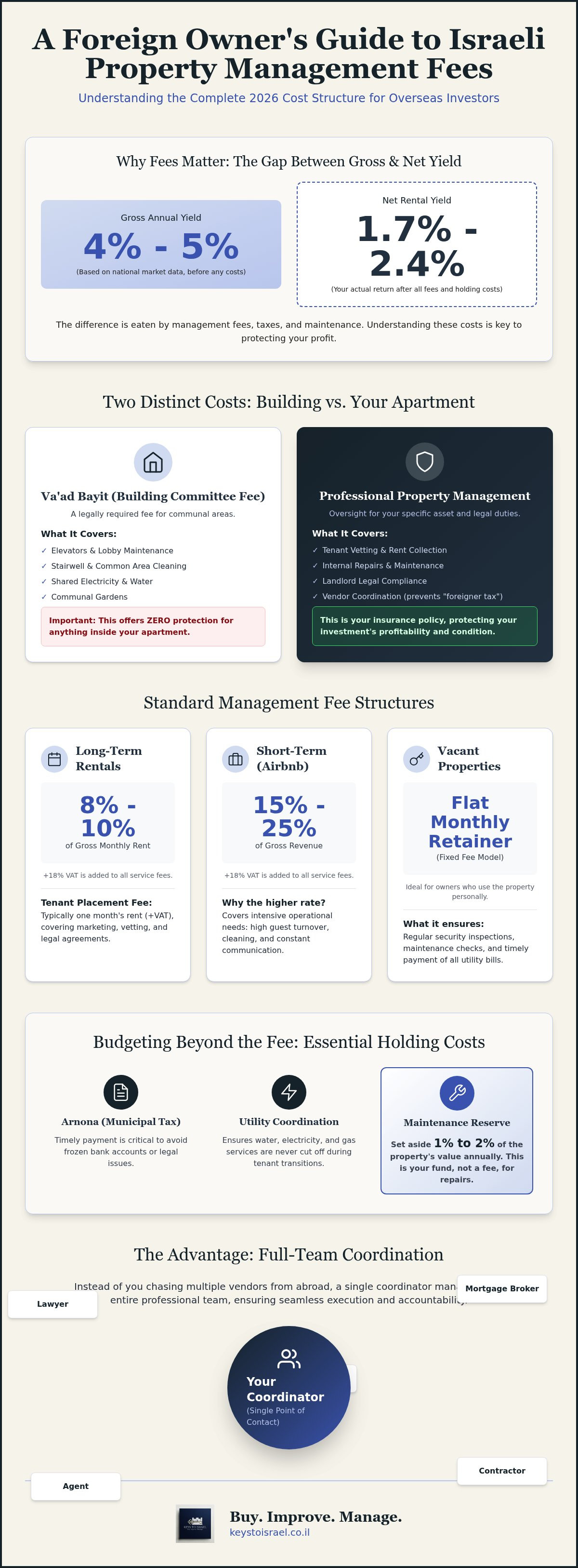
Residential properties across the country typically generate a 4% to 5% annual yield based on national market data. While these numbers are attractive, they represent a gross figure that doesn't account for the operational realities of being an overseas landlord. Understanding israel property management fees is essential to protecting that yield. For many owners, the cost of "doing nothing" actually exceeds the price of professional oversight. A single burst pipe or a tenant dispute can quickly erase a year of profit if you aren't there to handle it. You should view management costs as an insurance policy for your Israeli asset. It's the price of ensuring that a small leak doesn't become a structural disaster while you are five time zones away.
Vaad Bayit vs. Individual Property Management
Many foreign owners confuse the Vaad Bayit with a property manager. These are two distinct financial obligations. The Vaad Bayit is the building committee responsible for communal spaces like elevators, stairwell cleaning, and shared electricity. Paying this fee is a legal requirement under Israeli property laws, but it offers zero protection for what happens inside your front door.
Professional management covers your specific legal obligations as a landlord and the maintenance of the unit itself. While the building committee keeps the lobby lit, a coordinator ensures your specific investment remains habitable and profitable, justifying the israel property management fees through long-term asset protection. Without a local representative, you're forced to rely on the building committee's limited scope. This often leads to neglected internal repairs and higher costs when you're finally forced to hire unvetted contractors during a crisis. Having a dedicated team prevents the "foreigner tax" often applied by local vendors who assume you don't know the local market rates.
Standard Fee Structures for Residential Management
In the Israeli market, israel property management fees are generally structured around the specific type of occupancy. For long-term rentals, you should expect to pay between 8% and 10% of the monthly gross rent. It's crucial to remember that Value Added Tax (VAT), currently at 18%, is always added to these professional service fees. If you need to find a new tenant, the standard placement fee is typically equivalent to one month's rent plus VAT. This fee covers the coordination of marketing, candidate vetting, and the preparation of legal agreements that comply with local landlord and tenant laws.
Short-term or Airbnb-style management requires a significantly different budget. Because of the high turnover, laundry services, and guest communication, fees typically range from 15% to 25% of the gross revenue. While this percentage is higher, the increased operational intensity ensures your property maintains its value and guest ratings. For owners who prioritize flexibility over consistent long-term tenants, this structure is often the most logical choice for maintaining an active asset from abroad.
Percentage vs. Flat Fee Retainers
A percentage model is ideal for active rentals because it aligns your manager's incentives with your rental income. However, many overseas owners prefer to keep their apartments vacant for personal use during holidays or family visits. In these scenarios, a monthly retainer is the standard approach. This flat fee covers regular security inspections, maintenance checks, and the management of recurring utility bills. It ensures that your asset remains in peak condition and that you don't return to a flooded kitchen or a disconnected electricity meter. If you're weighing these options for your specific investment, you can see how it works through a dedicated coordination service that handles the details so you don't have to.
Hidden Operational Costs and Maintenance Reserves
While the base israel property management fees cover professional oversight, they don't include the actual costs of running the household. One of the most critical tasks is Arnona (municipal property tax) management. If you're abroad, ensuring this tax is paid on time is vital. Debt can accrue quickly and lead to legal complications or frozen bank accounts. Similarly, utility coordination for water, electricity, and gas prevents service cut-offs during tenant transitions. These administrative hurdles are exactly why overseas owners hire professional coordination to prevent small clerical errors from becoming expensive legal debts.
Budgeting for a maintenance reserve is standard practice for any savvy owner. You should set aside 1% to 2% of the property's value annually for recurring repairs and preventative care. This isn't a fee paid to the manager; it is a dedicated fund for the asset itself. When an emergency happens, expect a call-out fee for the technician's arrival. This is separate from the actual cost of parts and labor. Having a vetted team ready to go prevents you from paying a premium to an unknown contractor who might take advantage of your distance.
The Cost of Vacancy: Security and Upkeep
Leaving a property empty isn't free. Stagnant water in pipes can lead to bacterial growth or dried-out seals, causing major leaks when you finally turn the tap. Regular pipe flushing and security checks are essential parts of professional upkeep that go beyond basic cleaning. You can find more detail in our Managing Vacant Property in Israel: The 2026 Security & Maintenance Checklist. If you want to protect your investment without the headache of chasing municipal clerks, you can get in touch to see how we handle these operational details for you.
Maximising Value Through Professional Coordination
The true ROI of israel property management fees isn't found in a simple ledger of income and expenses. It's found in the coordination of a professional team that protects your asset from legal and operational risks. A dedicated coordinator assembles the necessary specialists, including lawyers, accountants, and engineers, to ensure every decision is backed by local expertise. This structure prevents costly legal errors and ensures your property remains compliant with evolving national rental laws. By acting as a single point of contact, a coordinator eliminates the need for you to chase multiple vendors across different time zones.
Working with a vetted network also helps you avoid the "foreigner tax" often applied by unvetted local contractors. When you lack a local network, you're vulnerable to inflated quotes and substandard work. Professional oversight ensures that maintenance is handled by reliable professionals at fair market rates. This meticulous local navigation preserves the long-term value of your investment, turning a potentially overwhelming logistical burden into a stable, well-managed asset.
Protecting Your Investment from Afar
For owners in the US, UK, or Canada, transparency is the foundation of peace of mind. Professional reporting provides a clear view of your property's status, from financial performance to physical condition. You can find a full breakdown of these services in our Israel Property Management: 2026 Overseas Owners Guide. Ultimately, investing in israel property management fees is about more than just maintenance. It's about securing your physical connection to the homeland. You can maintain your roots and support the local economy without the stress of long-distance logistics. This professional stewardship ensures your property stands ready for your return, representing a legacy of resilience and belonging in Israel.
Securing Your Israeli Asset for 2026 and Beyond
Owning property in Israel as an overseas resident doesn't have to be a source of constant anxiety. By understanding the standard israel property management fees and budgeting for essential maintenance reserves, you transform a complex logistical challenge into a predictable financial asset. Professional oversight is less of a cost and more of a safeguard against the "foreigner tax" and administrative neglect that can erode your 1.7% to 2.4% net yield. Whether you're managing a vacant holiday home or an active rental, having a local advocate ensures your interests are protected at every turn.
Keys to Israel acts as your single point of contact, managing a vetted contractor network and specialized requirements for overseas owners. We handle the coordination of lawyers, agents, and municipal clerks so you never have to chase a vendor from across the globe. If you're ready to stop worrying about the distance and start enjoying the stability of your investment, talk to us about managing your property. Your stake in Israel deserves the meticulous care and local expertise that only a dedicated coordination team can provide.
Frequently Asked Questions
Is the Vaad Bayit fee the same as a property management fee?
No, the Vaad Bayit fee is not the same as a property management fee. The Vaad Bayit is a mandatory communal payment for building maintenance like elevator repairs and lobby cleaning. In contrast, israel property management fees cover the professional oversight of your specific apartment. This includes handling tenant relations, coordinating internal repairs, and ensuring your unit remains compliant with local laws while you are abroad.
How much is the standard percentage for managing a rental in Israel?
Standard fees for long-term rentals typically range from 8% to 10% of the monthly gross rent. If you choose to run a short-term or Airbnb-style rental, fees often increase to between 15% and 25% due to the higher operational intensity of guest turnover and cleaning. All these professional service charges are subject to an additional 18% Value Added Tax (VAT), which is standard for commercial services across the country.
Who pays the management fees, the landlord or the tenant?
The landlord is responsible for paying professional management fees, while the tenant typically pays the day-to-day living costs. In a standard Israeli rental agreement, the tenant covers the Arnona municipal tax, water, electricity, and the monthly Vaad Bayit dues. As the owner, your management costs ensure the asset is maintained and the rent is collected, protecting your long-term investment without requiring your physical presence in the country.
Are property management fees in Israel subject to VAT?
Yes, all israel property management fees are subject to Value Added Tax (VAT), which currently stands at 18%. This tax applies to most professional services in the country, including fees paid to lawyers, real estate agents, and contractors. When you are budgeting for management, it's essential to confirm whether a quoted price includes this tax or if it will be added to your final monthly invoice to avoid surprises.
What happens if my property is vacant? Do I still pay management fees?
You still pay management fees for a vacant property, but the structure usually shifts from a percentage to a monthly flat-fee retainer. This fee ensures your asset stays secure through regular inspections and preventative maintenance like pipe flushing. Managers also handle recurring utility bills and municipal taxes during vacancy periods. These costs prevent expensive damage from leaks or security breaches, making them a vital part of owning an overseas asset.


Comments