
Israel Property Management Explained: What Overseas Owners Need to Know

Updated: 4 days ago
Imagine waking up in New York at 3:00 AM to an urgent notification about a burst pipe in your Tel Aviv apartment, only to realize the contractor doesn't speak English and the local municipality office is already closed for the day. For many, the dream of owning a piece of the Holy Land quickly turns into a logistical hurdle of time zone math and Hebrew-speaking bureaucracy. You invested in the Israeli market for its long-term capital appreciation and stability, not to spend your weekends acting as a long-distance landlord to unreliable contractors.
We understand that your priority is a secure investment that runs on autopilot while you remain in North America. This 2026 guide is designed to help you secure that peace of mind. By establishing a professional system for property management israel for overseas owners, you can protect your assets from neglect and ensure your rental income remains consistent. We will break down the latest 2026 purchase tax frozen rates, explain how to navigate the new 2025 eviction rules, and show you how a vetted local representative can bridge the geographical gap to provide a truly hands-off ownership experience.
Table of Contents
The Realities of Managing Israel Property from North America
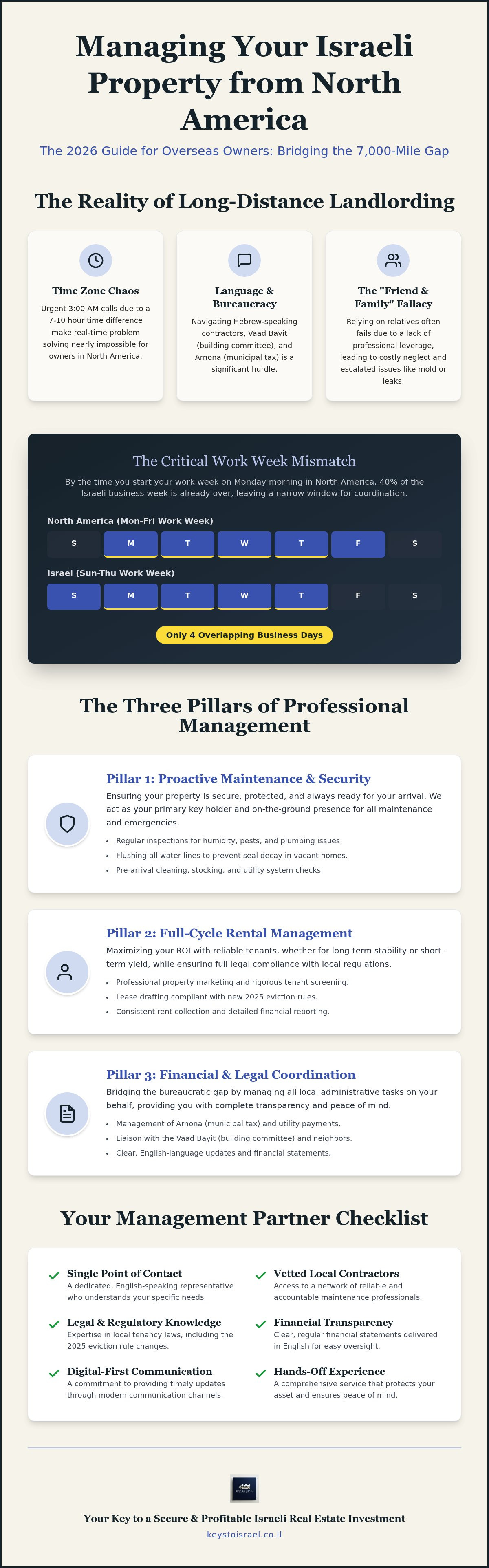
Owning a high-value asset in Jerusalem or Tel Aviv while living in North America presents challenges that go beyond simple logistics. Many investors initially rely on the "relative or friend" model, assuming a family member can handle the occasional repair. This approach frequently fails. A friend lacks the professional leverage to hold contractors accountable, and they rarely have the time to perform the meticulous inspections required to protect your investment. Small issues, like a minor window seal leak, often escalate into expensive mold remediation because no one was physically present to catch the "distance-decay" effect before it became a crisis.
Professional property management israel for overseas owners is not a luxury; it's a structural necessity for maintaining asset value. Without a dedicated representative, you're forced to manage a property across a 7,000-mile gap where the language, work culture, and legal frameworks are fundamentally different. We act as your protective advocate, ensuring that the physical and financial health of your investment remains a priority, even when you're thousands of miles away.
Bridging the 7,000-Mile Communication Gap
The most immediate hurdle is the misaligned work week. Israel operates on a Sunday-to-Thursday cycle. While you're observing a quiet Sunday in New York or Miami, the Israeli business world is at its peak. By the time you open your laptop on Monday morning, forty percent of the Israeli work week has already passed. This 7-to-10-hour time window makes real-time coordination with local contractors or utility companies nearly impossible for a solo owner. We serve as your steady hand on the ground. We ensure that emergency situations are handled during local business hours while you're still asleep. Our team prioritizes digital-first communication, providing clear, English-language updates so you're never left guessing about the status of your apartment.
The Hidden Bureaucracy of Israeli Ownership
Navigating Hebrew-speaking bureaucracy is a significant hurdle for many owners. From managing Arnona (municipal property tax) to coordinating utility transfers, the paperwork is dense and unforgiving. Owners must also interface with the Vaad Bayit, or building committee, which manages shared spaces and neighbor disputes. Understanding the nuances of Israeli land and property laws is essential for staying compliant with local regulations. For example, as of 2025, landlords must provide a legitimate legal reason to evict a tenant even at the end of a lease. Having a local ally who speaks the language and understands these shifting legal requirements ensures your interests are protected without you ever having to board a flight.
The Three Pillars of Professional Property Management
Professional property management israel for overseas owners is not a generic service. It is a strategic framework that adapts to your specific ownership goals. Most investors fall into one of three categories: maintaining a private holiday home, securing a long-term residential tenant, or operating a high-turnover short-term rental. Each path requires a different level of local presence and specialized oversight to ensure the asset remains protected and profitable.
Vacant Home Oversight and Maintenance
If you intend to use your property primarily as a private residence for family visits, the goal is security and readiness. A vacant apartment in Israel faces unique risks, from humidity-driven mold to plumbing seals that dry out and crack when left unused. We implement regular inspection protocols to ensure the property remains in peak condition. This includes flushing all water lines, testing electrical systems, and monitoring for pest activity. Our team acts as the primary key holder, managing emergency access for the building committee or utility providers. Before your arrival, we coordinate professional cleaning and ensure the home is fully stocked, allowing you to transition from the airport to your living room without logistical friction.
Full-Cycle Rental Management
Owners seeking a consistent return on investment must choose between long-term stability and short-term yield. Long-term residential management focuses on tenant screening and lease oversight. We market the property to a local audience and vet potential residents to ensure financial reliability. We also coordinate with legal professionals to draft contracts that comply with current regulations. For instance, security deposits in 2026 remain legally capped at the lower of three months' rent or one-third of the total lease value. This pillar provides the most stability for owners who prefer a steady, "set-and-forget" income stream.
Short-term management, such as Airbnb-style rentals, offers higher gross revenue but involves significantly more operational complexity. In 2026, short-term rental income is taxed as business income; hosts cannot utilize the 10% flat tax option available for long-term residential leases. We manage the high turnover, professional cleaning, and guest communication required to maintain high ratings. If your property needs updates before entering the rental market, our renovation management services provide the local oversight necessary to ensure contractors meet your quality expectations. This full-cycle approach protects your capital while maximizing your monthly cash flow.
Short-Term vs. Long-Term Rentals: Which Strategy Fits You?
Deciding between high-yield turnover and steady residential income is a pivotal decision. Effective property management israel for overseas owners requires a strategy that accounts for gross rental yields, which currently range from 2.5% to 3.3% as of 2026. While these yields are stable, the primary driver for the Israeli market remains long-term capital appreciation. Your rental choice should protect that asset value without creating a logistical crisis you can't manage from North America.
The Short-Term Rental (Airbnb) Model
The appeal of the short-term model lies in its ability to capitalize on Israel's massive tourism peaks, particularly during Pesach and Sukkot. In Tel Aviv, average annual occupancy for short-term units fluctuates between 44% and 56%, with typical monthly revenues reaching up to 10,000 NIS. However, this model is high-intensity. It requires 24/7 guest support and meticulous turnover coordination. You also need to consider the 2026 tax landscape. Short-term income is classified as business income, meaning you can't use the 10% flat tax rate available to long-term landlords. Some municipalities also impose commercial Arnona rates, which can eat into your margins if you don't have a professional local team to monitor compliance and expenses.
The Long-Term Stability Model
For many overseas owners, the long-term model offers the most sustainable path. It provides a predictable cash flow with significantly lower maintenance overhead. In cities like Tel Aviv, where a 2-bedroom apartment averages 8,700 NIS per month, a reliable tenant provides a "set-and-forget" experience. This strategy is often the first choice for those following our Israel property purchase 2026 guide, as it simplifies tax compliance and reduces the risk of wear and tear. Non-resident landlords can often opt for a 10% flat tax on gross income, avoiding the complexities of individual business filings. We use our local market knowledge to minimize vacancy rates and ensure that annual maintenance issues are addressed before they become costly repairs. This balance of stability and professional oversight ensures your investment grows while you remain focused on your life in North America.
Evaluating a Management Partner: A North American Owner's Checklist
Selecting a partner for property management israel for overseas owners requires more than a simple price comparison. You need a steward who understands the unique friction of the Israeli market while respecting North American standards of communication and accountability. Use this five-step checklist to ensure your representative is equipped to handle the complexities of your investment.
Vetted Contractor Network: Confirm they have a pre-screened list of plumbers, electricians, and handymen. In Israel, "knowing a guy" isn't enough; you need professional accountability and reliable lead times.
Professional Coordination: They must be able to interface with your Israeli lawyer and mortgage broker. This ensures your legal and financial interests are aligned without you playing middleman.
Reporting Frequency: Demand a clear schedule for financial and operational updates. Transparency is non-negotiable when you're thousands of miles away.
Renovation Experience: If your property needs upgrades, verify their track record with remote renovation management in Israel. Managing a construction site from abroad is a high-risk endeavor without local oversight.
City-Specific Expertise: Jerusalem's stone-clad maintenance needs differ from Tel Aviv's coastal humidity challenges. Ensure they have deep roots in your specific municipality.
Transparency and Financial Reporting
A professional management report shouldn't be a vague summary. It must include itemized maintenance expenses, rental income receipts, and documentation for municipal payments. Handling currency exchange is another critical area. Your partner should provide guidance on international transfers to ensure you aren't losing significant margins to bank fees or poor exchange rates between USD and NIS. Clear documentation ensures that when tax season arrives, your records are ready for both Israeli and North American filings. This level of granular detail prevents financial surprises and keeps your investment's ROI predictable.
The Importance of a Single Point of Contact
Managing separate vendors yourself, such as plumbers, agents, and building committees, is a recipe for exhaustion. The value of "Advocacy Management" lies in having one person responsible for the entire ownership lifecycle. Keys to Israel acts as your local representative, filtering the noise and solving problems before they reach your inbox. We don't just watch your property; we guard your interests against unreliable contractors and bureaucratic delays. If you're ready to secure your investment with a steady hand on the ground, explore our professional property management services to see how we bridge the gap between North America and Israel.
Protecting Your Asset: The Keys to Israel Advantage
Owning property in a foreign market demands a partner who acts as your steady hand. We understand that while your investment is located in Israel, your expectations are rooted in North American standards of transparency, punctuality, and professional accountability. Navigating the Israeli real estate landscape requires more than just local knowledge; it requires a protective advocate who can bridge the cultural and logistical gaps that often derail long-distance ownership. Professional property management israel for overseas owners transforms a potentially high-stress asset into a stable, hands-off component of your financial portfolio.
The transition from the initial purchase to active management should be seamless. Many owners feel a surge of anxiety once the keys are handed over and the legal process concludes. Our role is to absorb that pressure by providing proactive oversight and meticulous navigation of local requirements. We don't just react to problems; we anticipate them. By maintaining a physical presence and a deep network of local roots, we ensure that your interests are guarded with the same care you would provide if you were standing on the property yourself.
Beyond Maintenance: Strategic Investment Oversight
Effective management extends far beyond fixing leaky pipes or collecting rent. We provide strategic investment oversight by monitoring local market trends and property values in real time. If the market shifts or a specific neighborhood in Jerusalem or Tel Aviv sees a spike in demand, we inform you of the opportunities to adjust your strategy. This includes coordinating renovations to increase rental yield and equity. Because we understand the long-term lifecycle of Israeli property, we help you plan for future milestones, whether that involves a transition from short-term to long-term rental or preparing the asset for a future sale. Our goal is to ensure your property remains a high-performing asset for decades, not just months.
Getting Started with Professional Management
The onboarding process is designed to be methodical and transparent. When you establish property management israel for overseas owners with our team, we begin with a comprehensive property audit. This initial inspection documents the current state of the asset, identifies immediate maintenance needs, and establishes a baseline for future reporting. We also assist in establishing the necessary Power of Attorney for local representation, ensuring we can interface with municipal offices and building committees on your behalf without delay. This structured approach provides the clarity and control you need to manage your Israeli investment with total confidence. If you are ready to secure your piece of the Holy Land, contact Keys to Israel for a tailored management proposal and experience the peace of mind that comes with a dedicated local ally.
Securing Your Israeli Legacy
Owning property in Israel should be a source of long-term pride and financial stability, not a cause for midnight stress. Managing an asset across time zones requires more than just a casual observer on the ground. It demands a professional system that accounts for the unique Sunday-to-Thursday work cycle and the nuances of local residential laws. Professional property management israel for overseas owners is the essential link that transforms a distant apartment into a protected, high-performing asset. By choosing a strategy that aligns with your financial goals, you ensure your capital appreciation remains the priority.
Keys to Israel provides expert local oversight for owners in Toronto, New York, and Miami, serving as your single point of contact for the entire ownership lifecycle. We utilize a vetted contractor network to handle all maintenance and repairs, ensuring your property is always market-ready. You deserve the peace of mind that comes with knowing your home is being guarded by a dedicated local ally. Secure your Israeli investment with Keys to Israel's professional management today. We are ready to act as your steady hand on the ground, protecting your interests and maximizing your returns.
Frequently Asked Questions
What are the typical property management fees in Israel for overseas owners?
Industry standard fees for a reliable local manager typically range from 8% to 12% of the annual gross rental income. This cost covers the essential oversight required to protect your investment. When considering property management israel for overseas owners, remember that this fee is an investment in asset protection. It ensures that maintenance is handled proactively rather than reactively, which saves significant capital over the long-term lifecycle of your property.
Do I need a Power of Attorney for a property manager to act on my behalf?
Yes, establishing a Power of Attorney (POA) is a standard and necessary step for any property manager to act on your behalf. This legal document allows your representative to interface with municipal offices, utility companies, and building committees (Vaad Bayit). Without a POA, your manager cannot legally sign lease agreements or resolve bureaucratic hurdles. We guide our clients in Montreal and New York through this process to ensure full compliance with Israeli administrative requirements.
Can a property manager in Israel help with my tax reporting as a foreigner?
We provide comprehensive coordination with qualified tax and legal professionals to ensure your reporting is accurate and timely. While we don't offer direct tax or financial advice, we act as a bridge between you and the specialists who do. We maintain meticulous records of all income and expenses, ensuring that your tax professional has the necessary documentation to apply for the 10% flat tax rate or other relevant exemptions available to non-residents.
What happens if there is an emergency at my property on Shabbat?
Emergencies on Shabbat require a pre-established protocol and a local representative who can coordinate immediate action. Israel's unique cultural and religious calendar means many services pause from Friday sunset to Saturday night. We maintain a vetted network of contractors who are available for critical repairs, such as burst pipes or electrical failures, during these times. This proactive oversight ensures that your property remains secure and functional regardless of the day of the week.
Is short-term rental management legal in all Israeli cities?
Short-term rental legality varies significantly between municipalities across Israel. While there is no national cap on nights as of 2026, cities like Tel Aviv have implemented specific licensing requirements and may charge commercial Arnona rates for Airbnb-style units. We monitor these local regulatory shifts to ensure your rental strategy remains compliant. For owners in Miami or Los Angeles, having a local ally who understands these city-specific rules is vital for avoiding heavy municipal fines.
How do property managers in Israel handle tenant vetting for foreign owners?
We use deep local market knowledge to perform rigorous tenant vetting for our international clients. This process includes verifying financial stability, checking local references, and ensuring the tenant understands the specific terms of an overseas-owned lease. Because 2025 eviction laws require legitimate legal reasons to end a tenancy, the initial screening is your most important defense. We handle the entire negotiation to ensure your residential income remains stable and predictable for the long term.
Can you manage a property that currently needs a full renovation?
Yes, we specialize in managing properties that require extensive updates through our renovation management service. If you've purchased an older apartment in Jerusalem or Tel Aviv, we coordinate with a vetted team of contractors to oversee the project from start to finish. We ensure the work meets high standards and stays on schedule, providing regular digital updates so you can monitor the progress from New York or Toronto without needing to board a flight.
How do I receive rental income from my Israeli property into my US or Canadian bank account?
We coordinate with financial institutions to facilitate the transfer of rental income into your North American bank account. This includes helping you navigate currency exchange hurdles between the Israeli Shekel (NIS) and USD or CAD. By working with specialized transfer services, we help you minimize bank fees and secure favorable exchange rates. Our goal is to make the financial aspect of property management israel for overseas owners as seamless and efficient as possible.


Comments