
Buying Property in Israel: 7 Myths Debunked

Updated: 4 days ago
Relying on a well-meaning relative to oversee your real estate acquisition is often the fastest way to lose money and strain family ties. Many North American investors assume that local blood is a substitute for professional oversight, but the reality of the Israeli market is far more complex. You're right to feel anxious about buying property in israel pitfalls, especially with the 2026 tax updates and the strict documentation banks now require. It's easy to feel like an outsider who's destined to overpay or get lost in the bureaucracy.
This guide changes that dynamic by exposing the most common traps that catch foreigners off guard. We'll move past the "cousin myth" to provide a pragmatic strategy for managing the 8% purchase tax brackets and coordinating renovations without being physically present. You'll gain a clear list of red flags to watch for and the confidence that your assets are being guarded by a steady, local hand. We're breaking down seven pervasive myths to ensure your investment remains a source of stability rather than a logistical nightmare.
Table of Contents
The "Just Like Home" Myth: Why North American Norms Fail in Israel
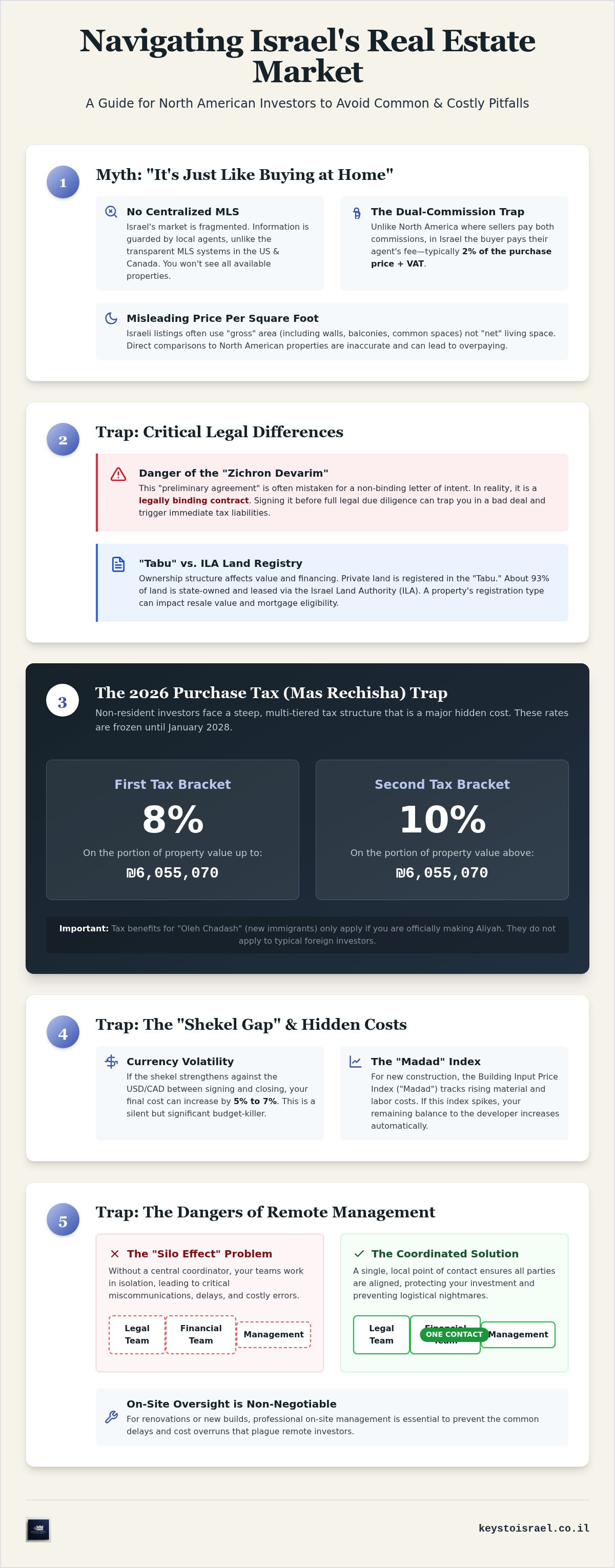
One of the biggest mistakes North American investors make is assuming the Israeli real estate market mirrors the structured, transparent systems of New York or Toronto. It doesn't. While you might be used to a centralized Multiple Listing Service (MLS) where every property is visible to all agents, Israel’s market is highly fragmented. Information is often guarded by individual agents or shared within small local networks. If you expect a standardized, predictable sequence of events, you'll likely encounter significant frustration and missed opportunities.
This lack of transparency leads directly into the dual-commission trap. In the U.S. and Canada, the seller typically covers the commission for both agents. In Israel, it's the standard practice for the buyer to pay 2% of the purchase price plus VAT to their agent. When you combine this with a price-per-square-foot metric that doesn't account for "gross" versus "net" living space, it's easy to see how investors overpay. Comparing a Tel Aviv penthouse to a Manhattan condo based solely on square footage is a misleading exercise that often ignores the unique structural and legal realities of the region. These discrepancies are core buying property in israel pitfalls that can inflate your initial budget by tens of thousands of dollars before you even sign a contract.
The Danger of the "Zichron Devarim" (Preliminary Agreement)
A Zichron Devarim is a legally binding contract that bypasses the essential due diligence period required for a safe purchase. North Americans often mistakenly treat this document as a non-binding "letter of intent" or a simple memo to hold the property. In reality, the Israeli court system views it as a final agreement. Signing this document before your lawyer reviews the title is a major error. It triggers immediate tax liabilities and can trap you in a deal for a property with structural or legal defects that you didn't see coming.
Understanding the "Tabu" vs. ILA Land Registry
The way a property is registered dictates its future resale value and mortgage eligibility. Private land is registered in the "Tabu," or Land Registry Office, while about 93% of land is owned by the state and leased through the Israel Land Authority. These Israeli land and property laws create different tiers of ownership that directly affect your rights. Banks are often hesitant to finance properties with short-term leases or complex registration histories. If you purchase a leasehold without understanding the expiration date or the capitalization terms, you may find it difficult to sell or refinance the property later.
The Financial Pitfalls: Closing Costs and the "Shekel Gap"
Most investors begin their journey with a spreadsheet that only accounts for the property's sticker price. This is a dangerous oversight. If you don't factor in the high entry costs specifically applied to non-residents, your investment's projected ROI will vanish before you even receive the keys. These financial surprises are among the most common buying property in israel pitfalls that catch North Americans off guard, often because the rules change frequently and without much international fanfare.
Currency volatility is another silent deal-killer. Foreign buyers often ignore the impact of currency fluctuations. If the shekel strengthens against the USD or CAD between the time you sign the contract and your final payment, the property could effectively cost you 5% to 7% more than you originally planned. For new construction, you also have to manage the Building Input Price Index, known as the "Madad." This index tracks the rising costs of construction materials and labor; if the index spikes, your remaining balance to the developer increases automatically.
2026 Purchase Tax (Mas Rechisha) for Non-Residents
For 2026, foreign buyers face a steep tax structure that differs significantly from what local residents pay. Non-residents currently pay a purchase tax of 8% on the property value up to ₪6,055,070, and 10% on any amount above that threshold. These rates are frozen until January 2028. A common mistake is assuming that "Oleh Chadash" tax benefits apply to all Jewish investors. In reality, you only qualify for these significant discounts if you are actually making Aliyah. You can find the specific brackets in our guide to Israel Property Purchase Tax for Non Residents in 2026.
Hidden Closing Costs You Haven't Budgeted For
Closing costs in Israel involve more than just a simple filing fee. You should budget for legal fees, which typically range from 0.5% to 1% of the purchase price. While you might find "discount" lawyers, they often lack the bandwidth to handle the meticulous due diligence an overseas buyer requires. You also need to account for the bank appraisal, or "Shama." It's a frequent buying property in israel pitfalls when a bank's conservative valuation comes in lower than the purchase price, forcing you to bridge the funding gap with extra cash. Finally, remember that every professional service, from your lawyer to your agent, is subject to a 17% VAT that many North Americans forget to calculate. Coordinating these payments through a professional purchase coordinator ensures you aren't blindsided by these hidden escalations at the eleventh hour.
The Distance Pitfall: Remote Renovation and Management Traps
Many investors believe the hardest part of the journey ends when they receive the keys. In reality, the phase following the acquisition is where the most expensive buying property in israel pitfalls often emerge. There's a pervasive myth that you can manage a high-end renovation or property maintenance through WhatsApp messages and occasional check-ins from a cousin in Jerusalem. This approach rarely ends well. Without professional, on-site oversight, remote renovations in Israel typically run 30% over budget and fall several months behind schedule. A well-meaning relative simply doesn't have the technical expertise or the professional leverage to hold contractors accountable for North American quality standards.
Vacant properties in Israel also face a unique set of risks. The local climate, characterized by high humidity in coastal areas and intense heat, can cause a "ghost apartment" to deteriorate with surprising speed. Mold can take over a bathroom in weeks, and plumbing seals can dry out and crack if water isn't run regularly. If your property remains unmanaged, you aren't just risking structural damage; you're also vulnerable to squatters or undetected leaks that can lead to massive water bills and neighbor disputes. Professional coordination isn't a luxury; it's a necessary safeguard for your equity.
Managing Contractors from New York or Los Angeles
The cultural and language barrier is often the primary cause of friction during a renovation. "Israeli style" construction standards frequently prioritize structural speed over the meticulous "finish" that buyers from New York or Los Angeles expect. If you don't have a detailed, milestone-based contract written in Hebrew that mirrors your expectations, you'll likely find yourself in a dispute over what constitutes a "completed" job. Paying contractors in cash is another major risk. It leaves no paper trail for tax purposes and strips you of legal recourse if the work is subpar. Even worse, unvetted contractors may perform "Horev," or illegal construction, such as closing off a balcony without a permit. These violations lead to heavy municipal fines and can make the property impossible to sell later. Keys to Israel mitigates this by using a vetted team of contractors who understand the precision required for high-end international clients.
The Hidden Costs of Vacant Property Ownership
Owning an empty unit doesn't mean your expenses stop. You're still responsible for "Arnona" (municipal tax) and "Vaad Bayit" (building committee) fees every month. Ignoring these leads to interest-heavy debt and potential legal action from the building’s committee. Beyond the bills, an unmanaged property is a security risk. Regular inspections ensure that windows are sealed, systems are functioning, and the property remains secure. For a comprehensive look at protecting your investment, see our Managing Vacant Property in Israel: A Security Checklist. Taking a proactive stance on maintenance prevents small issues from becoming five-figure repairs while you're 6,000 miles away.
Due Diligence Pitfalls: Neighborhood and Structural Red Flags
A common mistake among overseas investors is equating a "luxury" price tag with a guaranteed safe investment. In Israel, the term luxury is often used loosely by developers to describe cosmetic finishes rather than structural integrity or long-term neighborhood stability. If you rely solely on a glossy brochure, you risk falling into one of the most significant buying property in israel pitfalls: purchasing an asset that looks perfect today but loses value tomorrow due to local shifts you didn't see coming.
Due diligence in Israel requires two distinct layers. First, you must verify the legal and municipal status of the physical structure. Second, you must analyze the hyper-local neighborhood dynamics that dictate future rental yields and resale potential. Failing to look beyond the four walls of the apartment can lead to "buyer's remorse" once you realize the quiet street you chose is slated for a decade of disruptive urban renewal.
Neighborhood Dynamics: More Than Just a Map
Neighborhood demographics in Israel can shift with surprising speed. In Jerusalem areas like Katamon or Baka, the secular-religious balance is a critical factor for long-term value. If a neighborhood's character changes significantly, it can affect everything from which shops are open on Shabbat to the demand for your property as a short-term rental. Additionally, you must investigate "Pinui Binui" (urban renewal) projects. A neighboring building might be scheduled for demolition and expansion; this can permanently block your sunlight and view, instantly devaluing your investment. Investors from Los Angeles or Miami often misinterpret "proximity to the beach" in Tel Aviv, forgetting that salt air acceleration requires much higher maintenance budgets for building exteriors and HVAC systems.
Structural and Legal Compliance (Bedek Bayit)
While your lawyer checks the title, they rarely visit the property to see if the physical reality matches the municipal records. This is where the "Illegal Balcony" trap occurs. If a previous owner enclosed a balcony or added a room without a permit, the municipality can order you to demolish it at your own expense. You should never sign a contract without a professional "Bedek Bayit" (property inspection) report. These inspectors look for "Ritivut" (dampness), which is a chronic issue in Israeli stone and concrete buildings. They also verify if the electrical systems meet modern standards and if the "Pelad" security doors are properly installed. A frequent trick is selling a "storage room" as a bedroom; an inspector will catch this discrepancy between the floor plan and the legal usage, saving you from a costly legal nightmare. To ensure your potential home is structurally sound and legally compliant, coordinate a professional property inspection before committing your capital.
The Coordination Solution: Securing Your Israel Investment
The complexity of the Israeli market often leads to what we call the "silo effect." This happens when your lawyer, mortgage broker, and real estate agent operate in complete isolation from one another. Without a central coordinator, you're the one forced to bridge the communication gap from a different time zone. This lack of professional synergy is one of the primary buying property in israel pitfalls. When these professionals don't talk, deadlines are missed, tax filings are delayed, and the buyer ends up paying the price in both stress and shekels.
A professional Buyer’s Representative acts as the essential bridge between these parties. Beyond simple communication, an advocate can leverage local relationships to negotiate better terms. In some cases, this includes coordinating group purchases where multiple investors pool their interests to secure volume discounts or better specifications from developers. This level of representation is the only way for North Americans to buy with genuine peace of mind. Once the transaction is complete, this coordination ensures a seamless transition into the management phase, protecting your equity and ensuring the property appreciates as intended.
Building Your Israel Investment Team
To navigate this market safely, you need a specialized quartet of professionals who understand the needs of foreign owners. This team should include a specialist real estate lawyer, a mortgage broker experienced with international KYC regulations, a buyer coordinator for local oversight, and a dedicated property manager. David Bitton and the Keys to Israel team act as the "conductor" for this professional orchestra, ensuring every member is aligned with your specific goals. This integrated approach is vital for meeting the Can Foreigners Buy Property in Israel? 5 Vital Requirements for 2026.
Next Steps: From Toronto or NYC to Tel Aviv
You don't need to be physically present in Israel to start your investment journey. The process typically begins with a remote consultation to define your budget, target neighborhood, and long-term objectives. To avoid the logistical hurdle of flying in for every signature, it's essential to set up a Power of Attorney (POA) correctly at the start. A properly executed POA allows your legal team to act on your behalf for contract signings and municipal registrations while you remain in Toronto or New York. If you're ready to move past the myths and secure a stable asset, the first step is to coordinate your Israel property purchase with Keys to Israel and build a strategy based on local reality rather than distant assumptions.
Protecting Your Israeli Real Estate Legacy
Success in the Israeli market requires a fundamental shift in perspective. You've learned that standard North American norms don't apply here, especially regarding fragmented listing data and the legal finality of preliminary agreements. By understanding the 2026 tax landscape and the reality of remote renovation, you've already taken the first step toward a more secure acquisition. Avoiding buying property in israel pitfalls is a matter of replacing distant assumptions with grounded, local expertise.
Realizing your investment goals shouldn't be a source of constant anxiety. When you bridge the geographical gap with a steady, local hand, you transform a complex transaction into a manageable project. Secure your Israeli investment with a professional coordinator to gain access to our vetted network of contractors and legal professionals. We provide expert local representation for North American buyers and specialized remote property management that keeps your asset secure in your absence. Your future in Israel is waiting; let's make sure it's built on a foundation of professional transparency and local reliability.
Frequently Asked Questions
What is the biggest mistake foreign buyers make in Israel?
The most significant error is assuming the process mirrors North American standards and relying on informal family help. This often leads to buying property in israel pitfalls like signing binding preliminary agreements without a lawyer. Without professional coordination, you risk missing critical deadlines or failing to document the source of funds required by Israeli banks. Professional oversight ensures every legal and financial step is handled with precision.
How much are the closing costs for a property in Israel in 2026?
You should budget between 10% and 15% of the purchase price for closing costs in 2026. This includes the 8% purchase tax for non-residents, a 2% real estate agent fee plus VAT, and legal fees typically ranging from 0.5% to 1.5%. You must also account for the bank appraisal and the 17% VAT on all professional services. Failing to calculate these costs is a frequent trap.
Do I need to be in Israel to buy a property?
You don't need to be physically present in Israel to complete a purchase. Most investors use a specific Power of Attorney (POA) that allows their lawyer to sign contracts and municipal documents on their behalf. While a remote consultation is necessary to define your goals, modern digital tools and local representation allow you to manage the entire acquisition from your home in New York, Los Angeles, or Toronto.
Is it safe to buy property in Israel as an investment right now?
Israel remains a stable real estate market for long-term growth, but safety depends on meticulous due diligence. Success requires understanding neighborhood shifts and the 2026 tax environment. While demand in cities like Tel Aviv and Jerusalem stays high, you must verify structural integrity and legal registration to protect your capital. Working with a local advocate ensures you're making a calculated investment rather than an emotional one.
What is the "Mas Rechisha" tax for non-residents?
Mas Rechisha is the Israeli purchase tax that applies to every property acquisition. For non-residents in 2026, the rate is 8% on the property value up to ₪6,055,070 and 10% on any amount above that threshold. Unlike Israeli residents, foreign buyers don't receive an exemption for their first home. This tax must be paid within 60 days of signing the purchase agreement to avoid heavy interest and penalties.
How do I avoid overpaying for an apartment in Jerusalem or Tel Aviv?
Avoiding overpayment starts with hiring an independent appraiser (Shama) before you sign a contract. Israeli agents often quote prices based on gross square footage, which includes shared building spaces, rather than net living space. Having a local coordinator who understands these metrics prevents you from paying a premium for unusable space. Proper representation ensures you're negotiating based on actual market data rather than inflated asking prices.
Can I manage a renovation in Israel from the US or Canada?
Managing a renovation from 6,000 miles away is nearly impossible without a dedicated on-site manager. Cultural barriers and differing construction standards mean local finishes often fall short of North American expectations. A professional coordination service vets contractors, manages milestone payments, and conducts regular inspections. This prevents the common 30% budget overruns and significant delays that plague unmanaged remote projects. This is a key way to avoid buying property in israel pitfalls.
What is a "Bedek Bayit" and why do I need one?
A Bedek Bayit is a comprehensive engineering and structural inspection of the property. You need one because it identifies hidden issues like dampness, electrical non-compliance, and illegal additions that aren't visible to the naked eye. While a lawyer checks the title, the inspector ensures the physical building matches the municipal permits. This report is your primary defense against inheriting someone else's construction violations or structural nightmares.


Comments