
Can Foreigners Buy Property in Israel? 5 Vital Requirements

Updated: 4 days ago
What if the biggest barrier to owning a home in Jerusalem isn't the price tag, but the thousands of miles of bureaucracy between your desk and the front door? It's natural to feel a sense of anxiety when you're navigating a market where the documentation is in Hebrew, the tax brackets are frozen at 8%, and the banking rules feel like a moving target. You're right to worry about being overcharged or mismanaging a high-stakes investment from abroad.
The good news is that you don't need citizenship to secure your investment, but you do need a clear strategy. This guide answers the core question: can foreigners buy property in israel while protecting their interests? We'll provide a transparent roadmap for 2026, covering everything from the 50% mortgage cap for non-residents to the critical distinction between private and state-owned land. You'll gain a clear understanding of your legal rights and the logistical steps required to coordinate a successful purchase with reliable local representation.
Table of Contents
Can Foreigners Legally Own Land in Israel in 2026?
Israel maintains one of the most accessible real estate markets globally for international investors. If you're asking can foreigners buy property in israel in 2026, the answer is a definitive yes. The government actively encourages foreign capital to strengthen the local economy, viewing international buyers as a stabilizing force. Our role is to help you bridge the gap between your current location and the local reality of the Israeli market. For North American investors, 2026 presents a unique window. While local market shifts create headlines, the underlying demand for housing remains high, and the frozen tax brackets provide a predictable entry point.
However, the process isn't identical for every buyer. There is a distinction based on eligibility for the Law of Return. While anyone can buy on private land, certain state-managed lands have specific eligibility criteria that often favor those with Jewish heritage or those eligible for Aliyah. Understanding this distinction early helps avoid wasted time on properties that may not fit your specific legal profile.
Who Qualifies as a Foreign Buyer?
In the eyes of the Israeli Tax Authority, a foreign buyer is anyone whose primary center of life is outside Israel. This status is determined by where you spend the majority of your time and where your financial interests lie. If you don't hold an Israeli ID card, you'll be categorized as a non-resident, which subjects you to different purchase tax rates than a local citizen. This classification remains true even if you hold Israeli citizenship but live permanently in New York or Toronto.
If you're considering buying through a foreign corporation, the path is legal but involves more rigorous oversight. Banks will require extensive documentation to verify the source of funds and the identity of all shareholders. For many overseas buyers, purchasing as an individual remains the more straightforward route to securing a residential asset.
The "Tabu" vs. Israel Land Authority (ILA) Distinction
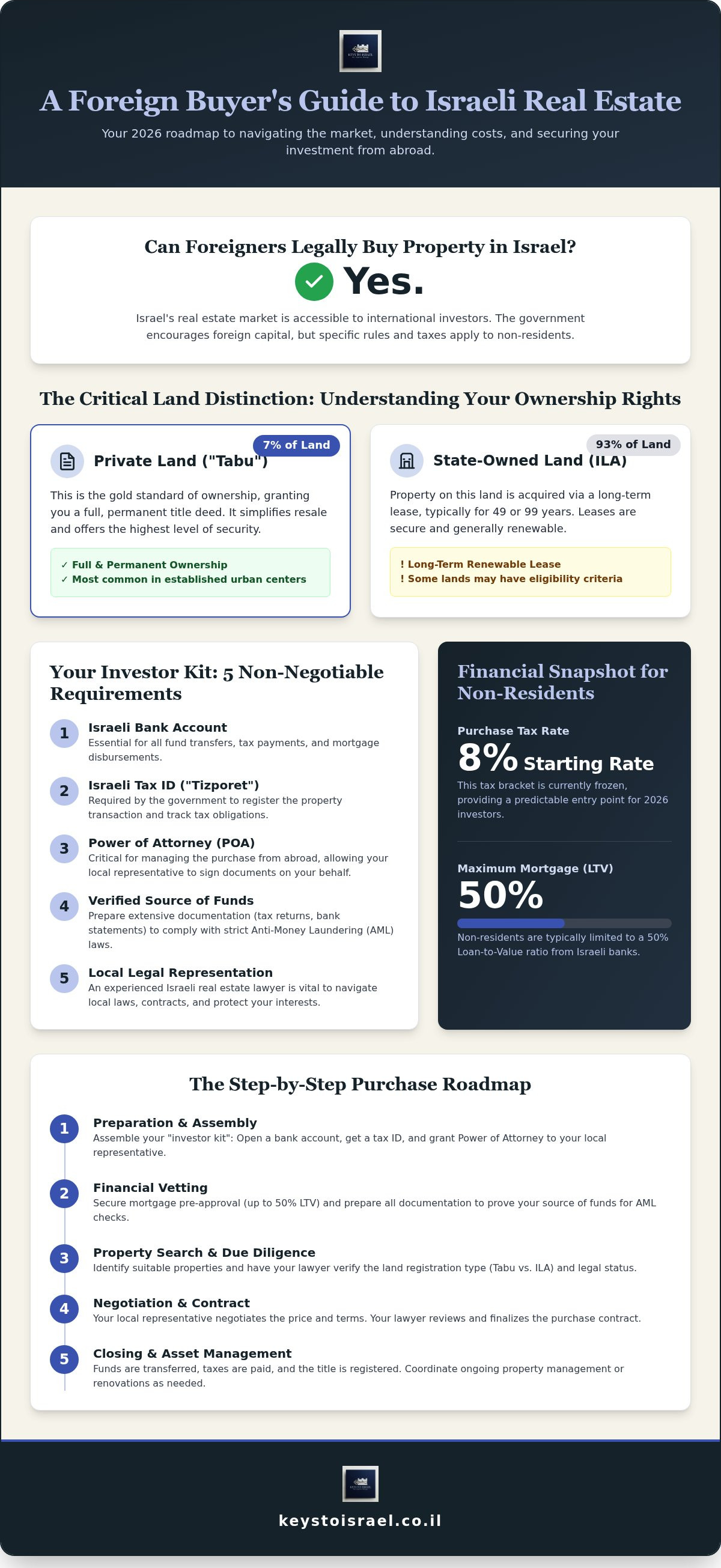
Understanding the legal foundation of the land is vital for your security. Approximately 93% of the land in Israel is state-owned and managed by the Israel Land Authority (ILA). When you buy on ILA land, you're technically purchasing a long-term lease, typically for 49 or 99 years. These leases are generally renewable, and recent reforms have simplified the process for leaseholders to gain effective ownership rights.
The remaining 7% is privately owned land, commonly referred to as "Tabu." This is the gold standard for ownership because it grants you full, permanent title. Most older, established apartments in the urban centers of Tel Aviv and Jerusalem are registered in the Tabu. Identifying which category a property falls into before signing is essential for a smooth transaction. Reviewing Israeli land and property laws reveals that while ILA land is secure and common, Tabu registration often simplifies the resale process and offers a greater sense of permanence. Knowing these nuances is a key part of how can foreigners buy property in israel without facing unexpected bureaucratic hurdles later.
5 Vital Requirements for Foreign Property Buyers
If you're asking can foreigners buy property in israel, the legal answer is a definitive yes, but the practical answer depends on your preparation. The Israeli market moves with a speed that often surprises North American buyers. To compete effectively, you must assemble an "investor kit" before you even view your first listing. This proactive approach prevents the heartbreak of losing a property because your paperwork wasn't ready for the negotiation table.
Your logistics start with two non-negotiable items: a local Israeli bank account and a "Tizporet," or Israeli tax identification number. The bank account is essential for fund transfers and tax payments, while the Tizporet is required for the government to track the transaction. Additionally, if you're managing this purchase from abroad, a Power of Attorney (POA) is your most critical document. It grants your local representative the authority to sign filings and contracts, keeping the process moving without requiring you to fly across the world for every signature.
Financial Readiness and Funding
Proving the source of your funds is often the most time-consuming part of the purchase process. Israeli banks operate under strict Anti-Money Laundering (AML) regulations. You'll need to provide clear documentation, such as tax returns and bank statements, to satisfy these requirements early. If you plan to use financing, keep in mind that non-residents are typically limited to a 50% Loan-to-Value (LTV) ratio for mortgages.
Currency management is another area where buyers often lose significant capital. Moving large sums of USD or CAD into Israeli Shekels (ILS) through standard retail banks can cost you 3% to 5% in unfavorable exchange rates and hidden fees. Using a specialized currency strategist is a smarter way to protect your investment. Professional property purchase coordination can help you align these financial moving parts so you're ready to strike when the right opportunity appears.
Legal and Professional Representation
Your lawyer in New York or Toronto cannot represent you in an Israeli real estate transaction. You must engage a local Israeli attorney who specializes in real estate law. Their primary job is to perform "due diligence," ensuring the property has a clean title and is free of hidden liens or legal disputes. While the lawyer protects your legal interests, they don't manage the entire project. You still need a central point of contact to bridge the gap between the lawyer, the real estate broker, and the bank. This oversight ensures that no detail falls through the cracks during the high-stakes transition from offer to ownership.
The Step-by-Step Purchase Roadmap for Overseas Investors
Buying a home from thousands of miles away requires more than just a digital signature. It demands a structured, four-phase approach to ensure your capital is protected. If you're wondering how can foreigners buy property in israel without being physically present, the answer lies in meticulous local coordination. The roadmap starts with a "boots on the ground" evaluation and ends with the final key handover.
Phase 1: Property search and local evaluation to verify the asset's actual condition.
Phase 2: Negotiation and the "Zichron Devarim." Be extremely cautious here; this preliminary memo can be legally binding in Israel.
Phase 3: Legal due diligence and signing the binding Purchase Agreement.
Phase 4: Fulfillment of the payment schedule and settlement of all government taxes.
From Search to Binding Agreement
A remote walkthrough is only as good as the person holding the camera. You need a representative who knows how to spot dampness, structural cracks, or neighborhood noise issues that a listing agent might omit. Before you enter negotiations, obtain an "Ishur Ekroni." This is an official mortgage pre-approval from an Israeli bank. It confirms your budget and signals to sellers that you're ready to move. When it's time to sign, your Power of Attorney allows your local representative to execute the contract on your behalf, saving you the cost and time of an international flight.
Closing and Registration
The closing process is governed by strict deadlines. You must pay the Purchase Tax (Mas Rechisha) within 60 days of signing the agreement. For 2026, the rates for non-residents are 8% on properties up to ₪6,055,070 and 10% on any amount above that. To secure your investment, your lawyer will register a "Caution Note" (He'arat Azhara) in the land registry immediately after the first payment is made. This prevents the seller from selling the property to anyone else while the transaction is pending. During the final handover, don't release the last payment until you've verified that the property matches the agreed-upon condition and all previous utility bills have been settled by the seller.
Costs and Taxes: Budgeting for Your Israeli Investment
Budgeting for a cross-border acquisition requires a clear-eyed look at the total cost of entry. If you're investigating can foreigners buy property in israel, remember that closing costs typically add another 11% to 13% to the sticker price. This includes state-mandated taxes and the professional fees required to secure a clean title. Failing to account for these "extras" can stall a transaction or lead to significant financial strain at the closing table.
The primary expense for non-residents is the Purchase Tax (Mas Rechisha). Unlike local buyers who may receive exemptions for their first home, foreigners are treated as multiple-property owners by default. Beyond the tax, you must budget for the standard professional fees that facilitate the deal. In Israel, the real estate agent commission is typically 2% plus VAT. Legal fees generally range from 0.5% to 1% plus VAT, depending on the complexity of the contract. Since the VAT rate is 18% in 2026, these percentages represent a significant portion of your capital outlay.
There are also smaller, essential costs that overseas buyers often overlook. These include appraisal fees for mortgage approval, mortgage insurance, and the cost of professional Hebrew-to-English translations for complex contracts. We recommend our clients use professional tax and legal coordination to ensure every shekel is accounted for before the first payment is wired.
The Purchase Tax (Mas Rachisha) Burden
For 2026, the purchase tax brackets for foreign residents are frozen. You will pay 8% on the property value up to ₪6,055,070. Any amount exceeding this threshold is taxed at 10%. If you're buying a property "on paper" (new construction), you must also track the Construction Input Index. This index can increase your remaining balance as building material costs rise during the construction phase. If you plan to make Aliyah within one year of the purchase, you may be eligible for a reduced tax rate, but this requires careful timing and professional oversight.
Ongoing Costs of Ownership
Ownership doesn't end at the key handover. You'll face municipal taxes (Arnona), which vary based on the city and the square footage of the apartment. In high-demand areas like Tel Aviv or Jerusalem, these rates can be substantial. If your property is in a luxury tower, expect a high Va’ad Bayit (building maintenance) fee to cover amenities like security and gyms. Finally, be aware of the "Ghost Apartment" tax. This doubling of the Arnona rate applies to properties left vacant for most of the year, making professional property management a vital strategy for maintaining your ROI.
Managing the Asset: Why Coordination Trumps Simple Buying
The moment you receive the keys is often the moment the real work begins. While the legal question of can foreigners buy property in israel is settled by the deed, the financial success of your investment depends on what happens next. Many international buyers discover that the "dream apartment" in Jerusalem or Tel Aviv requires significant modernization to meet their personal standards or to command a premium rental income. Managing these logistical hurdles from a different time zone is a recipe for frustration and budget overruns.
You'll find that the Israeli construction and maintenance landscape operates on its own cultural and professional rhythm. Without a local ally, you're left trying to vet contractors, negotiate quotes, and verify the quality of materials through a smartphone screen. A successful investment requires a transition from the purchase phase to active asset oversight, ensuring your property doesn't just sit vacant but actively builds value. This is where professional coordination becomes more valuable than the initial search.
Renovation Management from Abroad
Most older Israeli apartments offer incredible potential but lack the modern finishes North American owners expect. We bridge this gap by providing renovation management that ensures your project meets international standards. Our process involves vetting local contractors who have a proven track record of reliability and quality. We act as your eyes and ears on-site, overseeing every stage of the project from the initial demolition to the final coat of paint. By maintaining strict oversight of timelines and budgets, we prevent the common pitfalls of remote construction. Strategic upgrades, such as modernized kitchens or central air conditioning, significantly increase your property's market value and rental ROI.
Full-Cycle Property Management
Once your property is ready, the challenge shifts to day-to-day maintenance and tenant relations. Leaving an apartment vacant for long periods is risky; it leads to deterioration and triggers the "Ghost Apartment" tax we discussed earlier. Professional property management for overseas owners provides the necessary stewardship to protect your asset. We conduct regular inspections to catch minor leaks before they become major floods and handle all tenant communications on your behalf. Whether you're targeting long-term residents or the high-turnover Airbnb market, having a single point of local contact ensures that emergencies are handled instantly. This level of coordination transforms a high-stakes foreign acquisition into a stable, passive investment that you can monitor with confidence from thousands of miles away.
Securing Your Future in the Israeli Real Estate Market
Navigating the transition from overseas interest to successful ownership requires a steady hand and a clear roadmap. We've established that the answer to can foreigners buy property in israel is a definitive yes, provided you account for the 2026 tax landscape and the strict 50% mortgage cap for non-residents. Success isn't just about finding the right address; it's about managing the legal due diligence, banking hurdles, and renovation logistics that define the Israeli market. These complexities are manageable when you have the right local ally on the ground.
You don't have to manage these high-stakes decisions alone from thousands of miles away. Whether you're an investor in New York, Miami, or Toronto, having a single point of contact ensures your interests are protected at every stage. We provide expert coordination through a vetted network of Israeli lawyers and contractors, offering comprehensive remote renovation management to maximize your ROI. Navigate your Israel property purchase with Keys to Israel and transform your vision of Israeli ownership into a secure, managed reality. Your investment in the land is a long-term legacy; let's ensure it's built on a foundation of professional excellence and local expertise.
Frequently Asked Questions
Can a non-Jew buy property in Israel?
Yes, non-Jewish foreigners can legally purchase real estate in Israel, but certain restrictions apply based on land type. While private land, known as "Tabu," is open to all buyers, land managed by the Israel Land Authority often requires the purchaser to be eligible for Aliyah. Since only about 7% of Israeli land is private, non-Jewish investors typically focus on urban centers where Tabu registration is more prevalent.
How much down payment do I need as a foreign resident?
You generally need a 50% down payment to secure a property. Israeli banks typically cap the Loan-to-Value ratio at 50% for non-residents, meaning you must provide half the purchase price in equity. Beyond this down payment, you should budget an additional 11% to 13% of the property value to cover the mandatory purchase tax, legal fees, and agent commissions.
Do I need to travel to Israel to complete the purchase?
You don't need to be physically present in Israel to complete a transaction. Most international buyers use a Power of Attorney to authorize a local representative or lawyer to sign contracts and file government documents on their behalf. This allows you to manage the entire acquisition from your home in New York or Toronto while we coordinate the local logistics and inspections.
What is the purchase tax for foreigners in 2026?
In 2026, foreign residents pay a purchase tax of 8% on the property value up to ₪6,055,070. Any portion of the price exceeding this amount is taxed at a rate of 10%. These brackets are currently frozen and are not adjusted for inflation. It's vital to settle this tax within 60 days of signing your purchase agreement to avoid late penalties.
Can I get a mortgage in Israel with a US or Canadian income?
Yes, Israeli banks frequently grant mortgages to buyers with North American income streams. To qualify, you must provide thorough documentation, including tax returns and bank statements, to comply with strict Anti-Money Laundering regulations. This financial transparency is a core requirement when you ask can foreigners buy property in israel using local financing, as banks must verify the stability and source of your capital.
What is the difference between Tabu and ILA land?
Tabu land is privately owned, granting the buyer full and permanent title to the property. Land managed by the Israel Land Authority is state-owned and typically involves a long-term lease of 49 or 99 years. While ILA leases are common and generally renewable, Tabu registration is often preferred by foreign investors for its simplicity and the sense of permanent ownership it provides.
How long does the property purchase process take in Israel?
The entire purchase cycle usually takes between three and six months. This timeline includes the initial search, legal due diligence, mortgage approval, and the structured payment schedule. Delays often occur during the bank's verification of foreign funds, so starting your financial preparation early is the best way to ensure the process moves toward a timely closing and key handover.
Is it better to buy a new "on paper" apartment or a second-hand one?
The choice depends on your timeline and risk tolerance. Second-hand apartments in established neighborhoods often provide a faster path to rental income and allow for immediate renovation to increase ROI. "On paper" properties offer modern amenities but carry the risk of construction delays and price increases tied to the Construction Input Index. We often guide clients toward second-hand units for greater financial predictability.


Comments