
The Step-by-Step Israel Property Purchase Process

Updated: 4 days ago
Buying a home in Jerusalem or Tel Aviv from six time zones away isn't just a financial transaction; it's a high-stakes logistics project where your lawyer is only one piece of the puzzle. It's natural to feel uneasy about the israel property purchase process when you're worried about being overcharged as a "foreigner" or struggling with Hebrew legal documents you can't read. If you're coordinating a purchase from North America, you need more than a broker; you need a steady hand on the ground to ensure Western standards are met and your interests are protected.
This guide provides a professional roadmap designed specifically for overseas investors to approach the Israeli market with local expertise and total confidence. As your local ally, we'll break down the 2026 tax brackets, the essential professional team you need, and the step-by-step timeline to ensure a seamless, transparent acquisition. By the end of this article, you'll understand how to bridge the geographical gap and secure an asset that's ready for immediate use without the typical logistical hurdles.
Table of Contents
The 2026 Reality of the Israel Property Purchase Process
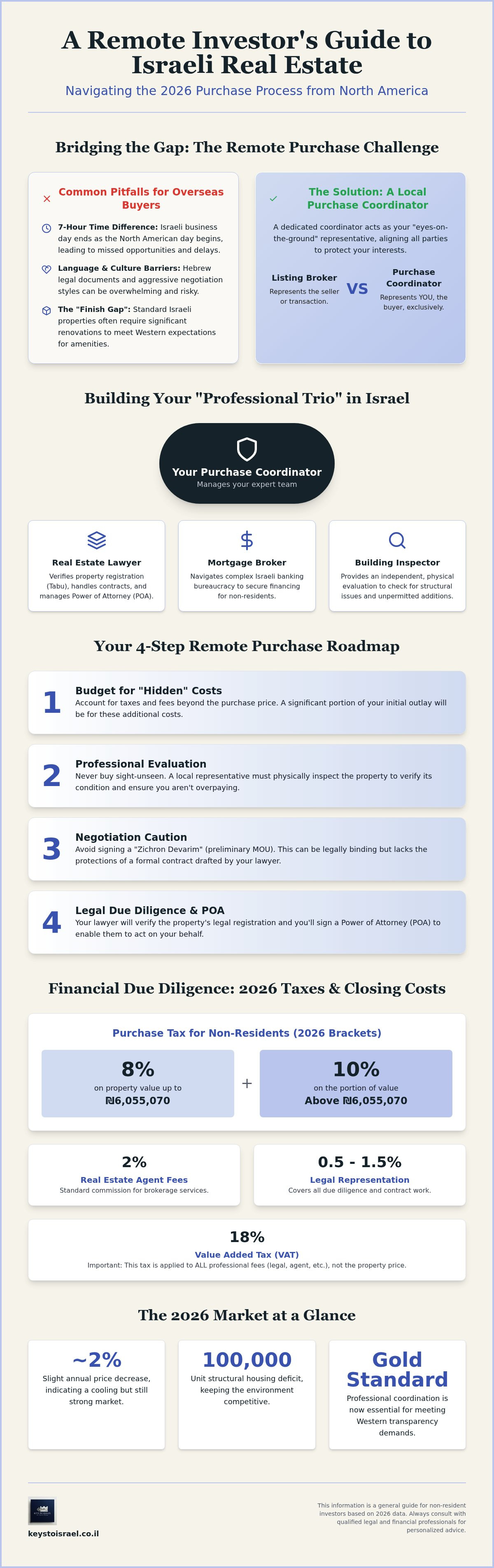
The 2026 israel property purchase process looks significantly different than it did even five years ago. While the market has shown signs of cooling with a slight annual price decrease of around 2%, the structural housing deficit of 100,000 units keeps the environment competitive. For investors in New York or Toronto, the "Remote Purchase Model" is now the standard approach. This model allows you to acquire assets without boarding a plane, but it requires a fundamental shift in how you view representation. Unlike the relatively standardized markets in the US or Canada, Israel operates on a system where physical presence and local relationships dictate the outcome of a deal.
Managing a transaction from Miami or LA means you're fighting a seven-hour time difference. When you're just starting your morning coffee, the Israeli business day is already winding down. This gap often leads to missed opportunities or delayed signatures. Understanding the nuances of Israeli property law is vital, but having someone to bridge that gap in real-time is what prevents a deal from collapsing. Western buyers now demand a level of transparency and communication that wasn't always present in the local market, making professional coordination the new gold standard.
Why North American Buyers Face Unique Challenges
If you're used to the predictable flow of a North American real estate closing, the "Israeli style" of negotiation can be jarring. Deals here often happen quickly and with a level of directness that feels aggressive to the uninitiated. Beyond the culture, currency fluctuations between the Dollar and the Shekel can swing your budget by tens of thousands of dollars in a single month. There's also the "finish" gap. A "standard" apartment in Israel often lacks the amenities Westerners take for granted, such as built-in cabinetry or specific HVAC configurations. You aren't just buying a floor plan; you're often buying a shell that needs a Western-style renovation to meet your standards.
The Role of a Purchase Coordinator vs. a Broker
It's vital to distinguish between a listing broker and a purchase coordinator. A broker's primary duty is often to the seller or the transaction itself. In contrast, a coordinator acts as your "eyes-on-the-ground" representative. They provide an independent evaluation of the property before you ever make an offer, ensuring you aren't overcharged as a foreign investor. By syncing your lawyer, mortgage broker, and building inspectors, a coordinator removes the logistical burden from your shoulders. They don't just find a property; they manage the entire israel property purchase process to ensure every Western standard is met before the keys change hands.
The 7-Step Roadmap to Buying Property in Israel Remotely
The israel property purchase process requires a methodical approach to avoid the pitfalls of a foreign legal system. Success depends on moving through a series of checkpoints that protect your capital and ensure the property's legal status is "clean." Following a structured roadmap allows you to maintain control even when you aren't physically present in the country.
Step 1: Budgeting for the "Hidden" Costs. You must account for more than just the sticker price. Non-residents face a purchase tax of 8% on values up to ₪6,055,070, jumping to 10% on the portion above that. Expect to pay 2% for real estate agent fees and between 0.5% and 1.5% for legal representation. Remember that an 18% VAT applies to all professional fees, which can add a significant layer to your initial cash outlay.
Step 2: Property Search and Professional Evaluation. Never buy based on marketing photos or a video call with a listing agent. A local representative should physically inspect the property to verify its condition and check for unpermitted additions. This independent evaluation ensures you aren't overpaying for a property that requires massive structural repairs.
Step 3: The Negotiation and "Zichron Devarim" Caution. Israeli sellers often push for a "Zichron Devarim," a preliminary memorandum of understanding. Don't sign this document. In Israel, it's often considered a legally binding contract but lacks the detailed protections your lawyer will include in the final agreement. Wait for the formal contract to ensure your interests are guarded.
Step 4: Legal Due Diligence and Power of Attorney (POA). Your lawyer must verify the property's registration through the Israel Land Authority or the Land Registry (Tabu). Since you're purchasing from abroad, you'll sign a Power of Attorney at an Israeli consulate or through an apostille process. This allows your legal team to sign documents and register the property on your behalf. If you want to ensure every step is handled with Western-standard oversight, engaging a property purchase coordination service can bridge the gap between your lawyer and the local bureaucracy.
Financing and the Mashkanta (Mortgage)
Opening an Israeli bank account from New York or Montreal is mandatory but often frustrating due to strict anti-money laundering regulations. Israeli banks generally limit foreign residents to a 50% Loan-to-Value (LTV) ratio, meaning you'll need a significant down payment. Using a specialized mortgage broker is essential because they know how to present North American income documents to Israeli underwriters who may not be familiar with your specific tax structures.
Signing and Registration (Tabu)
The final phase of the israel property purchase process involves the "Tabu," or Land Registry. Once the contract is signed via your POA, your lawyer immediately registers a "Cautionary Note" (He'arat Azhara). This note is a critical legal shield that prevents the seller from selling the property to another party or placing liens on it while you complete your payment schedule. The process is only complete when the title is fully transferred and registered in your name, a step that can take several months depending on current administrative backlogs.
Building Your "Professional Trio" in Israel
A successful israel property purchase process depends on a specific team that works in sync. In North America, you might rely heavily on a real estate agent to drive the transaction. In Israel, the legal and financial stakes require a "Professional Trio" consisting of a lawyer, a mortgage broker, and a purchase coordinator. If you're managing this from abroad, these professionals aren't just service providers; they're your protective shield against a complex and often opaque market.
The lawyer is your most critical hire for legal due diligence. They verify the title and ensure the contract protects you from liens or undisclosed debts. A significant risk for foreign buyers is the temptation to use the seller’s lawyer to save time or fees. Don't do this. That lawyer’s primary loyalty remains with the seller. You need independent representation to ensure the contract terms aren't skewed in the seller's favor. For a deeper look at the legalities, this guide to buying property in Israel outlines the standard protections every non-resident should expect during the acquisition.
The Coordinator Advantage
If the lawyer handles the paper and the broker handles the money, the coordinator is your "Chief of Staff" on the ground. This role is the missing link for remote investors. A coordinator manages the flow of information between all parties to prevent the delays that often kill deals. They verify that the physical state of the property matches the legal description in the Tabu. While you're in a different time zone, they're physically present for inspections and appraisals. This ensures that no details are overlooked by contractors or government officials while you're asleep in New York or Toronto.
Vetting Your Local Team
When hiring your team, you shouldn't just look for credentials. Ask potential lawyers how many foreign clients they've represented in the last year and how they manage communication across time zones. It's vital that your team understands Western service expectations, particularly regarding response times and transparency. A vetted team should also provide access to a local contractor network. Since most Israeli apartments require some level of "Westernizing" after purchase, having a coordinator who can transition into renovation management ensures your property is ready for use immediately after closing.
Financial Due Diligence: Taxes and Closing Costs
Financial surprises are the most common cause of stress in the israel property purchase process. While you've likely accounted for the property price, the ancillary costs in Israel can represent an additional 10% to 15% of your total budget. For non-residents in 2026, the primary expense is the Purchase Tax (Mas Rechisha). This tax is currently 8% for property values up to ₪6,055,070, with the portion above that amount taxed at 10%. These brackets are frozen through the end of 2027, providing some predictability for your long-term planning.
Professional fees scale with the complexity of the transaction. Real estate agents typically charge 2% of the purchase price, while legal fees range from 0.5% to 1.5%. You must also factor in an 18% VAT on all professional services. If you're buying a new construction project, be aware of the Construction Input Index linkage (Madad). This adjustment links your remaining balance to the cost of building materials. If inflation in the construction sector rises, your final payout will increase accordingly, potentially straining your initial financing plan.
Tax Coordination for Foreign Investors
Understanding your non-resident tax status is essential to avoid double taxation or missing local deadlines. Beyond the initial purchase tax, you'll face an annual municipal property tax (Arnona), which saw a baseline increase of 1.626% for 2026 across all municipalities. Managing these payments and the strict anti-money laundering documentation required by Israeli banks is difficult from abroad. Engaging a professional for tax and legal coordination ensures that your capital moves safely and your local obligations are met without delay.
Appraisal and Inspection Costs
A private appraisal (Shama’ut) is a vital safeguard before you sign any binding agreement. While your bank will require its own appraisal for a mortgage, a private report gives you an unbiased view of the property's market value and legal standing. For second-hand apartments, an engineering inspection (Bedek Bayit) is non-negotiable. These reports often reveal hidden structural issues or unpermitted modifications that can be used as leverage in your final negotiation. If the inspection reveals significant flaws, you can either request repairs or adjust your offer to cover the cost of a future renovation.
Beyond the Keys: Renovation and Management
Closing the deal is often viewed as the finish line, but for overseas investors, it's merely the start of the operational phase. The israel property purchase process often yields a property that, while legally yours, does not yet meet Western living standards. Most Israeli apartments are sold with "standard" finishes that lack the built-in cabinetry, modern HVAC systems, or high-end kitchens common in New York or Toronto. To protect your investment and maximize its value, you'll likely need to transition immediately from acquisition to renovation.
Transforming a local shell into a Western-standard home requires more than just a contractor. It requires a local ally who understands the gap between Israeli building norms and North American expectations. Without this oversight, you risk owning an asset that is difficult to rent or uncomfortable for personal use. Your goal is to move from the signing table to a "turnkey" state as efficiently as possible.
Renovation Management from Abroad
Managing a construction project from 6,000 miles away is impossible without a dedicated project manager. If you attempt to hire contractors directly from abroad, you risk delays, budget overruns, and quality compromises that you won't discover until your next visit. Professional renovation management provides a vetted network of local specialists who understand your specific requirements. Your representative acts as your eyes and ears, providing regular photo and video updates and conducting site inspections to ensure the work stays on schedule. This level of coordination ensures that the final result matches the vision you had when you first began the israel property purchase process.
Ongoing Property Management for Overseas Owners
Once the renovation is complete, the focus shifts to long-term stewardship. The 2026 rental market remains a strong driver for investors; as of August 2026, rents for new tenants increased by 4.7%. Choosing between a long-term lease and a short-term rental strategy depends on your personal use goals and local municipal regulations in cities like Jerusalem or Tel Aviv. Regardless of your choice, property management for overseas owners is the only way to maintain the "peace of mind" factor. A local manager coordinates regular maintenance for vacant units, manages tenant relations, and handles rent collection. This steady hand on the ground ensures that your Israeli asset remains a source of stability rather than a source of long-distance anxiety.
Securing Your Israeli Asset with Local Expertise
The israel property purchase process in 2026 is manageable when you have a steady hand on the ground to navigate the local bureaucracy. We've explored how a professional roadmap, from vetting your legal team to managing construction index linkage, protects your capital. Success isn't just about signing the contract. It's about ensuring your property meets Western standards through expert renovation and long-term management.
If you're managing an acquisition from New York, Toronto, or Miami, you don't have to struggle with time zones or language barriers alone. Keys to Israel acts as your single point of contact, offering deep local knowledge and specialized renovation management for overseas owners. We provide the protective advocacy you need to turn a complex foreign transaction into a seamless investment.
Schedule a consultation with Keys to Israel to coordinate your purchase and take the first step toward a secure, turnkey property. Your future in the Israeli market starts with an ally you can trust.
Frequently Asked Questions
Can foreigners buy property in Israel without a visa?
Yes, foreigners and non-residents can legally purchase property in Israel without holding a specific visa or citizenship. Israeli law allows for full ownership or long-term leasing by international investors. You'll need to provide valid identification and comply with strict anti-money laundering documentation requirements. This accessibility makes the israel property purchase process attractive to North American buyers looking to diversify their portfolios or secure a home for future use.
What is the current purchase tax for non-residents in 2026?
As of 2026, non-resident buyers pay a purchase tax of 8% on property values up to ₪6,055,070. Any portion of the purchase price exceeding this amount is taxed at a rate of 10%. These brackets are currently frozen through the end of 2027. You must declare this tax within 30 days of signing your contract and ensure payment is completed within 60 days to avoid penalties from the Tax Authority.
How long does the property purchase process in Israel typically take?
The timeline from initial search to final registration usually spans four to six months. While the negotiation and contract signing can happen within weeks, the subsequent steps involve banking approvals and bureaucratic filings. Land registration reform in 2026 has sometimes extended processing times at the Land Registry (Tabu). Having a local coordinator helps manage these delays by ensuring all documents are submitted correctly and followed up on immediately.
Can I get an Israeli mortgage if I live in the US or Canada?
Yes, Israeli banks offer mortgages to North American residents, though the terms differ from local loans. You should expect a maximum Loan-to-Value (LTV) ratio of 50%, meaning you'll need to provide a 50% down payment. Interest rates for foreign borrowers in early 2026 have ranged from 4.8% to 6.2%. You'll need to work with a mortgage broker who can translate your US or Canadian tax returns into the format required by Israeli underwriters.
Do I need to be physically present in Israel to sign the contract?
You don't need to be physically present in Israel to complete your purchase. By granting a Power of Attorney (POA) to your Israeli lawyer, they can sign the contract and all registration documents on your behalf. This POA is typically signed at an Israeli consulate in your home country or through a local notary with an apostille. This remote model is a standard part of the israel property purchase process for our North American clients.
What is a Zichron Devarim and why should I be careful with it?
A Zichron Devarim is a preliminary memorandum of understanding that sellers often push buyers to sign. You should avoid signing this document because it's often legally binding under Israeli law but lacks the comprehensive protections of a full contract. Once signed, it can be difficult to renegotiate terms or withdraw from the deal without significant financial penalties. Always wait for your lawyer to finalize a formal contract that includes essential legal safeguards.
How much should I budget for closing costs in Israel?
You should budget approximately 10% to 15% above the purchase price for closing costs. This includes the 8% purchase tax for non-residents, a 2% real estate agent commission, and legal fees ranging from 0.5% to 1.5%. Don't forget that an 18% VAT applies to all professional services. If you're buying new construction, you must also account for the Construction Input Index, which can increase your final payment based on rising building material costs.
Who manages my property in Israel while I am abroad?
A professional property management service is the best way to oversee your investment from a distance. They handle everything from regular maintenance inspections and tenant relations to rent collection and emergency repairs. For vacant units, they ensure the property remains secure and in good condition. This local presence is vital for maintaining the "Peace of Mind" factor and ensuring your asset is ready for your personal use whenever you visit the country.


Comments