
Buying New vs Second Hand in Israel: The Investor's Comparison

Updated: 4 days ago
The shiny appeal of a brand-new apartment in Israel often feels like the safest bet for an overseas investor, but the hidden math of 2026 suggests otherwise. You likely want the security of a modern build without the headache of managing a renovation from thousands of miles away. However, with approximately 84,000 unsold new homes currently sitting on the market, the choice between buying new vs second hand israel has never been more complex or more critical for your bottom line.
It's easy to feel overwhelmed when you don't speak the language or understand why a "fixed" price suddenly climbs due to the Construction Input Index, which rose 3.6% over the last twelve months. This article provides a cold, data-driven breakdown of the financial and logistical trade-offs you face today. We'll analyze everything from the 8% purchase tax floor for foreign residents to the reality of managing a remote project. By the end, you'll have a clear framework to decide if a new build or a managed second-hand renovation is the smarter path for your capital and your connection to the land.
Table of Contents
The Numbers Behind the Choice: Israel’s 2026 Market Reality
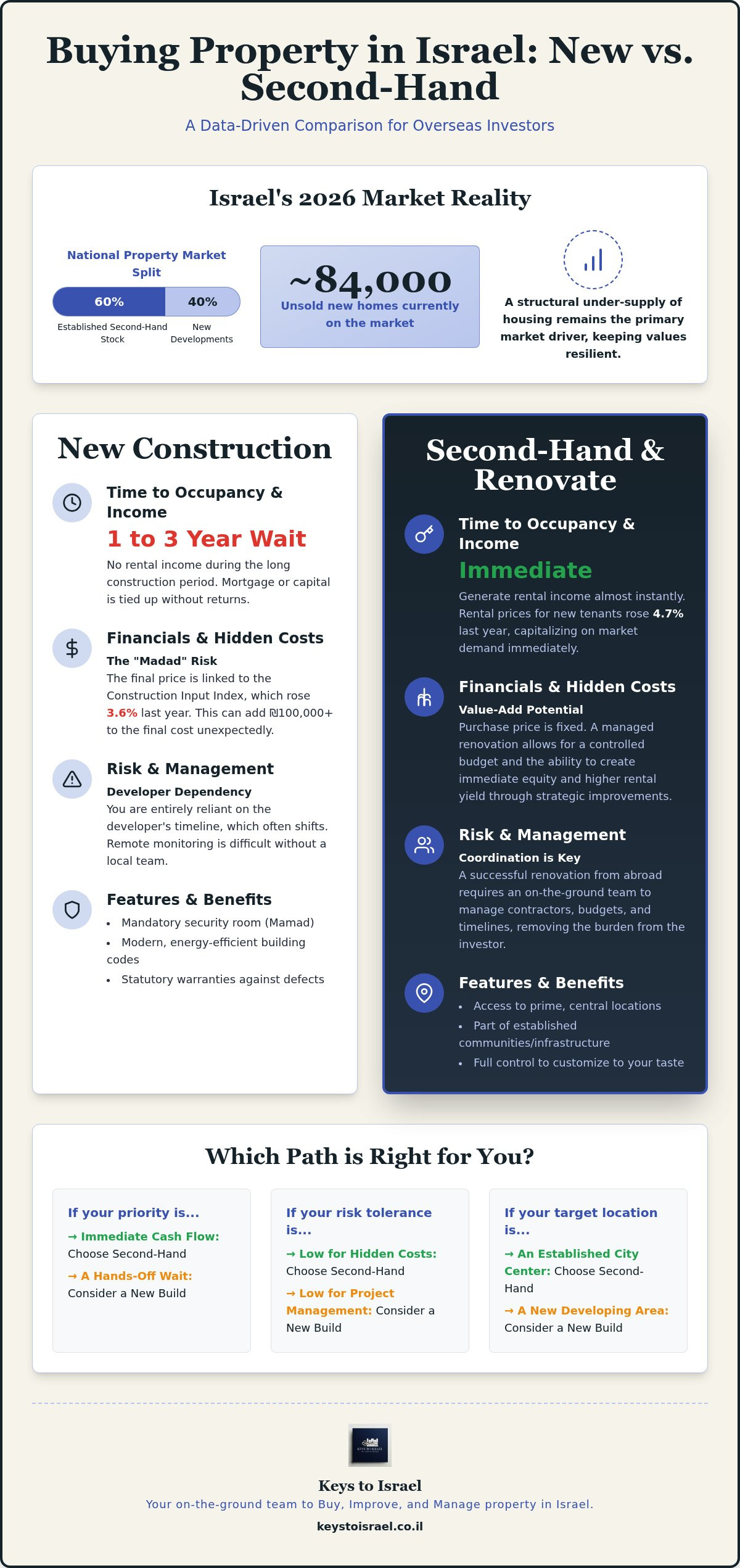
The choice of buying new vs second hand israel begins with the inventory data. Nationally, the property market maintains a roughly 60/40 split between established older stock and new developments. While developers currently hold approximately 84,000 unsold units, the underlying reality is one of structural under-supply. This persistent shortage remains the primary driver of the market, keeping values resilient even during economic shifts.
If you are pursuing remote real estate investing in Israel, you have to choose your timeline carefully. Second-hand units offer immediate keys and the potential for instant rental cash flow. In contrast, new builds typically involve a wait of 1 to 3 years before the property is delivered. For the overseas buyer, this means carrying mortgage costs or capital outlays for years without any offsetting income.
The Supply-Demand Imbalance
Israel's population growth consistently outpaces the speed of the national planning and construction committees. It takes years for a project to move from the initial approval stage to final completion. This lag ensures that both asset types remain viable, but they serve different strategic goals. New builds capture value as the neighborhood matures, while second-hand units benefit from being part of an already established infrastructure. The History of Housing in Israel demonstrates that despite temporary price dips, the long-term trajectory is defined by this fundamental scarcity of available units.
Entry Points for Overseas Investors
Second-hand units are the primary entry point for central residential areas where land is already fully utilized. You won't find many empty plots in high-demand zones. Instead, new stock is created through urban renewal projects that replace or reinforce older buildings. These projects offer a middle ground, but they require a local ally to monitor the progress and ensure the developer meets the agreed-upon standards. Without a physical presence, you are relying entirely on the developer's timeline, which often shifts.
New Construction: The Hidden Costs of Buying On Paper
When evaluating the choice of buying new vs second hand israel, many overseas investors gravitate toward new developments for their perceived simplicity. You sign a contract with a developer and wait for the keys. However, the sticker price on a new build is rarely the final cost. This is because most Israeli construction contracts link the unpaid balance to the Construction Input Index, known as the Madad. This index tracks the rising cost of materials and labor, which grew by 3.6% in the 12 months leading to July 2026.
A 2026 Israeli Real Estate Market Analysis highlights that while developers currently hold about 84,000 unsold units, they rarely drop headline prices. Instead, they offer financing perks. For a remote buyer, the real risk lies in the delivery window, which often spans two to three years. During this time, you have no rental income to offset your mortgage, and any delay in construction compounds your financial carry. Effective israel property purchase coordination is essential here to ensure someone is physically monitoring the site and holding the developer to their contractual obligations.
The Construction Input Index Trap
If the index rises by just 3% over a three-year build, it can add over 100,000 Shekels to a 3.5 million Shekel purchase. You should negotiate a cap on this linkage or consider paying a larger portion upfront if you have the liquidity. If you're unsure how to structure these payments from abroad, talk to us to see how we coordinate these professional negotiations.
Warranties and Modern Infrastructure
The primary advantage of a new build is the mandatory security room (Mamad) and adherence to modern building codes. These units are significantly more energy-efficient than the uninsulated stock from the 1970s. Additionally, Israeli law provides statutory warranty periods that cover structural defects for several years, giving you a layer of protection that second-hand properties lack.
Second-Hand Properties: Immediate Returns and Renovation Potential
Second-hand properties represent the most pragmatic path for investors prioritizing cash flow. Unlike new builds that require years of patience, an existing unit allows you to generate rental income almost immediately. With rental prices for new tenants rising by 4.7% in the year to July 2026, the case for immediate entry is strong. Data from the Israel Tax Authority real estate review shows that second-hand prices have faced the steepest corrections in urban centers. This correction creates a window for the "Buy and Improve" strategy. By purchasing an older unit below market value and executing a targeted upgrade, you bypass the premiums of new construction.
When debating buying new vs second hand israel, the fear of "hidden issues" like decaying plumbing or outdated electrical systems often stalls decision-making. These risks are real, but they are manageable through professional oversight. Our remote renovation management israel service is designed to bridge this gap, ensuring that structural assessments happen before you commit your capital.
Evaluating Older Infrastructure
You shouldn't sign a contract on an older property without a professional engineering inspection. We coordinate this process by bringing together an engineer and an appraiser to verify that the purchase price reflects the actual state of the building. This coordination prevents you from overpaying for a unit that requires significant structural remediation. It's about buying with your eyes open, even from across the ocean.
The Renovation Value-Add
A strategic renovation can significantly boost your returns. Industry data suggests that modernizing an older unit can increase rental yields by 15% to 20% compared to its unrenovated state. High-end tenants in Israel look for modern kitchens, updated bathrooms, and efficient air conditioning. A managed renovation removes the "second-hand" stigma, allowing your property to compete directly with new builds for the best tenants. Get in touch to learn how we manage the full renovation team for you.
The Investor’s Decision Framework: Buying, Improving, and Managing
Deciding between buying new vs second hand israel depends on your specific goals and liquidity. If you prioritize immediate cash flow, second-hand properties are the logical choice. If you are focused on long-term capital gains in emerging districts, a new build might suit you better. Use this four-point checklist to guide your decision:
Timeline: Do you need rental income today or can you wait three years for delivery?
Budget Certainty: Can you absorb index-linked price increases on a new build?
Location: Are you targeting established city centers where only older stock exists?
Management: Are you prepared to coordinate a renovation or do you need a turnkey solution?
Choosing Based on Your Investment Horizon
A "Buy New" strategy often targets long-term appreciation as new infrastructure matures. However, the "Second Hand" path allows for the "Buy and Improve" model. By assembling a team to handle the improvement phase, you create equity through renovation rather than waiting for market inflation. This proactive approach requires a vetted team of contractors, engineers, and agents who work under a single point of oversight to ensure the project stays on track while you are abroad.
The Role of Local Coordination
Chasing individual lawyers, agents, and contractors from another time zone is a recipe for frustration. Professional property management israel for overseas owners ensures your interests are guarded locally. Coordination reduces the "foreign investor tax" often paid when overseas buyers are overcharged for services they cannot verify. We follow a clear philosophy: Buy. Improve. Manage. This framework removes the friction of remote ownership.
Ultimately, this isn't just about spreadsheets. Owning a piece of Israel is a hedge against global uncertainty and a testament to historical resilience. Whether you are planning for future Aliyah or strengthening diaspora ties, the numbers support the emotional pull of the homeland. Talk to us to see how it works.
Securing Your Position in the Israeli Market
The choice of buying new vs second hand israel ultimately depends on whether you prioritize immediate rental cash flow or the statutory warranties of a modern build. New construction carries the risk of index-linked price increases and delivery delays, while older properties offer entry into high-demand city centers if you have the right team to manage the "improve" phase. You don't have to navigate these logistical hurdles alone from across the ocean. We act as your single point of contact, providing expert local navigation and a team of vetted contractors to handle everything from purchase coordination to full renovation management.
This methodical approach ensures your capital is protected and your connection to the land remains a source of stability rather than stress. If you're ready to move beyond the uncertainty of remote ownership and build a legacy in the homeland, see how it works. Taking the first step is the hardest part, but we're here to ensure the path is clear and your interests are guarded at every stage of the journey.
Frequently Asked Questions
Is it cheaper to buy a new apartment or a second-hand one in Israel?
Second-hand units are frequently cheaper on a price-per-meter basis, especially when you factor in that they don't include the 18% VAT charged on new construction. When comparing buying new vs second hand israel, you must look at the total cost of ownership. New builds often require additional payments for the Construction Input Index, while second-hand properties allow you to lock in a fixed price and avoid the developer's premium.
What is the Construction Input Index and how does it affect my purchase?
The Construction Input Index tracks the cost of building materials and labor, applying specifically to the unpaid balance of new-build contracts. Since the index rose 3.6% in the 12 months leading to July 2026, it can add tens of thousands of Shekels to your final price. Second-hand properties are not linked to this index; the price you sign for in the contract is the final price you pay at closing.
Can I renovate an Israeli apartment if I live in New York or London?
You can manage a complete renovation remotely by using a local coordination service to oversee the project. Managing contractors from a different time zone is nearly impossible without a physical presence to verify the quality of work. We assemble a full team of vetted professionals and act as your single point of contact. This ensures the renovation stays on schedule and meets local standards while you remain in your home country.
What are the main risks of buying an apartment "on paper" in Israel?
The primary risks include construction delays and price inflation through the Construction Input Index. You also face a significant period without rental income while the building is being completed, which can last several years. These variables often make buying new vs second hand israel a more complex financial decision than it appears. Existing properties offer more predictability because the physical structure is already finished and ready for inspection.
How long does the purchase process take for second-hand properties?
The process for existing homes generally takes between three and six months from the initial offer to the delivery of keys. This timeline includes the legal due diligence period, mortgage approval, and the payment schedule defined in your contract. Unlike new developments that keep your capital tied up for years, second-hand units offer a faster transition to the management phase; allowing you to begin generating rental returns much sooner.


Comments