
Israel Property Investment Strategy: The Remote Investor's Guide

Updated: 4 days ago
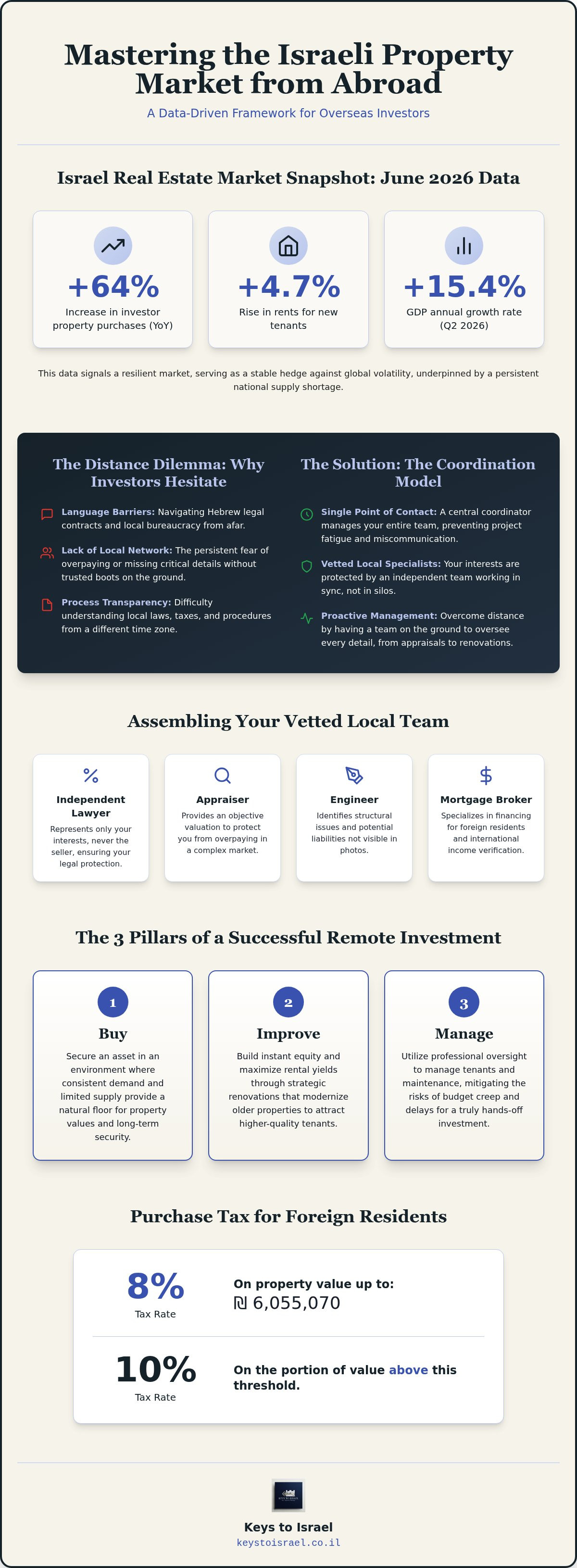
In June 2026, property purchases by investors in Israel surged by 64% compared to the previous year. This spike occurred even with a stronger shekel and purchase tax rates for foreign residents held at 8% for properties up to ₪6,055,070. While the data shows a stabilizing market with rents for new tenants rising by 4.7%, the path to entry remains daunting if you are staring at it from thousands of miles away.
You likely understand the long term value of owning an asset in the homeland, but the logistics of remote real estate investing in Israel often feel like a minefield. It's difficult to trust a process when you're facing Hebrew legal contracts you can't read and the persistent fear of overpaying because you lack a local network. We'll show you how to master a data driven approach to acquiring and managing property while overcoming these specific language and legal hurdles. This guide previews a hands off investment lifecycle where you coordinate a vetted team of local specialists to ensure your interests are protected without you ever having to chase a contractor or a mortgage broker.
Table of Contents
Analyzing Israel’s Real Estate Market Resilience and 2026 Data
In June 2026, property purchases by investors jumped 64% compared to the previous year. While the national home price index showed a slight 1.5% year-over-year decline, this surge in activity indicates a strong belief in the market's recovery phase. For those considering remote real estate investing in Israel, this data confirms that the market serves as a stable hedge against global economic volatility. With GDP growing at an annual rate of 15.4% in the second quarter of 2026, the economy demonstrates a resilience that few other regions can match.
The Supply-Demand Gap: A National Perspective
Examining the history of housing in Israel reveals a consistent pattern: demand almost always outpaces new housing starts. In 2026, population growth continues to exceed the rate of new construction. This creates a natural floor for property values, especially in high-demand urban corridors. When you invest here, you aren't just buying a building; you're securing a stake in an environment where limited land availability ensures long-term asset security. Remote real estate investing in Israel allows you to capture this growth while living elsewhere.
Why Foreign Investors Hesitate: The Transparency Problem
The primary hurdle for many isn't the market's health but the transparency of the local process. If you don't speak Hebrew, the language barrier represents a significant risk in legal contracts. You also have to navigate national purchase taxes for non-residents, which are currently set at 8% for properties up to ₪6,055,070 and 10% for value above that threshold. This gap between international expectations and local bureaucratic reality often leads to hesitation. Without a local network, it's easy to feel like you're overpaying or missing critical legal nuances that could affect your yield. Success requires bridging this distance with a strategy that prioritizes local coordination over simple transactions.
The Remote Investment Framework: Coordination Over Transaction
Traditional brokers focus on the transaction. Once the commission is paid, you're often left alone to navigate the complex aftermath. For remote real estate investing in Israel to succeed, you need a coordination model instead. Managing an independent lawyer, an appraiser, an engineer, and a mortgage broker from a different time zone is a recipe for project fatigue. One missed email or misunderstood Hebrew document can stall your progress for weeks.
A single point of contact ensures your team works in sync rather than in silos. For example, a local appraiser protects you from overpaying, while an engineer identifies structural issues that listing photos won't show. This oversight is vital when you can't be there to walk the halls yourself. According to a 2026 real estate market analysis, long-term yields depend heavily on avoiding these early financial leaks. If you want to simplify this process, see how it works.
Assembling Your Local Professional Team
You need an independent lawyer who represents only your interests, never the developer or the seller. Similarly, mortgage brokers for foreign residents understand international income verification better than standard local bank clerks. They know which banks are currently friendly to overseas capital. You can find more detail on these roles in our Israel Property Purchase: 2026 Overseas Investor Guide.
The Power of Attorney: Managing Logistics from Abroad
You don't need to fly in for every signature. A restricted Power of Attorney (POA) allows your lawyer to handle specific procedural tasks without giving them total control over your assets. You can sign these documents at your local Israeli consulate or via an international notary with an apostille. This setup keeps the process moving while you remain at home. It bridges the geographical gap and ensures your investment doesn't wait for your next vacation to move forward.
Strategic Pillars: Maximizing Yield through Improvement and Management
In the year leading up to July 2026, rents for new tenants in Israel rose by 4.7%. This growth indicates a rental market that has decoupled from sales prices, creating a unique opportunity for those focused on yield. For remote real estate investing in Israel to be truly profitable, you must focus on the "Improve" phase. Modernizing an older apartment doesn't just attract better tenants; it builds instant equity in a market defined by a national supply shortage. However, managing a renovation from abroad involves significant risks like budget creep and schedule delays that can erode your returns.
Remote Renovation: Ensuring Standards from a Distance
Renovating a property you haven't physically visited requires more than just a video call. While some competitors suggest AI can replace local oversight, the reality of the Israeli construction culture demands a physical presence. You need vetted contractors who understand international quality standards and a coordinator to ensure building code compliance. According to the Israel Tax Authority real estate market review, the investment in professional oversight is often offset by the long-term value appreciation of modernized assets. Our Renovating in Israel from Abroad: The 2026 Remote Management Guide provides a framework for keeping these projects on track.
Property Management: Protecting Your National Asset
The "Manage" phase is where your investment becomes truly hands-off. Whether you opt for the 10% flat tax on gross rental income or keep the property vacant for personal use, you need a system for regular inspections. Ongoing maintenance is a preventative cost-saving measure. One missed pipe leak can turn into a major structural issue if the property sits empty for months. We coordinate everything from tenant communication to emergency repairs so you don't have to chase anyone. You can read more in our Israel Property Management: 2026 Overseas Owners Guide. To see how we can protect your asset, get in touch.
Bridging the Distance: Your Long-Term Connection to the Landscape
Remote real estate investing in Israel is rarely just a calculation of rental yields or capital gains. While the 2026 data shows a stabilizing market with the Bank of Israel interest rate at 3.25%, the real value lies in the bridge you build to the homeland. This "Aliyah-adjacent" strategy allows you to secure a physical footprint in a country defined by historical resilience. You aren't just buying four walls; you're establishing a foundation that remains ready whenever you or your family decide to make the move permanent.
Securing a Future for the Next Generation
Owning property serves as a literal stake in the country's future. It's a shift from being a spectator in the diaspora to being an active participant in the local landscape. By acquiring an asset today, you hedge against future price increases in a region where land is finite and demand is constant. This long-term perspective transforms you from a remote investor into a future resident. It ensures that your connection to the country is backed by a tangible, secure asset that can be passed down through your family.
Taking the First Step with Confidence
The primary barrier to entry is often the fear of the unknown. You might worry about navigating the 8% purchase tax or the complexities of a Hebrew contract from thousands of miles away. However, these hurdles are purely logistical. When you have a local team to coordinate the details, the distance disappears. You don't need to be an expert in Israeli law to start the process; you just need a steady hand on the ground to manage the specialists for you.
The pull of the homeland is powerful, and the current economic numbers support the sentiment. If you're ready to move past the hesitation, see how it works by speaking with a local coordinator. It's a low-pressure way to explore how a data-driven investment can secure your place in Israel's future.
Securing Your Stake in the Homeland
Success in remote real estate investing in Israel hinges on shifting from a transaction-based mindset to a coordination-led strategy. By focusing on the full lifecycle of Buy, Improve, and Manage, you turn a complex foreign acquisition into a predictable, high-yield asset. You've seen that the national supply shortage provides a natural floor for property values, while professional local oversight prevents the budget creep common in remote renovations.
We provide expert local coordination for overseas buyers and direct advisory from David Bitton to ensure you never have to chase a contractor or lawyer yourself. If you're ready to bridge the gap between your current location and your future in Israel, see how it works. Taking this first step is about more than just numbers; it's about establishing a permanent connection to a landscape defined by resilience. Your foundation in Israel is waiting, and with the right local ally, the distance is no longer a barrier.
Frequently Asked Questions
Can I buy property in Israel without visiting the country in person?
Yes, you can complete a purchase entirely from abroad using a restricted Power of Attorney (POA). This legal document allows your Israeli lawyer to sign specific procedural contracts on your behalf. You sign the POA at your local Israeli consulate or before a notary with an apostille. This makes remote real estate investing in Israel accessible without the need for international travel during the acquisition phase.
What are the main taxes for foreign real estate investors in Israel in 2026?
Foreign investors currently pay an 8% purchase tax on property values up to ₪6,055,070, with a 10% rate applied to any value above that threshold. If you sell, you'll face a 25% capital gains tax on the real profit. For rental income, the most common choice is a 10% flat tax on the gross amount. These rates are verified through the end of 2027.
How do I manage a renovation in Israel while living abroad?
Managing a renovation requires a local coordinator to oversee a vetted team of contractors, engineers, and specialists. We provide renovation management to ensure your project stays on schedule and meets international quality standards. Physical oversight is essential to verify that materials and building codes match the agreed specifications. This prevents budget creep and ensures the "Improve" phase of your investment lifecycle builds the intended equity.
Is it better to rent out my Israeli property long-term or as a short-term Airbnb?
The choice depends on your financial goals and personal use needs. Long-term rentals offer predictable yields and lower turnover costs, with rents for new tenants rising by 4.7% in the year leading to July 2026. Short-term Airbnb stays provide higher potential income and flexibility if you visit the country frequently. We coordinate the management for both models, ensuring your property remains well-maintained regardless of the rental strategy.
What is the role of a property purchase coordinator compared to a real estate broker?
A real estate broker typically acts as a listing agent focused on closing a single transaction. In contrast, a property purchase coordinator manages your entire professional team, including the lawyer, mortgage broker, appraiser, and engineer. This model prioritizes your long-term interests rather than a commission. We act as your single point of contact to ensure you don't have to chase individual vendors across different time zones.


Comments