
Israel Real Estate Portfolio: A Guide for Overseas Investors

Updated: 5 days ago
Owning multiple properties across an ocean shouldn't feel like running an offshore crisis center. If you already hold residential assets abroad, you know the frustration of chasing contractors across distant time zones, deciphering municipal tax letters, and watching tenant turnover quietly erode your annual yields. Cohesive Israel real estate portfolio management solves this exhausting friction. Instead of juggling dozens of fragmented contacts alone, you can bring every acquisition, renovation, and ongoing lease under a single, dependable operational framework that protects your asset values.
In this guide, you'll discover how to systematically oversee maintenance, vet quality tenants, and navigate legal obligations without local language barriers. We'll show you how to maintain complete financial transparency and scale your holdings effectively, giving you genuine peace of mind from thousands of miles away.
Table of Contents
The Operational Friction of Managing an Israel Real Estate Portfolio Remotely
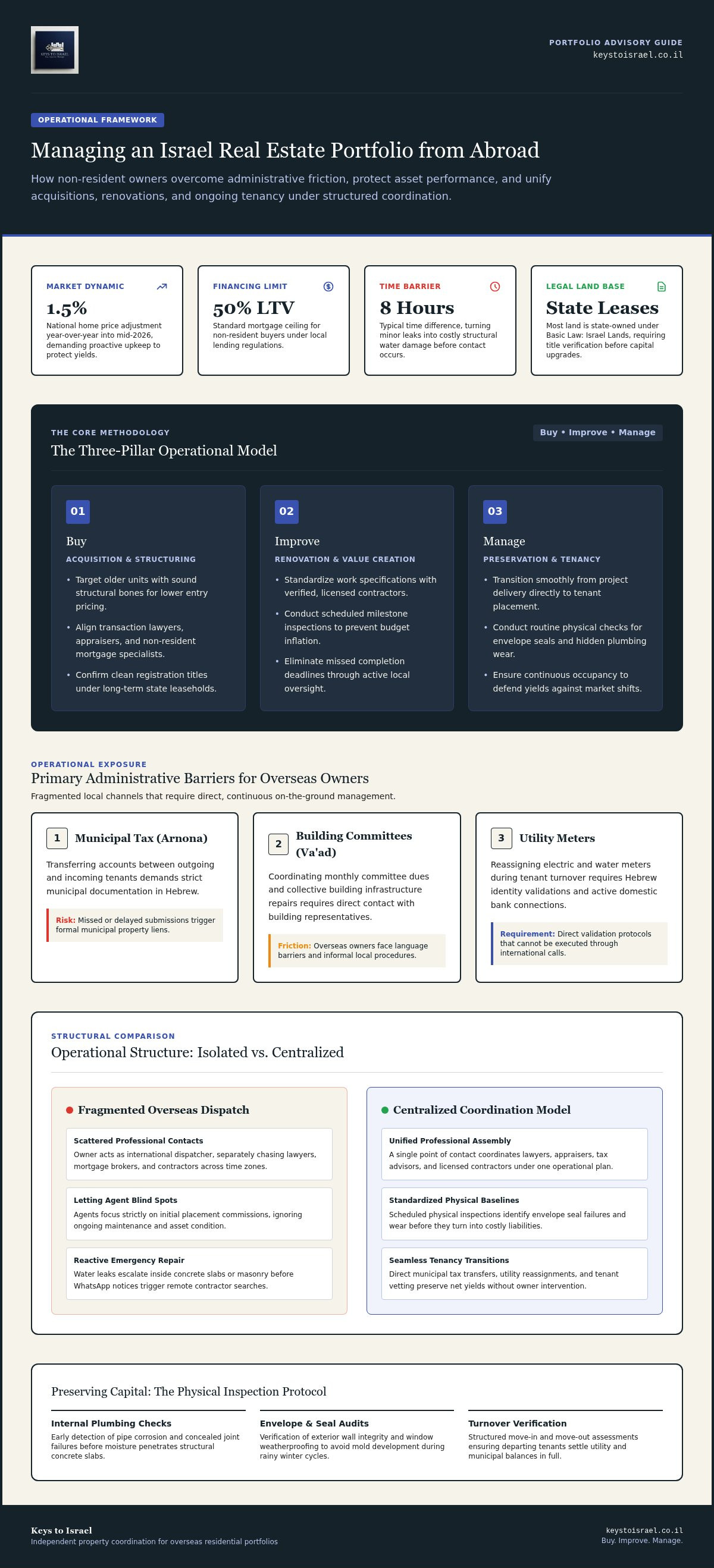
Acquiring multiple residential holdings is one thing; operating them across an ocean is an entirely different operational hurdle. Remote portfolio decay occurs when physical maintenance, compliance, and tenant handovers lack continuous local oversight, slowly eating away at real asset value. While national home prices adjusted by 1.5% year-over-year into mid-2026, solid underlying tenant demand still requires proactive upkeep to defend rental returns. When you manage from thousands of miles away, an eight-hour time difference turns a minor plumbing failure into an expensive structural mold problem before you even receive the WhatsApp message.
Effective Israel real estate portfolio management requires direct systems, not fragmented emergency calls. Understanding the scale of Israel's construction and real estate market helps explain why individual owners get lost in the shuffle: local contractors and utility departments prioritize active on-site relationships over international phone calls.
Administrative Barriers for Non-Resident Property Owners
Every apartment you hold introduces separate operational channels:
Municipal tax accounts: Transferring Arnona between outgoing and incoming tenants demands strict municipal documentation in Hebrew. Missed submissions trigger municipal property liens.
Building committees (Va'ad Bayit): Managing regular dues and collective building infrastructure repairs requires direct communication with building representatives.
Utility meters: Transferring electric and water bills requires Hebrew identity validations and local banking connections.
Relying on scattered letting agents across your holdings creates blind spots. One agent focuses strictly on securing their placement fee, another ignores preventative maintenance, and neither coordinates your overall fiscal position. Review our Israel property management overseas owners guide to see how establishing standardized operational baselines protects your net yields.
The Three-Pillar System for Scaling Israeli Residential Investments
Scaling a multi-property footprint requires moving beyond one-off transactions. Successful Israel real estate portfolio management rests on three interconnected pillars: Buy, Improve, and Manage. Rather than purchasing newly built units at peak pricing, seasoned buyers often target older, underperforming properties with sound bones. This approach captures lower entry pricing while unlocking value through focused capital upgrades.
Ownership rights in Israel differ significantly from Western markets. Under the Basic Law: Israel Lands, the vast majority of land is state-owned and administered through long-term leases rather than freehold private deeds. Coordinating legal verification upfront ensures your purchases carry clean registration titles before you commit renovation funds.
Aligning Acquisitions, Renovations, and Long-Term Oversight
Connecting your operational stages prevents costly friction between handoffs:
Buy: Align transaction attorneys, appraisers, and mortgage specialists under a cohesive acquisition plan, keeping non-resident financing within the standard 50% loan-to-value limits.
Improve: Standardize work specifications with licensed, vetted contractors. Our remote renovation management guide details how milestone inspections prevent budget inflation and missed deadlines.
Manage: Transition directly from project completion to rigorous tenant placement and systematic routine checks.
Managing isolated vendors across three separate lifecycles burns time and capital. If you want to streamline multiple holdings under a structured framework, see how it works with a dedicated local coordinator.
Building a Resilient Ownership Structure Through Centralized Coordination
Handling multiple properties shouldn't force you into a full-time dispatch role. When you manage separate professionals directly from abroad, miscommunications multiply quickly. Proactive Israel real estate portfolio management replaces scattered relationships with centralized oversight, keeping your entire portfolio moving forward under a unified operational plan.
Asset preservation requires disciplined physical oversight. Routine, documented inspections identify internal plumbing leaks and envelope seal failures before water spreads through concrete slabs or masonry walls. Alongside physical audits, regular administrative reviews verify clean status across national land registries, municipal tax accounts, and cross-border banking compliance, protecting your holdings from unexpected administrative freezes.
Assembling and Directing Your Local Professional Team
Instead of vetting separate vendors for every issue, a dedicated coordinator directs your extended advisory circle:
Due diligence: Directing licensed appraisers and engineers to evaluate structural integrity before purchase commitments.
Transaction protection: Aligning independent mortgage consultants and real estate lawyers so your legal interests remain thoroughly guarded. Consult our Israel real estate legal coordination guide to see how structured legal oversight protects non-resident buyers.
Operational execution: Supervising on-site maintenance trades and administrative filings directly.
You don't need to navigate local bureaucracy or language barriers alone. Talk to us about coordinating your property holdings and building a resilient, hands-off ownership framework.
Protect and Scale Your Israeli Property Assets With Confidence
Growing an overseas property portfolio shouldn't mean sacrificing your peace of mind to foreign bureaucracy. Effective Israel real estate portfolio management succeeds when you consolidate purchase coordination, renovation execution, and ongoing tenant oversight under one dependable roof. Rather than juggling separate contractors and legal advisors across distant time zones, working with a dedicated single point of contact ensures every asset receives rigorous local care.
Holding residential real estate in Israel is more than a financial transaction; it's a lasting stake in the country's ongoing growth and resilience. With the right operational framework on the ground, long-distance ownership becomes deeply rewarding rather than an administrative burden. Talk to us about structuring and managing your property holdings in Israel with complete transparency.
Frequently Asked Questions
Can a foreign resident manage an Israeli real estate portfolio without local bank accounts?
Operating without an Israeli bank account is practically impossible when scaling multiple residential assets. Domestic utility providers, municipal tax offices, and building committees require payments through local standing orders or domestic banking channels. While foreign currency transfers work for major transactions, disciplined Israel real estate portfolio management relies on establishing functional local banking rails with guidance from vetted banking and legal professionals.
How often should an overseas owner conduct physical inspections on Israeli rental properties?
You should conduct documented physical inspections at least twice a year, alongside move-in and move-out turnovers. Semi-annual checkups identify hidden plumbing leaks, moisture ingress around window seals, and rooftop solar heater deterioration before seasonal winter rains strike. Having on-site representation audit these systems ensures minor issues get fixed promptly rather than turning into structural liabilities that drain your cash flow.
What is the role of a property coordinator versus a traditional real estate broker?
A traditional real estate broker focuses solely on matchmaking buyers and sellers to earn transactional commissions, stepping away once contracts close. In contrast, an independent coordinator oversees the complete lifecycle of your investments across the Buy, Improve, and Manage stages. They direct vetted lawyers, appraisers, renovation contractors, and ongoing tenant relationships, providing continuous accountability across your entire portfolio.
How do currency fluctuations between foreign income and Israeli Shekels impact rental yields?
Currency swings directly impact your real returns because Israeli rental income and operating expenses are Shekel-denominated. If your home currency strengthens against the Shekel, converted foreign cash flow shrinks; if the Shekel appreciates, overseas returns rise. Holding dedicated Shekel reserves locally for operational expenses and property taxes buffers your portfolio from sudden foreign exchange volatility and timing mismatches.


Comments