
Israel Real Estate Due Diligence: The Investor's Checklist

Updated: 4 days ago
Imagine finding a beautiful apartment in Jerusalem from 6,000 miles away, only to discover after signing that an illegal balcony addition makes the property unmortgageable. For many overseas investors, this scenario is a common pitfall when rigorous Israel real estate due diligence is overlooked. It's natural to feel anxious when you're trying to coordinate a high-stakes transaction across different time zones and complex legal systems.
You're right to worry about whether the land registration matches the physical reality of the building. Navigating the 2026 market requires more than just a standard contract; it demands a proactive approach to verifying every detail on the ground. We're here to act as your steady hand, ensuring your interests are protected by someone who knows the local pitfalls intimately.
This article provides a comprehensive checklist of the legal, physical, and financial steps you must take to secure your investment. We'll break down everything from the 2026 purchase tax brackets for foreign buyers to the specific risks of ILA versus Tabu registration, giving you a streamlined roadmap to manage your property acquisition remotely with absolute confidence.
Table of Contents
What is Real Estate Due Diligence in Israel and Why Does it Matter?
Buying property in a foreign country often feels like navigating a minefield without a map. In the Israeli market, this process is particularly high-stakes because standard purchase contracts are typically written to protect the seller. This creates what we call the "Foreigner’s Risk." If you sign a contract without performing exhaustive Israel real estate due diligence, you're essentially agreeing to accept the property "as-is," along with any hidden legal or physical defects the seller hasn't disclosed.
Israeli due diligence is the process of verifying that the legal title, physical structure, and municipal permits align perfectly. It's a multi-disciplinary investigation that looks beyond the surface of a beautiful apartment to confirm its legal, physical, and financial status. By 2026, the landscape has shifted toward increased digitalization. While the Israel Land Authority and the Land Registry (Tabu) have digitized many records, making initial checks faster, the complexity of local regulations remains high. You still need a boots-on-the-ground presence to ensure the digital data matches the physical reality.
The Legal vs. Physical Gap
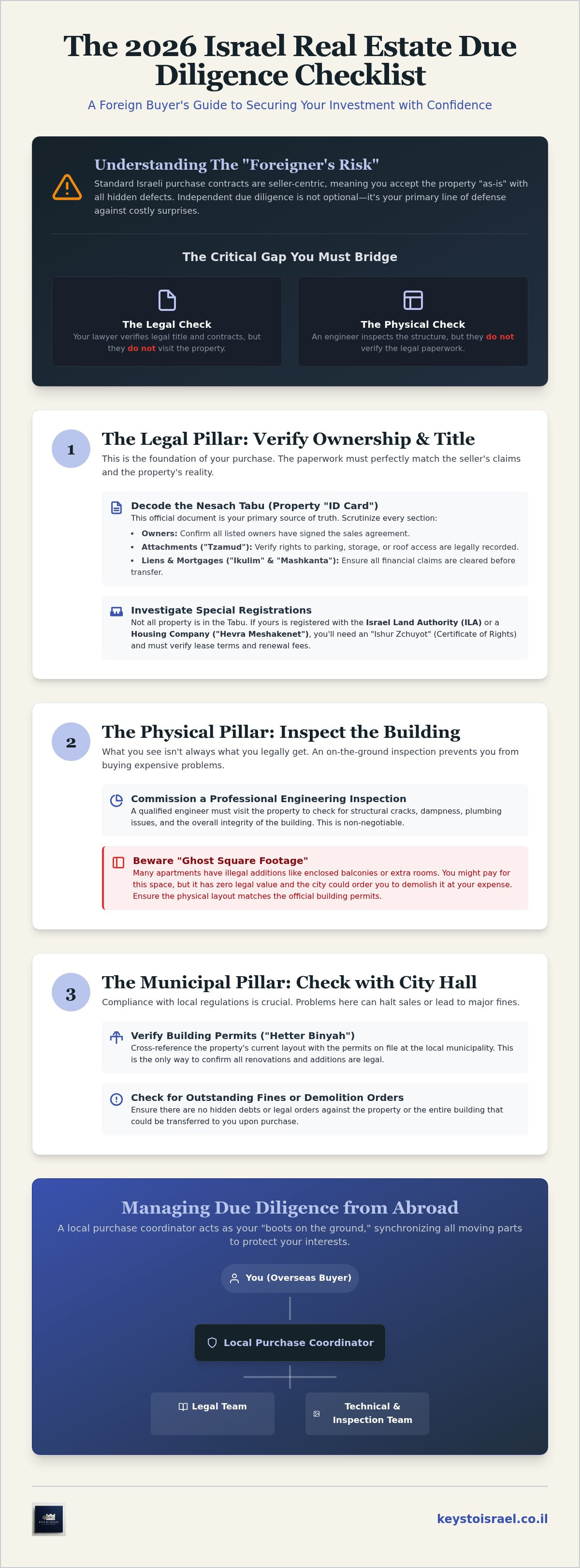
One of the most common misunderstandings for overseas buyers is the role of their Israeli lawyer. Your lawyer's job is to verify the legal title and ensure the contract is sound. However, they won't visit the property to check for dampness, structural cracks, or unpermitted renovations. They rely on Israeli land and property laws to confirm ownership, but they aren't engineers. This creates a dangerous gap between the paperwork and the actual building. A local coordinator bridges this divide by synchronizing the legal team with technical inspectors, ensuring that what you see in the sales pitch is what is actually recorded in the Nesach Tabu.
Risks of Skipping the Process
The consequences of cutting corners can be financially devastating. Without thorough Israel real estate due diligence, you might inherit ancient mortgages or undisclosed liens that prevent you from ever selling the property. Even worse is the "ghost square-footage" problem. Many Israeli apartments feature enclosed balconies or extra rooms that were built without a building permit. If you buy these without checking, you're paying full price for space that city hall could order you to demolish tomorrow. You might even find yourself responsible for building-wide demolition orders or municipal fines that were never mentioned during the property tour.
The Legal Pillar: Verifying Ownership and the Nesach Tabu
The Nesach Tabu is the fundamental "ID card" for any Israeli property. It provides a snapshot of the legal reality, which may differ significantly from what a listing agent promises. When performing Israel real estate due diligence, this document is your first stop. It confirms who owns the property, lists any existing mortgages, and identifies legal restrictions that could halt a sale. By 2026, while many of these records have moved online, interpreting the data still requires local expertise to ensure no details are lost in translation.
Decoding the Nesach Tabu
Reading this document requires a trained eye. You must verify the "Owners" section to ensure all listed parties have signed off on the sale. If a property was inherited, you'll need to see probate records to confirm the seller’s right to act. Another critical area is the "Tzamud" or attachments. This section lists specific rights to parking spots, storage units, or roof access. If it's not in the Tabu, you don't legally own it. You also need to look for "Ikulim" (liens) or "Mashkanta" (mortgages) held by banks. These must be cleared before any funds are transferred to the seller.
Special Registrations: ILA and Housing Companies
Not every property is registered in Israel's Land Registry (Tabu). Many properties, particularly on kibbutzim, moshavim, or in newer developments, are registered with the Israel Land Authority (ILA) or a "Hevra Meshakenet" (Housing Company). In these cases, you won't get a Nesach Tabu; instead, you'll receive an "Ishur Zchuyot" (Certificate of Rights). This certificate is equally important but follows different rules.
For ILA properties, you're often a "lessee" rather than a "freehold" owner. This is common in Israel, but you must check the lease expiration and any capitalization fees due for 2026 renewals. On February 15, 2026, the Israeli cabinet approved the resumption of land registration processes in specific regions, which adds a new layer of verification for buyers in those areas. If the registration is still with a Housing Company, it often indicates the building hasn't been fully parcelled yet. This adds complexity to your Israel real estate due diligence, as you must verify the developer's standing and ensure no "He’arat Azhara" (cautionary notes) exist that could block your future ownership. Managing these disparate registries from abroad is a logistical hurdle. Having a local representative to coordinate with the various authorities ensures no legal detail is missed while you're thousands of miles away.
Physical and Municipal Due Diligence: Beyond the Paperwork
Legal title is only half the battle. You can own a property legally while inheriting a structural nightmare or a municipal lawsuit. Comprehensive Israel real estate due diligence must extend to the physical walls and the city hall records. This is where many overseas investors stumble because they assume a clean title means a clean building. In the Israeli market, the physical reality often contradicts the official paperwork.
The Engineering Inspection (Bedek Bayit)
Buying a home without a private engineering inspection, known as a Bedek Bayit, is a recipe for financial disaster. Israeli buildings often hide significant issues behind fresh coats of paint. A professional engineer checks for structural cracks, water infiltration, and electrical safety. While OECD housing market data suggests a resilient economy, the granular reality of an individual building requires a much closer look.
Don't ignore the "invisible" costs. Plumbing systems in 20-year-old buildings are often reaching the end of their functional lifespan. Replacing internal pipes can cost tens of thousands of shekels and require tearing up expensive flooring. We coordinate vetted engineers for our remote clients, ensuring a detailed report reaches you before you commit. This physical verification ensures the price you pay matches the actual condition of the asset.
Municipal Verification and Zoning
The "Heter Bniya" (Building Permit) is your most important municipal document. You must ensure the current floor plan matches the city hall records exactly. If a previous owner enclosed a balcony or added a room without a permit, you become legally responsible for that violation the moment you sign. This can lead to heavy fines or orders to restore the property to its original state.
You also need to understand the "Hetal Hashbaha" (Betterment Levy). This is a tax triggered when the municipality approves a plan that increases the property's potential value. If there are unused building rights, the tax bill can be substantial. It's vital to determine whether the buyer or seller will cover this cost before signing the contract.
Finally, always check the "Taba" (Zoning Plan). You need to know if that empty lot next door is slated for a 20-story tower or if your building is a candidate for "TAMA 38" urban renewal. These factors drastically change the property’s future value and your quality of life. Verifying these municipal details ensures you aren't buying into a construction zone without your prior knowledge.
The Ultimate 2026 Israel Real Estate Due Diligence Checklist
Moving from theory to action requires a structured approach. Performing Israel real estate due diligence isn't a single event but a series of phases designed to eliminate risk at every level. By following this 2026 checklist, you ensure that no legal lien, structural defect, or tax liability goes unnoticed before your funds leave your account. This methodical process provides the transparency needed to invest with confidence from abroad.
Pre-Contract Legal Checklist
Your lawyer will handle the heavy lifting, but you must verify that these specific items are addressed. A "clean" title from last month isn't enough in a fast-moving market where new liens can appear overnight.
Obtain a fresh Nesach Tabu: Ensure the document is less than 24 hours old before you sign the contract to catch any last-minute changes.
Confirm no "Ikul" or "Tzav": Verify that no new attachments (liens) or court injunctions have been placed on the property by creditors.
Verify the "Tashrit": Request the official building map from the registry to confirm the apartment's legal boundaries match the physical walls you've seen.
Physical & Municipal Checklist
Physical checks prevent you from inheriting the seller's illegal building choices. These steps bridge the gap between what's on paper and what's actually standing on the ground.
Schedule a Bedek Bayit: Get a professional engineering report to identify structural issues, leaks, or aging systems that require immediate repair.
Review the "Tik Binyan": Request the building file from the municipality to check for past violations or pending demolition orders.
Check "Ishur Iriya" status: Confirm there are no outstanding municipal debts that could block the eventual transfer of title in the Tabu.
Investment & Tax Checklist
The financial reality of 2026 requires precise budgeting. For foreign buyers, the purchase tax remains a significant factor. As of early 2026, non-residents face a tax rate of 8% on the first 6,055,070 NIS, jumping to 10% for any amount above that threshold. This rate is currently set to remain in effect through December 31, 2026.
You must also ensure that the bank's appraisal, or "Shama’ut," aligns with your purchase price. If the appraiser values the property lower than your contract price, you'll need to cover the difference in cash. For a full breakdown of these costs, consult our Israel Property Purchase: 2026 Overseas Investor Guide. Managing these moving parts from abroad is complex, but you don't have to do it alone. You can work with a local purchase coordinator to have a seasoned ally manage this entire checklist on your behalf.
Managing Due Diligence from Abroad: The Coordination Advantage
Managing Israel real estate due diligence from places like New York, Miami, or Toronto presents a unique set of logistical hurdles. The 7-hour time difference means your business day is just beginning when Israeli professional offices are winding down for the evening. This geographical gap often leads to communication delays that can stall a transaction or, worse, force you to make rushed decisions without all the facts. For high-stakes investments, you need a local proxy who operates in the same time zone as the property to ensure nothing is missed.
The Problem with Fragmented Service
In a typical transaction, services are often siloed. Your lawyer reviews the contract, while your engineer inspects the structure. These professionals rarely communicate with each other, which leaves dangerous gaps in your protection. If an inspector finds a structural leak, your lawyer needs to know immediately to adjust the escrow terms or the final price in the contract. Without a coordinator to bridge this gap, critical information gets lost in translation between different firms and bureaucracies. We act as your single point of contact, ensuring that every specialist is working from the same set of facts.
How We Protect Your Investment
Our role as your local ally begins with vetting the right professionals for your specific needs. We don't just find an inspector; we coordinate with specialists who understand the nuances of 2026 Israeli building standards and municipal codes. We manage the entire timeline to ensure all Israel real estate due diligence is finalized before you sign a "Zichron Devarim" or any binding purchase agreement. This protective advocacy ensures you never commit funds to a property with hidden legal or physical liabilities.
We provide remote investors with total transparency through high-definition video walkthroughs and secure digital document rooms. You'll see the exact condition of the plumbing and the specific notations in the municipal file as if you were standing in Jerusalem or Tel Aviv yourself. Once the acquisition is secure, our support continues through the post-purchase phase. We move seamlessly from coordinating your due diligence to renovation management, ensuring your new asset is optimized for the local market and protected for the long term.
Take the Next Step Toward Your Israeli Property Goals
Investing in a foreign market doesn't have to be a gamble. By verifying the Nesach Tabu, performing a professional engineering inspection, and confirming municipal permits, you eliminate the "Foreigner's Risk" that catches many off guard. Successful Israel real estate due diligence requires more than just reading a contract; it demands a local presence that can bridge the geographical gap and synchronize your legal and technical teams effectively.
If you're managing this process from New York, Toronto, or Miami, you don't need to struggle with time zones or fragmented services. We act as your single point of contact for all Israeli professionals, providing a vetted team of engineers and legal coordinators who specialize in high-stakes overseas transactions. You deserve the peace of mind that comes with knowing your investment matches the legal and physical reality on the ground. Our team ensures that every detail is checked, every risk is mitigated, and every transaction is transparent.
Secure your Israeli investment with expert local coordination. Your future property in Israel is a significant milestone, and with the right ally, you can acquire it with absolute confidence.
Frequently Asked Questions
What is the most common mistake foreign buyers make during due diligence in Israel?
The most common mistake is assuming that a lawyer's legal review covers the physical condition of the property. Many foreign investors skip the engineering inspection, only to discover structural issues or illegal building additions after the sale. Comprehensive Israel real estate due diligence must include a "Bedek Bayit" to verify that the apartment is structurally sound and that all square footage is legally permitted by the local municipality.
Does the real estate agent perform the due diligence for me?
No, a real estate agent does not perform due diligence for you. Their primary role is to facilitate the search and negotiation; they often represent the seller's interests as well. Due diligence is an independent process that requires a specialized team, including a lawyer for title verification and a private engineer for physical inspections. Relying on an agent for these checks creates a significant conflict of interest.
How much does a full due diligence report cost in Israel?
The cost of a full due diligence process varies because it involves multiple independent professionals. You'll typically pay separate fees for a legal title search, a professional engineering report (Bedek Bayit), and a municipal records review. While these expenses add to your initial budget, they are a fraction of the cost of repairing a major structural defect or paying off an inherited municipal lien discovered after closing.
How long does the due diligence process typically take?
You should expect the entire process to take between two and four weeks. While a Nesach Tabu can be pulled instantly online, obtaining a "Tik Binyan" from the municipality or scheduling a vetted engineer for an on-site inspection takes more time. Coordination is key during this window to ensure all reports are synchronized and reviewed before you reach the final contract signing stage.
Can I sign a preliminary agreement (Zichron Devarim) before due diligence?
You should never sign a Zichron Devarim before completing your due diligence. In Israel, this "preliminary agreement" is a legally binding contract that can commit you to the purchase before you've verified the property's legal or physical status. Signing one prematurely can lead to heavy financial penalties if you later try to back out due to defects discovered during a late-stage Israel real estate due diligence review.
What happens if the physical inspection finds a major defect?
If a major defect is discovered, you have the option to renegotiate the purchase price or walk away from the deal entirely. Discovering a structural issue or an unpermitted addition provides critical leverage during the negotiation phase. You can request that the seller repairs the issue before closing or ask for a price reduction that covers the cost of bringing the property into legal and physical compliance.
Is the Nesach Tabu enough to prove ownership in 2026?
The Nesach Tabu is a vital document, but it isn't always enough to prove ownership in 2026. While it covers properties registered in the Land Registry, many Israeli homes are still recorded with the Israel Land Authority (ILA) or a private Housing Company. In these cases, you must obtain an "Ishur Zchuyot" to verify the seller’s rights. A thorough check involves cross-referencing all relevant registries to ensure the title is clear.
Do I need a separate appraisal if I am not taking a mortgage?
Yes, you should commission a private appraisal (Shama’ut) even if you aren't taking a mortgage. A professional appraiser provides an unbiased valuation based on recent market data and the property's legal status. This ensures you aren't overpaying based on a seller's inflated asking price. It also confirms that the apartment’s value aligns with its legal permits, protecting your equity from day one of the investment.


Comments