
Israel Group Property Purchase: The Negotiation and Legal Guide

Updated: 4 days ago
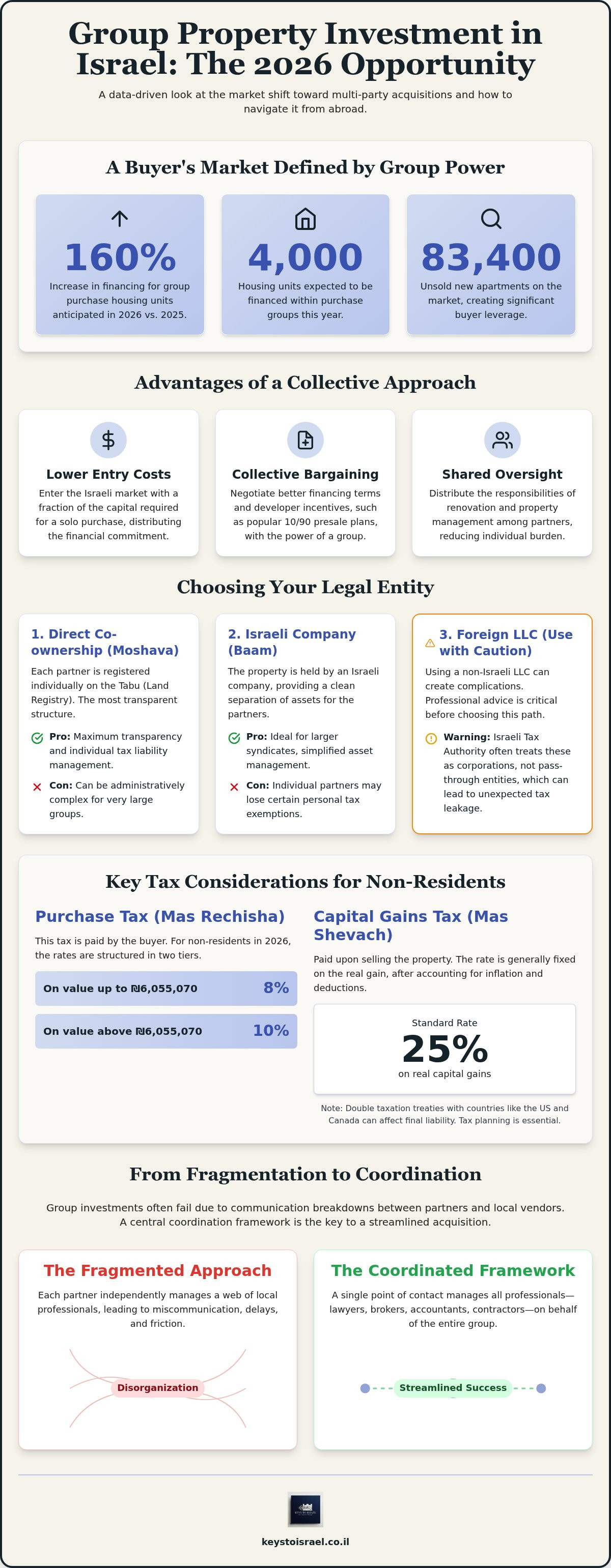
Financing for approximately 4,000 housing units within purchase groups is anticipated in 2026, representing a 160% increase compared to 2025. This surge comes as 83,400 unsold new apartments sit on the market, creating the strongest buyer's window in over a decade. While the opportunity is clear, coordinating multiple stakeholders from abroad often feels like a full-time job you didn't ask for. You're likely balancing concerns about Israeli tax treatment for foreign LLCs and the friction of managing banks and lawyers across time zones. Using specific group real estate negotiation strategies Israel buyers trust can turn this logistical headache into a streamlined acquisition.
We understand that without a local network, multi-party acquisitions feel risky. This guide provides a clear framework to help you secure legal title and minimize tax exposure. You'll learn how to align your partners, navigate the current 8% to 10% purchase tax brackets, and implement a management process that protects your assets long after the keys are in hand. Our goal is to ensure your investment in the land remains a source of stability rather than a source of stress.
Table of Contents
The Rise of Group Property Acquisitions in Israel: 2026 Market Trends
The 2026 market is defined by a significant shift in how overseas investors approach the Holy Land. Data indicates a 15 percent increase in multi-party purchases by diaspora groups over the last two years. This trend is accelerating. Financing for approximately 4,000 housing units within purchase groups is anticipated this year; this is a 160 percent jump from 2025. With 83,400 unsold new apartments currently on the market, groups are pooling resources to secure assets that were previously out of reach for individual buyers.
Individual investors often find the current 8 percent purchase tax on properties up to ₪6,055,070 a high barrier to entry. By forming a collective, you can access higher-yield commercial or residential assets while distributing the tax burden and maintenance costs. This approach allows for shared risk in a market that has seen prices decline for nine consecutive months. Understanding the Israeli property law framework is essential; it dictates how these groups are registered and managed. Implementing effective group real estate negotiation strategies Israel requires a local ally who understands these legal shifts and can coordinate between multiple stakeholders.
Why Investors Are Choosing Group Structures Now
The primary driver is capital efficiency. Most overseas buyers don't want to tie up all their liquidity in a single foreign asset. Group structures offer three distinct advantages:
Lower entry costs: You can enter the Israeli market with a fraction of the capital required for a solo purchase.
Collective bargaining: Groups can negotiate better financing terms and developer incentives, such as the popular 10/90 presale plans.
Shared oversight: You aren't the only one chasing contractors; the responsibility for renovation and management is distributed among the partners.
This model bridges the gap between wanting a stake in Israel and the practical hurdles of long-distance ownership. It allows for a diversified portfolio while maintaining a tangible connection to the land.
Evaluating Legal Entities: LLCs, Partnerships, and Co-ownership
Choosing the right legal structure is a central part of group real estate negotiation strategies Israel buyers must get right. You have three main options. Direct co-ownership, known as Moshava, involves registering each individual partner on the Tabu (Land Registry). This offers maximum transparency and allows each person to manage their own tax liability. However, for larger syndicates, an Israeli company (Baam) provides a cleaner separation of assets. Be careful with foreign LLCs; the Israeli Tax Authority often treats these as corporations rather than pass-through entities, which can lead to unexpected tax leakage.
Regardless of the entity, you need a detailed Heskem Shituf (Group Agreement). This document defines how decisions are made and how partners can exit the investment. It covers what happens if one person wants to sell or if there's a disagreement on renovation costs. Without this, you're relying on general law, which doesn't account for the unique needs of diaspora investors. Since most land is managed by the Israel Land Authority, your agreement must align with local regulatory standards to ensure a smooth registration process.
Tax Implications for Non-Resident Groups
In 2026, non-residents face a Purchase Tax (Mas Rechisha) of 8% on values up to ₪6,055,070 and 10% above that. If you buy through an Israeli company, the entity pays these rates, but individual partners may lose personal exemptions. Capital Gains Tax (Mas Shevach) is generally 25% on real gains. US and Canadian investors should look closely at double taxation treaties to ensure they don't pay twice. You can find more details in our Israel Real Estate Legal Guide. Implementing these group real estate negotiation strategies Israel requires careful tax planning before signing any contracts. If you aren't sure which path fits your group, see how it works with a local coordinator.
Strategic Negotiation for Investment Groups: The Coordination Framework
Buying with a group increases your leverage, but it also multiplies the potential for friction. Most investment groups fail not because the asset is poor, but because communication between several partners and a dozen local vendors becomes fragmented. Without a structured coordination framework, you'll find yourself stuck in a loop of chaser emails and missed deadlines. Implementing effective group real estate negotiation strategies Israel requires a single point of contact who manages the flow of information so no individual investor is left chasing the lawyer or mortgage broker.
Local representation is not optional. You need someone on the ground to physically inspect properties and verify that a building actually has a mandatory MAMAD (security room) before you sign. Once the purchase is complete, the coordination continues. You need clear protocols for renovation management and rental income distribution to avoid disputes. This level of oversight ensures your group moves from buying to improving and managing without the typical overseas owner's anxiety.
Assembling the Professional Team
Your team must be capable of handling the complexity of multi-party contracts. This starts with a lawyer who understands cross-border group structures and continues with an appraiser who uses current 2026 market data to ensure you aren't overpaying. Finally, you need a mortgage broker experienced in multi-borrower applications for foreign residents. Our 2026 Overseas Investor Guide provides a deeper look at the financing landscape. To see how we assemble this team for you, get in touch to discuss your group's goals.
Executing Your Group Investment with Keys to Israel
Keys to Israel serves as the single point of contact for your entire investment group. We don't just facilitate a transaction; we manage the full lifecycle of your investment. This includes assembling the legal and financial team discussed in previous sections and executing specific group real estate negotiation strategies Israel buyers need to navigate the 2026 market. You don't have to worry about the language barrier or the stress of chasing vendors across different time zones. We coordinate the lawyer, accountant, and contractor so you can focus on the strategic goals of your collective.
From Purchase to Management
Once the acquisition is finalized, the work of improving and maintaining the asset begins. We manage the renovation process for group-owned properties to ensure local standards are met without you needing to be on-site. You can read our Remote Management Guide for specific details on how we handle local oversight. Our approach to property management for overseas owners provides transparency and regular reporting for all partners. This ensures that every member of the group stays informed about maintenance schedules and rental income distribution.
Investing in Israel is a pragmatic financial move. With the Bank of Israel interest rate at 3.25% as of September 2026, the market is positioned for those who take a long-term view. However, owning property here is more than just a line item on a balance sheet. It's a commitment to a shared heritage and a tangible stake in the future of the land. By securing an asset today, you're building a foundation for the next generation and maintaining a connection to the homeland that transcends market cycles. Talk to us to see how we can coordinate your group purchase strategy.
Securing Your Collective Future in Israel
Managing a multi-party acquisition from abroad requires a local ally who can unify your vision. You've seen how to evaluate legal entities like the Baam or Moshava and how current 2026 tax brackets impact your bottom line. By applying specific group real estate negotiation strategies Israel investors trust, you can bypass developer margins and secure assets that would be unattainable alone.
At Keys to Israel, we provide the steady hand needed to bridge the geographical gap. Our team offers specialized group negotiation services and coordination of vetted legal teams to ensure your interests are protected at every stage. As overseas property management experts, we stay with you long after the purchase is complete. Building an investment portfolio in Israel is a profound act of resilience and a commitment to our shared heritage. It's a way to ensure your family's connection to the land remains strong for generations. Talk to us about your group purchase plans to see how it works.
Frequently Asked Questions
Can we buy property in Israel through a US-based LLC?
Yes, you can buy through a US-based LLC, but it often triggers complex tax issues. The Israeli Tax Authority typically treats foreign LLCs as corporations rather than pass-through entities. This can lead to double taxation on rental income and capital gains. Most investors find that registering an Israeli company or using direct co-ownership on the Tabu is more efficient. We coordinate with tax specialists to ensure your group chooses the most stable entity.
What is a Heskem Shituf and why does our group need one?
A Heskem Shituf is a legally binding Group Agreement registered with the Land Registry. It's essential because it defines exactly how your group makes decisions, manages renovation costs, and handles rental distributions. Without one, you're governed by general law, which doesn't address the specific needs of overseas partners. Using specific group real estate negotiation strategies Israel experts recommend ensures this document covers every potential dispute before it happens.
How is Purchase Tax calculated for a group of non-residents in 2026?
For 2026, the Purchase Tax for non-residents is 8% on the property value up to ₪6,055,070 and 10% on any amount above that. If you buy through an Israeli company, the entity pays these rates. If you use direct co-ownership, each member's share is assessed. These rates are frozen through the end of 2027. We coordinate with accountants to calculate the exact exposure for each member of your group.
Do all group members need to be present in Israel to sign the contract?
No, you don't need to be physically present in Israel to sign the purchase contract. Each group member can sign a Power of Attorney (POA) at an Israeli consulate in their home country or before a local notary with an apostille. This allows your local lawyer to sign on your behalf. We manage the coordination between your group and the legal team to ensure all documents are processed correctly from abroad.
What happens if one member of the group wants to sell their share?
The process for selling a share is dictated by your Heskem Shituf. Most agreements include a right of first refusal, allowing existing members to buy the share before it's offered to outsiders. If no one buys it, the member can sell to a third party, provided they agree to the original group terms. This ensures the stability of the investment and prevents unknown parties from joining the group without consent.


Comments