
Guide to Israeli Property Appraisal Reports for Buyers

Updated: Sep 25
In Israel, a property appraisal is less of a price tag and more of a legal forensic audit. For foreign buyers, total closing costs can climb as high as 20% of the purchase price, so learning how to read an israeli property appraisal report is essential. You've likely found a home you love, but now you're staring at a 20 page Hebrew document called a Shuma. It's natural to worry if the square meters you're buying are legally registered or if you're accidentally inheriting a building violation.
We'll help you master the technicalities of this report to ensure your investment is legally sound and accurately valued. You'll learn to verify the market value against the asking price and confirm the property's status in the land registry. We're going to break down the document section by section, from identifying hidden irregularities to understanding the confusing gap between net and gross area. This is how you move forward with the confidence of a local.
Table of Contents
The Role of the Shuma in Your Israeli Property Purchase
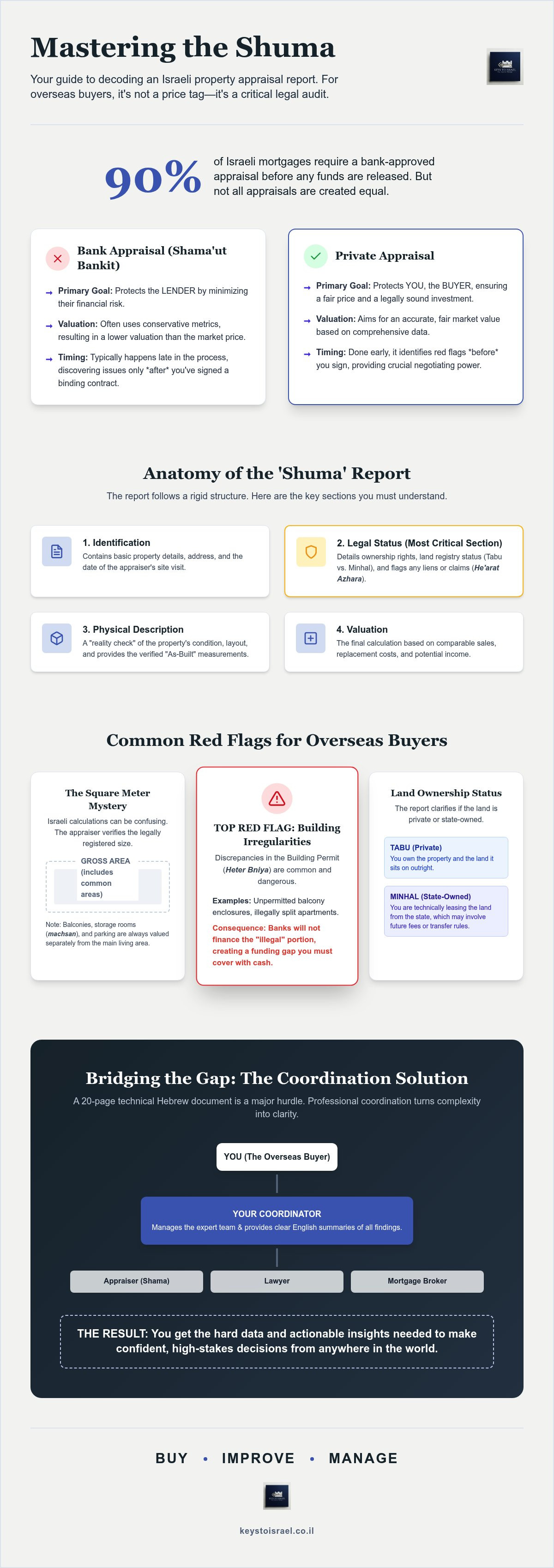
In Israel, the appraisal report, or Shama'ut, is the cornerstone of your due diligence. Roughly 90 percent of Israeli mortgages require a bank-approved appraiser to verify the property's value before any funds are released. This isn't just a suggestion; it's a mandatory step for the lender to mitigate risk. A Shama is a highly trained, licensed professional regulated by the Ministry of Justice. This oversight ensures that Real estate appraisal in Israel follows strict legal and valuation standards. Learning how to read an israeli property appraisal report allows you to see the property through the eyes of the law rather than the marketing of a broker.
Why a Bank Appraisal Might Not Be Enough
A Shama'ut Bankit (Bank Appraisal) primarily serves the lender's protection. If the bank's appraiser finds an issue, their goal is to lower the loan amount to protect the bank's capital, not to help you negotiate or fix the deal. Bank valuations frequently come in lower than the actual market price because they use conservative metrics. If you only rely on the bank's report, you might discover "irregularities" like illegal construction only after you've already signed a binding contract. Hiring a private appraiser early ensures someone is looking out for your specific financial interests.
The Language Barrier and the Coordination Solution
Most appraisal reports are 20-page technical documents written in dense Hebrew. For overseas buyers, deciphering these legal terms without local help is nearly impossible. This is where professional coordination becomes vital. Instead of chasing a Shama for answers you can't understand, a coordinator manages the professional team and provides a clear English summary of the findings. You get the hard data you need to confirm the property's value without getting lost in the translation. This approach bridges the geographical gap and ensures you aren't making high-stakes decisions based on guesswork.
Decoding the Key Sections of an Appraisal Report
Standard reports follow a rigid structure regulated by the Ministry of Justice. When you're learning how to read an israeli property appraisal report, you'll notice the document moves from high level identification to granular legal and physical audits. The structure typically includes:
Identification: Basic property details and the date of the site visit.
Legal Status: The most critical section, detailing ownership rights and encumbrances.
Physical Description: A reality check of the property's condition, layout, and actual size.
Valuation: The final calculation based on comparable sales, replacement costs, and potential income.
The Physical Description is particularly vital because it often contradicts the glossy marketing brochures. While an agent might quote a size based on a rough estimate, the appraiser provides a verified "As-Built" measurement that the bank will actually lend against.
Understanding Land Ownership (Tabu vs. Minhal)
The report identifies whether the land is private (Tabu) or state-owned (Minhal). If the land is state-owned, you're technically leasing it, which may involve future fees or specific transfer rules. The appraiser ensures the Nonsach Tabu (Title Deed) matches the physical reality of the apartment. Look closely for He'arat Azhara (Cautionary Notes). These notes indicate if another party has a claim or if there's a mortgage that must be cleared before the sale.
The Mystery of Israeli Square Meters
Square meter calculations in Israel are notoriously confusing for foreign buyers. "Net" area refers to the actual living space inside your walls, while "Gross" area often includes a portion of the building's shared hallways and stairwells. The appraiser compares the physical measurements with the area registered in municipal tax records. Discrepancies here often signal unpermitted additions. Components like balconies, storage rooms (Machsan), and parking spots are always calculated separately to avoid price inflation. If these technicalities feel overwhelming, you can see how it works when a professional team handles the coordination for you.
Identifying Red Flags and Construction Irregularities
In Israel, "irregularities" are common but dangerous. The top red flag in any report is a discrepancy in the Heter Bniya (Building Permit). If the seller enclosed a balcony or split a large apartment into two smaller units without a permit, the appraiser will flag it. Banks typically refuse to finance the "illegal" portion of the property. When you're learning how to read an israeli property appraisal report, you'll see these areas valued at zero or significantly discounted. This creates a funding gap you must cover with cash.
You should also look for the Mimmush Mahir (Forced Sale) value. This figure represents what the property would fetch in a quick, bank-mandated sale. It is always lower than the market price. This metric is a sobering but necessary reality check for your actual equity.
Common Legal Pitfalls in Older Buildings
Older properties often come with TAMA 38 potential. While this can increase future value, it often triggers a Betterment Tax (Hetal Hashbaha). The appraiser will note if this tax is due upon the sale. You also want to check the Zchuyot Bniya (Remaining Building Rights). Knowing if you can legally add a room or a rooftop terrace in the future is vital for long-term appreciation.
How to Read the Appraiser's Final Conclusion
The final estimate isn't just a number; it's often tied to specific "Conditions." If the appraiser finds a violation, they might set a condition that the seller must legalize the addition before the mortgage is approved. Understanding these conditions is a major part of how to read an israeli property appraisal report before you commit your capital. For a deeper dive into the legalities, check our Israel Real Estate Legal Guide for Overseas Investors. If you want to avoid these traps, get in touch to see how we coordinate the process.
Taking Action on Your Appraisal Findings
Once you've mastered how to read an israeli property appraisal report, you'll have the leverage needed to finalize your acquisition. With purchase tax rates for foreign buyers frozen at 8% up to 6,055,070 NIS through 2026, every shekel in the valuation counts toward your total closing costs. To see how the price you pay shapes your returns, read what Israel's 3.4% rental yields actually mean. If the appraisal is lower than the asking price, you have a data-backed reason to renegotiate. If irregularities are found, your lawyer uses the report to demand the seller rectify issues or lower the price to cover future legalization costs. Effective coordination ensures these professionals work together rather than leaving you to bridge the gaps yourself.
The Value of Professional Coordination
Keys to Israel acts as your local advocate, managing the appraiser and lawyer as a single team. You shouldn't have to spend your nights chasing Hebrew-speaking vendors or trying to translate technical jargon. This integrated approach is detailed in our Israel Property Purchase: 2026 Overseas Investor Guide. Having a steady hand on the ground provides the transparency you need when managing a high-stakes transaction from thousands of miles away. We handle the logistical friction so you can focus on the strategic outcome.
Securing Your Future in Israel
An appraisal isn't just an administrative hurdle; it's the foundation of a safe return home. Whether you're planning Aliyah or simply strengthening diaspora ties, history shows that owning property in the homeland is a long-term anchor of resilience. By verifying every square meter and legal detail now, you're protecting your family's legacy for generations. It's about more than a financial transaction; it's about establishing a permanent, secure connection to the land. Talk to us to start the process with a team you can trust.
Moving Forward with Your Israeli Property Investment
Buying a home in Israel shouldn't feel like a gamble. By now, you understand that the Shuma report is a forensic audit designed to protect your equity from illegal construction and valuation gaps. Mastering how to read an israeli property appraisal report gives you the leverage to negotiate with confidence; it ensures the property's legal status is airtight before you commit your capital. This document is your primary defense against the common irregularities found in the local market.
You don't have to navigate these complex Hebrew documents or manage multiple vendors alone. Keys to Israel provides expert coordination of appraisers and lawyers, bringing deep local knowledge of Israeli land law to your side. We act as your dedicated local advocate, specifically serving overseas Jewish investors who need a steady hand on the ground. Talk to us about your property search to see how we can secure your piece of the homeland with precision. We're ready to help you build your future in Israel with transparency and professional care.
Frequently Asked Questions
How much does a private property appraisal cost in Israel in 2026?
A private appraisal for a standard residential property typically ranges from 3,000 to 6,000 NIS plus 18% VAT. This fee varies based on the property's size and complexity. While bank-mandated reports are often cheaper because of pre-negotiated rates, a private report is far more comprehensive. It acts as a legal forensic audit that identifies potential pitfalls before you commit your capital to a binding contract.
Can I use the same appraiser for my bank and my private due diligence?
You can hire an appraiser from your bank's approved list to conduct your private due diligence, but the two reports serve different interests. A bank report focuses on the lender's risk and conservative valuation. A private report focuses on your protection. It's often best to have your private appraiser finish their work first. This lets you resolve any technical irregularities before the bank's assessment limits your mortgage.
What happens if the appraisal value is lower than the price I agreed to pay?
If the appraisal is lower than the purchase price, the bank will only provide a mortgage based on that lower figure. This creates a funding gap you must cover with extra cash. Understanding how to read an israeli property appraisal report helps you see if the low value is due to illegal construction. You can then use these facts to renegotiate the final price or demand the seller fix the issues.
Is the appraisal report written in English or Hebrew?
Official appraisal reports are written in Hebrew and use dense technical language regulated by the Ministry of Justice. For overseas buyers, this creates a significant barrier to understanding the property's true legal status. Our coordination service bridges this gap by providing you with a clear English breakdown of the appraiser's findings. You get the hard data and professional insights you need without having to translate the document yourself.
How long does it take to receive a completed appraisal report in Israel?
You can generally expect to receive a completed appraisal report within 5 to 10 business days after the site visit. The duration depends on the appraiser's ability to access municipal planning records and the complexity of the property's history. If there are missing building permits or registry discrepancies, the process might take longer. We manage this professional team to keep your due diligence on schedule with your contract requirements.


Comments