
Getting a Mortgage in Israel as a Foreigner: The 2026 Investor’s Guide

Updated: Sep 25
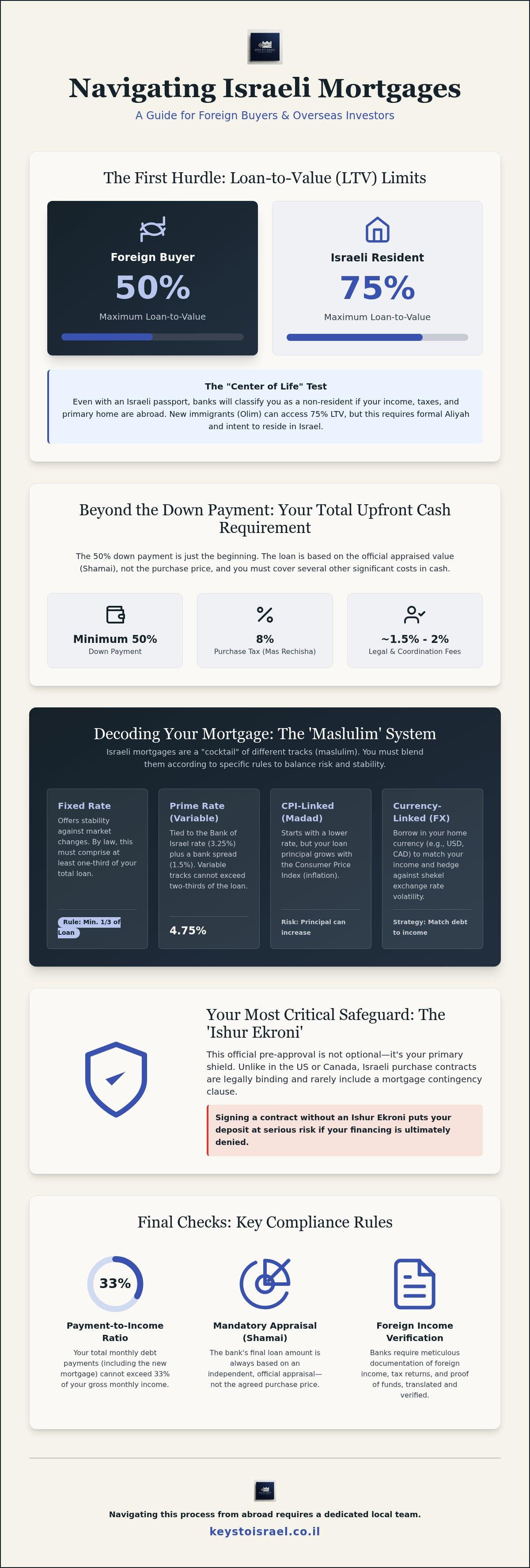
While Israeli residents can borrow up to 75% of a home's value, the Bank of Israel strictly caps your financing at 50% as a non-resident. When you add an immediate 8% purchase tax on properties up to 6,055,070 NIS, the financial entry point for overseas investors is significantly higher than for locals. You've likely realized that getting a mortgage in israel as a foreigner isn't just about finding a good rate; it's about navigating an opaque banking bureaucracy that doesn't always translate your foreign income or tax returns easily.
We understand that the distance makes these hurdles feel even taller. This guide will help you master the complexities of Israeli financing to secure your property investment with confidence and local expertise. You'll learn how to navigate the 2026 interest rate environment where the prime rate sits at 4.75% and the central bank is actively cutting rates. We'll unpack the "maslulim" mortgage track system, explain the total cost of capital, and outline a path to a seamless remote closing process that keeps you in control from abroad.
Table of Contents
Understanding Eligibility and Loan-to-Value (LTV) Limits for Non-Residents
The Bank of Israel sets strict boundaries on how much you can borrow based on your residency status. For those getting a mortgage in israel as a foreigner, the most critical number to remember is 50%. This is your maximum Loan-to-Value (LTV) ratio. In 2026, LTV represents the total percentage of the property's value that a bank will finance, with the remaining half coming from your own equity. These caps remain a cornerstone of the 2026 fiscal strategy to manage housing demand while maintaining a healthy banking sector.
Non-Resident vs. Israeli Citizen Living Abroad
Having an Israeli passport doesn't automatically qualify you for the 75% financing available to locals. Banks apply a "Center of Life" test to every application. If your income is earned in USD or CAD and your primary home is in Toronto or New York, you're a non-resident in the eyes of the credit department. To be treated as a resident, you must prove your life is centered in Israel through utility bills, school registrations, or tax filings. New immigrants (Olim Chadashim) can access up to 75% LTV, but this status requires formal Aliyah paperwork and a clear intent to reside in the country.
The 50% Down Payment Reality
The 50% rule is often more demanding than it looks on paper. Banks base their lending on the "Shamai" (appraisal) value, not necessarily the purchase price. If a surveyor values the apartment lower than your agreed price, the bank only covers 50% of that lower figure. You must also account for several additional costs that require immediate liquidity:
Purchase Tax (Mas Rechisha): 8% on the first ₪6,055,070 for foreign buyers.
Legal and coordination fees: Roughly 1.5% to 2% of the property price.
Currency exchange: Volatility between the Shekel and your home currency during the transfer process.
The current regulations aim to stabilize the market by ensuring foreign capital inflows are backed by significant personal equity. Getting a mortgage in israel as a foreigner requires a clear-eyed look at these liquidity requirements before signing a binding purchase contract.
Navigating the Israeli 'Maslulim': Mortgage Tracks and Interest Structures
Israeli mortgages aren't single-rate products. They're a "cocktail" of different tracks called maslulim. By law, you must keep at least one-third of your loan in a fixed-rate track. This regulation prevents your entire monthly payment from spiking if the market shifts suddenly. Recent mortgage trends for foreign residents show a growing preference for these blended structures to balance risk. Getting a mortgage in israel as a foreigner means deciding how much to link to the "Madad" (Consumer Price Index). While CPI-linked loans start with lower interest rates, your principal balance increases whenever inflation rises, which was 1.5% as of September 2026.
The Prime Track and Bank of Israel Benchmarks
The Prime track is the most common variable component. It's tied directly to the Bank of Israel policy rate, which currently sits at 3.25%. With the standard 1.5% bank spread, the Prime lending rate is 4.75%. Although the central bank made four rate cuts in 2026, commercial banks have been slow to pass these savings to borrowers. You can't put more than two-thirds of your loan into variable tracks; this ensures you maintain a buffer against potential future rate hikes.
Currency-Linked Tracks for Overseas Earners
For investors in New York or Toronto, borrowing in USD or CAD can be a smart hedge. If you earn in Dollars but your mortgage is in Shekels, a strengthening Shekel makes your monthly payment more expensive in your home currency. An FX-linked track allows you to match your debt to your income. It removes the volatility of the exchange market, though it often carries different interest structures than Shekel-based tracks. If you're unsure which mix fits your portfolio, see how it works when we coordinate with local mortgage experts on your behalf.
The Ishur Ekroni: Securing Your Pre-Approval Before Making an Offer
The Ishur Ekroni is more than a simple pre-approval; it's your primary shield in a fast-moving market. Unlike in the US or UK, Israeli purchase contracts rarely include a mortgage contingency clause. If you sign a binding agreement and your financing falls through, you face a "Hard Deadline" that usually carries a 10% penalty of the total property price. Getting a mortgage in israel as a foreigner requires having this document in hand before you sit at the negotiating table. It signals to the seller that you're a serious buyer with the necessary 50% equity ready for transfer.
Required Documentation for North American Buyers
Israeli banks maintain strict underwriting standards for foreign income. If you're based in New York or Toronto, you'll need to provide your last two years of W2s or T4s along with three months of pay stubs. Banks also pull a foreign credit report from Experian or Equifax to verify your debt-to-income ratio. Anti-Money Laundering (AML) compliance is equally critical. You must provide a clear, documented trail for your source of funds to satisfy Israeli banking oversight and ensure your capital can enter the country without delays.
The Step-by-Step Approval Timeline
The process moves in distinct phases. Gathering and submitting your documents usually takes one to two weeks. Once submitted, the bank typically issues the Ishur Ekroni within three to five days. This approval is generally valid for three months, though your specific interest rate lock might only last 24 days. Finalizing the loan involves a "Tiyul," which is the formal signing process. Since you're likely abroad, we coordinate this through a Power of Attorney. This allows your lawyer to sign locally on your behalf, keeping the transaction on track even if you aren't physically in the country.
Financial Compliance and Foreign Income Verification
Israeli banks prioritize your ability to repay over the collateral's value. When getting a mortgage in israel as a foreigner, you must meet the Payment-to-Income (PTI) threshold. While the Bank of Israel technically allows a PTI up to 50%, commercial lenders in 2026 almost always cap foreign borrowers at 33%. This means your total monthly debt obligations, including your home mortgage in London or New York, cannot exceed one-third of your net income. Lenders don't just look at the property; they look at your global financial profile to ensure stability.
The PTI (Payment-to-Income) Stress Test
Banks apply a safety margin by "discounting" your foreign income. If you earn in USD or CAD, a lender might only count 80% to 90% of your take-home pay to protect themselves against currency fluctuations. For self-employed investors in Montreal or Los Angeles, your CPA becomes a vital member of the team. They must provide a certified letter and audited financials that translate your business health into terms an Israeli credit officer understands. In 2026, the maximum PTI threshold for foreign borrowers remains strictly capped at 33% of net monthly income after accounting for global debt obligations.
AML Compliance and the Bank "Entry" Process
Satisfying the Anti-Money Laundering (AML) audit is often more complex than the mortgage itself. The logistical reality of getting a mortgage in israel as a foreigner involves more than just an approval letter. Israeli banks act as gatekeepers for the entire financial system. You must provide a "Source of Funds" trail that documents exactly how you earned your down payment, often going back several years. Your Israeli lawyer plays a central role here, verifying the flow of funds to ensure the bank accepts the transfer. We recommend using specialized currency transfer services rather than standard wire transfers to navigate these compliance layers efficiently. If the paperwork feels overwhelming, get in touch to see how we coordinate with accountants and lawyers to clear these hurdles for you.
Bridging the Gap: Coordinating Your Mortgage from Toronto, New York, or LA
Managing a cross-border transaction involves more than just signing papers. When you are getting a mortgage in israel as a foreigner, the time zone difference between North America and Tel Aviv can derail a closing. Banks operate on a Sunday-to-Thursday schedule. A missed email on a Friday morning in Toronto means waiting until Sunday for a resolution. This is why local representation is essential for the "Shamaut" (appraisal) process. An appraiser needs physical access to the property. Their valuation must align with your purchase price to maintain your 50% financing. We integrate this step into our Israel property purchase coordination to ensure no gaps exist between the bank's expectations and your contract obligations.
Using Power of Attorney (POA) for Remote Signings
You don't need to fly to Israel to sign your mortgage. Most banks accept a Power of Attorney (POA) executed at an Israeli consulate or through a local notary with an apostille stamp in cities like Miami or LA. However, a POA has limits. Some banks require you to personally sign specific account opening forms before the funds are released. We coordinate with your lawyer and mortgage broker to ensure all documents are in sync. This prevents missed payment dates that could trigger contract penalties.
The Keys to Israel Advantage
We serve as the central hub for the "Triangle" of the transaction: the buyer, the bank, and the lawyer. Our role is to oversee the appraisal and ensure the local team meets every bank requirement on time. Once the mortgage is secured and the keys are handed over, we facilitate the transition to property management Israel for overseas owners. Whether you need remote renovation management israel or long-term tenant oversight, we ensure your investment is managed with meticulous care. Getting a mortgage in israel as a foreigner is just the first step in a long-term investment lifecycle.
Securing Your Stake in Israel's Resilient Future
The 2026 market offers a clear window for investors who can navigate the 50% LTV cap and the 8% purchase tax. You've seen that success depends on more than just a low interest rate. It requires an Ishur Ekroni to protect your capital and a meticulous source of funds trail to satisfy Israeli banking oversight. Getting a mortgage in israel as a foreigner is complex; it's a logistical project that demands a local team to bridge the gap between your North American income and Israeli compliance standards.
We specialize in translating your W2, T4, or LLC profile for local lenders and coordinating the entire professional circle on your behalf. From initial pre-approval to the final remote signing, we ensure your interests are guarded. Talk to us to see how it works. Israel's history is one of remarkable resilience; owning a piece of it today is a powerful way to strengthen your connection to the homeland while the numbers still make the primary argument for your investment.
Frequently Asked Questions
Can a foreigner get a mortgage in Israel without an Israeli bank account?
No, you cannot secure financing without first opening a local Israeli bank account. The mortgage payments are debited monthly from this account via a standing order (Hora'at Keva). Opening an account as a non-resident involves strict compliance checks, including verifying your source of funds and tax residency. We coordinate with local bankers to streamline this process so your account is ready before the first mortgage drawdown.
What is the maximum age for a mortgage in Israel for non-residents?
Most Israeli banks require the mortgage term to end by the time the oldest borrower reaches age 75 or 80. If you are 60 years old, you might be limited to a 15 or 20 year term. This age limit impacts your monthly payment because a shorter term increases the principal repayment. Banks may also require older borrowers to provide additional life insurance coverage or a younger co-borrower to mitigate risk.
Do I need life insurance and building insurance to get an Israeli mortgage?
Yes, Israeli law requires both life insurance (Bituach Chayim) and building insurance (Bituach Mivneh) for all mortgage holders. The life insurance must cover the full loan amount and name the bank as the beneficiary. Building insurance protects the bank's collateral against fire or structural damage. These policies are usually paid monthly and are a prerequisite for getting a mortgage in israel as a foreigner to protect the bank's investment.
Can I use a US or Canadian mortgage to buy property in Israel?
No, you cannot use a foreign bank to place a mortgage directly on a property located in Israel. North American lenders don't have the legal mechanism to lien an Israeli asset. However, many investors choose to refinance a property in New York or Toronto to pull out equity for an Israeli purchase. If you need a loan secured by the Israeli property itself, you must work with a local Israeli lender.
How much are the closing costs for a mortgage in Israel?
Closing costs typically range from 10% to 12% of the property value for foreign buyers. This includes the 8% purchase tax, legal fees of 1% to 1.5%, and bank processing fees which are usually 0.25% of the loan amount. You must also budget for the mandatory Shamai appraisal and currency conversion fees. When getting a mortgage in israel as a foreigner, having these liquid funds ready is essential before signing.
Is it possible to refinance an Israeli mortgage later if rates drop?
Yes, you can refinance your mortgage if interest rates drop, but you must calculate the "Amalat Piraon Mukdam" (prepayment penalty). This fee compensates the bank for lost interest if current market rates are lower than your original rate. In 2026, with the Bank of Israel actively cutting rates, refinancing might become a viable strategy. We coordinate with mortgage brokers to help you determine if the long term savings outweigh the immediate penalties.
Can I pay off my Israeli mortgage early without penalties?
Early repayment depends entirely on which mortgage tracks (maslulim) you choose. Loans linked to the Prime rate can usually be paid off at any time without penalties. Fixed-rate tracks often carry fees if the current market rate is lower than your locked-in rate. Understanding these exit costs is a vital part of your initial strategy. We ensure your mortgage is structured to allow for flexibility if you plan to sell or pay down debt.
Does the bank require an Israeli co-signer for foreign borrowers?
No, Israeli banks do not typically require a local co-signer for foreign borrowers. As long as you meet the 50% LTV requirement and can verify your foreign income through tax returns or pay stubs, you can qualify independently. The bank's primary concern is your ability to service the debt from your home country. We help you present a clean financial profile to the bank's credit department to avoid unnecessary complications or guarantor requests.


Comments