
How to Expand Your Israel Property Portfolio from Abroad

Updated: 4 days ago
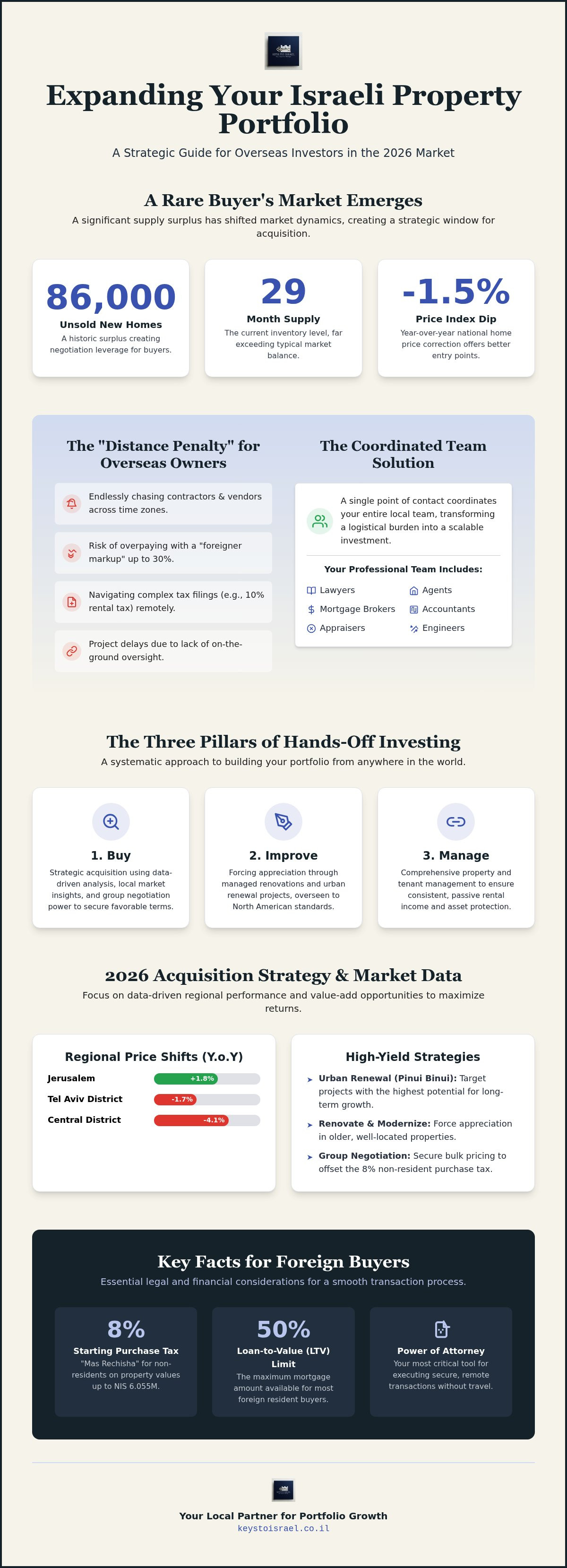
The 86,000 unsold new homes currently sitting on the Israeli market represent a rare, 29 month supply that has effectively shifted the power back to the buyer. While many investors hesitate due to a strengthening shekel or complex tax brackets, the current correction in the national home price index offers a strategic window for expanding Israel property portfolio from abroad. This surplus creates a unique opportunity to negotiate from a position of strength, provided you have the right oversight on the ground.
You likely already know that managing a single unit from New York, Toronto, or Los Angeles is a headache, let alone scaling to a multi-city portfolio. It is exhausting to chase contractors who overcharge or to worry if your 10% rental tax filing is accurate while you are asleep in a different time zone. The anxiety of navigating shifting local laws from thousands of miles away often stops good investments in their tracks.
This guide will show you how to build a hands-off investment vehicle that generates passive income without the logistical chaos. We will break down the 2026 tax landscape, the 50% LTV limits for foreign residents, and the exact roadmap for coordinating a local team that maintains your assets to North American standards.
Table of Contents
Scaling Your Real Estate Investments in Israel: Why Remote Management is the Key
The Israeli market in 2026 presents a logical contradiction. While headlines focus on geopolitical tension, the hard data reveals a buyer's market with 86,000 unsold new homes and a national price index that has dipped 1.5% year-over-year. For the savvy investor, this represents a calculated window for expanding Israel property portfolio from abroad. Scaling beyond a single legacy home requires moving from emotional acquisitions to a yield-focused collection.
Many overseas owners suffer from a "distance penalty." This is the real cost of project delays, poor contractor oversight, and the 30% markup often applied to foreign residents. Relying on a DIY approach is not a professional strategy. It leads to stalled renovations and stagnant rental income. Professional coordination ensures your assets are managed to high standards while you remain in your home time zone. You shouldn't have to spend your nights on WhatsApp chasing vendors who don't prioritize your timeline.
The Shift from Single Property to Portfolio
Your strategy for a third purchase cannot mirror your first. Successful expansion involves diversifying across regions to mitigate risk. While Tel Aviv saw a 1.7% price decrease, Jerusalem grew by 1.8%. Understanding the history of housing in Israel helps identify which hubs are resilient. You must trade emotional attachments for data-driven decisions on rental demand and urban renewal potential. Diversification ensures that a localized market dip doesn't paralyze your entire investment strategy.
The Role of Local Representation
A professional coordinator acts as your local advocate. We bridge the linguistic and cultural gaps that often derail Israeli business transactions. Instead of chasing five different vendors, you need a single point of contact. This model manages the lawyers, mortgage brokers, and contractors on your behalf. It transforms property ownership from a logistical burden into a scalable investment vehicle that respects your time and capital. It's about building a system where the "Buy. Improve. Manage." pillars function without your physical presence.
Strategic Acquisition Framework for the 2026 Israeli Market
The 2026 market is defined by a significant oversupply of new-build apartments. With 86,000 unsold units representing 29 months of supply, developers are more flexible than they have been in a decade. However, the impact of currency fluctuations on foreign buyers remains a hurdle, as the shekel trades around ₪2.90 to ₪3.06 against the US dollar. To succeed in expanding Israel property portfolio from abroad, you must focus on assets where you can force appreciation rather than relying on market timing alone.
Targeting High-Yield Locations
Data from June 2026 shows a bifurcated market. While the Central District saw a 4.1% price drop, Jerusalem grew by 1.8%. This shift suggests that luxury rentals in the capital and tech-driven hubs in the North remain resilient. Pinui Binui (urban renewal) projects offer the highest potential for portfolio growth. Alternatively, a "Renovate and Flip" strategy in older neighborhoods allows you to force appreciation by modernizing neglected units. See how it works by reviewing our current neighborhood forecasts.
Leveraging Group Negotiations
Individual buyers often lack the leverage to negotiate deep discounts with major developers. Group purchase negotiation changes this dynamic. By pooling interest with other diaspora investors, we can secure bulk-pricing terms and custom upgrades that are unavailable to the general public. This collective buying power is a primary tool for expanding Israel property portfolio from abroad while offsetting the higher 8% purchase tax for non-residents. We manage the entire coordination process, from initial vetting to the final contract, ensuring your remote due diligence is backed by local engineers and appraisers. This structural advantage is essential for scaling efficiently without the need for constant travel.
Navigating Legal and Tax Complexity from Abroad
Expanding Israel property portfolio from abroad requires a clear understanding of the 2026 tax environment. Foreign buyers face specific hurdles that local residents do not. For instance, the purchase tax (Mas Rechisha) starts at 8% for property values up to NIS 6,055,070 and climbs to 10% on the portion above that amount. These are not small numbers; they dictate your entry cost and overall ROI from day one.
A Power of Attorney (POA) is your most vital tool in this process. It allows your legal team to sign documents, register titles, and handle municipal requirements without you boarding a flight. We coordinate this by connecting you with lawyers who specialize in diaspora transactions. They ensure all paperwork is compliant with both Israeli law and your home country's regulations, keeping the process moving while you remain at home.
Closing the Deal Remotely
Managing international bank transfers is often where remote owners feel the most anxiety. Banks in Israel have strict anti-money laundering protocols that can freeze funds if not handled correctly. We work with mortgage brokers who understand foreign income streams and can navigate the 50% Loan-to-Value (LTV) limit for non-residents. This coordination ensures your capital moves safely from Miami or Toronto to the developer’s account on schedule.
Tax Compliance for the Overseas Landlord
Rental income tax for non-residents offers three main paths in 2026. You can choose a flat 10% rate on gross income, a progressive rate that allows for expense deductions, or seek an exemption if monthly rent is under NIS 5,654. Each choice impacts your net yield differently. Having an integrated coordination service means your accountant and lawyer are aligned. This prevents costly filing errors and ensures you are optimized for the 25% capital gains tax when you eventually sell. It is about building a secure foundation for expanding Israel property portfolio from abroad without the legal headaches.
Maximizing ROI Through Remote Renovation and Property Management
In a market where the national home price index has dipped 1.5% year-over-year, waiting for organic growth is a slow strategy. The fastest way to force appreciation when expanding Israel property portfolio from abroad is through strategic renovation. Older Israeli apartments often lack the modern finishings that high-yield tenants expect. By modernizing these spaces, you aren't just increasing rent; you are shielding your asset from the oversupply of 86,000 new-build units currently sitting on the market.
The primary risk for investors in New York, Toronto, or Los Angeles is the "remote-blind" markup. Local contractors often add a 30% premium when they realize an owner isn't physically present to inspect the work. You need a system that enforces North American standards of quality and timeline management without you having to board a flight. This ensures that your capital is used efficiently rather than being drained by poor oversight.
Managing Renovations from 6,000 Miles Away
Success depends on vetted contractors and strict milestone tracking. We use local oversight to ensure that what was promised in the quote is what appears in the apartment. Budget control is about more than just costs; it is about preventing the "scope creep" that leads to spiraling expenses. By having professional representation on the ground, you eliminate the linguistic and cultural gaps that lead to expensive misunderstandings. This allows you to scale your holdings with the confidence that each unit meets a consistent standard of excellence.
Full-Cycle Property Management
Once the renovation is complete, the focus shifts to yield optimization. Short-term rentals can offer higher gross returns, but they require intensive management. Long-term rentals, which saw a 3.2% price increase in the last year, provide more stability for a hands-off portfolio. We handle the security checklists, tenant screening, and regular inspections so your property remains an asset rather than a liability. Talk to us to see how we manage the day-to-day logistics for overseas owners.
Keys to Israel: Your Local Partner for Portfolio Growth
Building a successful collection of assets requires more than just capital; it requires an operational ecosystem. Keys to Israel operates on a Lifecycle Management model that handles every stage of the investment process. We aren't brokers looking for a quick commission. We are your local eyes and ears in Jerusalem, Tel Aviv, and Haifa. Our role is to assemble and manage your professional team so you never have to chase a lawyer or a contractor from a different time zone.
The Keys to Israel Advantage
The benefit of our model is a single point of contact for all purchase and management needs. We conduct personalized property evaluations based on your specific ROI goals rather than emotional appeals. Our vetted contractor network ensures that renovations meet high standards without the 30% "foreign owner" markup. We treat your investment with the same protective advocacy we apply to our own assets, ensuring long-term stability and growth.
Start Expanding Your Portfolio Today
If you already own property, we can link your current holdings into our managed system to improve efficiency. Investors from New York and Toronto have successfully used this framework to scale from a single unit to multi-city portfolios. The first step is to schedule a portfolio strategy session to identify high-yield opportunities in the 2026 market. Get in touch to see how it works and begin the process of expanding Israel property portfolio from abroad with a steady hand on the ground.
Israel has always been a market defined by historical resilience. Beyond the numbers and the 3.2% rental growth, owning land here is about a deep connection to the homeland. Whether you are planning for Aliyah or strengthening diaspora ties, we ensure your presence in Israel is secure and professionally managed. Talk to us to start building your legacy in the land that has always stood firm.
Secure Your Stake in the 2026 Israeli Market
The record surplus of 86,000 unsold homes creates a tactical window for investors who can navigate the 50% LTV limits and 2026 purchase tax brackets. Success in expanding Israel property portfolio from abroad isn't just about finding the right unit; it's about building an operational ecosystem that handles renovations and management without your physical presence. You don't have to chase contractors or worry about tax compliance from a different time zone when you have a steady hand on the ground.
Schedule your Israel property portfolio strategy session with Keys to Israel to leverage our expert local coordination for NY, Miami, and Toronto investors. We provide comprehensive management from purchase to renovation and rental, backed by deep expertise in the 2026 Israeli regulatory landscape.
Building a legacy in Israel is a long-term commitment to historical resilience and personal connection. With the right team, you can grow your holdings securely while staying focused on your life at home. Get in touch today to see how we can protect and grow your assets in the land that has always stood firm.
Frequently Asked Questions
Can I really buy property in Israel without being there in person?
Yes, you can complete the entire acquisition process remotely by granting a Power of Attorney to a local lawyer. This legal instrument allows your representative to sign contracts and register titles while you remain in your home country. By coordinating with a dedicated management partner, you can handle search, due diligence, and closing without boarding a flight. It's a foundational step for expanding Israel property portfolio from abroad.
What are the current purchase tax rates for foreign investors in 2026?
For 2026, foreign residents are taxed at the same rate as Israeli investors buying additional properties. You'll pay a flat 8% on the portion of the purchase price up to NIS 6,055,070. Any amount exceeding that threshold is taxed at 10%. These brackets are adjusted annually, so it's vital to have your tax coordination team verify the exact figures before you sign any binding purchase contract.
How do I ensure a renovation in Israel is done to a high standard remotely?
High standards are maintained through a combination of vetted local specialists and rigorous milestone tracking. Instead of managing contractors yourself, you use a coordination service that acts as your eyes and ears on-site. We enforce North American quality expectations and ensure projects stay on schedule. This professional oversight prevents the common "remote markup" and ensures the finished product actually drives the portfolio appreciation you expect for your investment.
Is it better to focus on short-term or long-term rentals for my portfolio?
The choice depends on your yield requirements and risk tolerance. Short-term rentals often generate higher gross income but involve more intensive management and shifting local regulations. Long-term rentals offer more stability, with rental prices increasing by 3.2% year-over-year as of mid-2026. A diversified portfolio often includes both types to balance consistent cash flow with the higher potential of vacation stays in high-demand residential districts.
What is the role of a property purchase coordinator in Israel?
A coordinator serves as your single point of contact, assembling and managing a full team of professionals. We don't act as listing agents; instead, we oversee the lawyers, mortgage brokers, appraisers, and engineers required for a secure transaction. This model eliminates the need for you to chase multiple vendors across different time zones. We ensure every pillar of the "Buy, Improve, Manage" process is handled with professional transparency.
How do I manage an Israeli mortgage with foreign income from the US or Canada?
Israeli banks are comfortable with foreign income, but they apply stricter lending criteria to non-residents. You are generally capped at a 50% Loan-to-Value (LTV) limit, meaning a 50% down payment is required. We coordinate with specialized mortgage brokers who understand how to present US or Canadian tax returns to local banks. This ensures you secure the best possible rates while navigating the 3.25% Bank of Israel base rate.
What are the risks of owning multiple properties in Israel as a non-resident?
The primary risks involve tax complexity and the "distance penalty" of poor oversight. Owning multiple units increases your exposure to shifting tax laws and the logistical challenge of maintenance. Without professional management, you risk overpaying for repairs or facing vacancies due to poor tenant screening. Expanding Israel property portfolio from abroad requires a structured system to mitigate these operational risks and protect your long-term inflation-adjusted capital gains.
How does Keys to Israel handle emergency maintenance for overseas owners?
We maintain a vetted network of contractors who are available to handle urgent repairs immediately. Our property management service includes regular inspections to catch small issues before they become emergencies. If a pipe bursts or an electrical fault occurs, our team coordinates the repair on the ground. You receive a clear report and invoice, ensuring the property is protected without you ever having to wake up for an emergency call.


Comments