
Closing Costs When Buying Property in Israel: The 2026 Investor’s Reference

Updated: 6 days ago
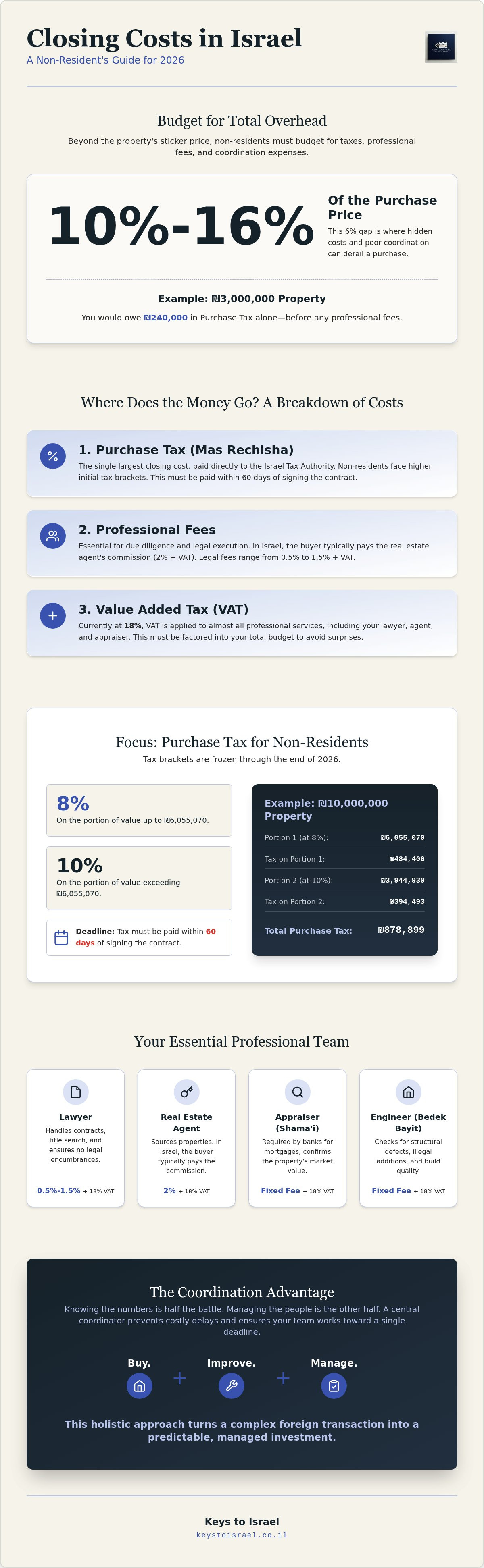
If you purchase a ₪3,000,000 property as a non-resident in 2026, you'll owe the Israeli government ₪240,000 in purchase tax before paying a single professional fee. Most foreign investors must budget for total closing costs when buying property in israel ranging from 10% to 16% on top of the sticker price. This 6% gap is often where overseas buyers fear they'll be taken for a ride by local vendors or lose money to confusing non-resident tax brackets.
We know the anxiety of managing a high-stakes transaction from a different time zone. You need a predictable budget and the confidence that no hidden costs will surface once the deal is in motion. This reference provides a clear breakdown of the 18% VAT rate and the specific tax brackets frozen through the end of 2026. We'll show you how to coordinate a vetted team of specialists to ensure your acquisition stays on track. You'll gain a reliable framework for choosing the right professionals and protecting your assets in a complex foreign market.
Table of Contents
The Reality of Israeli Real Estate Closing Costs in 2026
Closing costs are the total capital required to move a deed from the seller to the buyer in the Israeli Land Registry. For an overseas investor, these figures represent the difference between a successful acquisition and a failed contract. Total closing costs when buying property in israel typically range from 8% to 15% of the purchase price. This range exists because your final bill is a combination of statutory taxes, mandatory professional fees, and vital due diligence expenses. Overseas buyers face a different tax reality than local residents; ignoring this distinction often leads to budget collapses during the final stages of a deal.
Why the Sticker Shock Happens
If you're used to the US or UK models, the Israeli system will feel counterintuitive. In Israel, it's standard for the buyer to pay the real estate agent commission, whereas Western sellers often cover both sides. You must also account for the volatility of the Israeli Shekel. Since most overseas buyers hold capital in foreign currency, a sudden shift in the exchange rate can fluctuate your final closing figure by tens of thousands of shekels. A foundational understanding of Taxation in Israel is necessary to grasp how land appreciation and purchase taxes interact to create these high entry costs.
The Coordination Advantage
Knowing the numbers is only half the battle. Managing the people who charge them is the other half. If your lawyer and mortgage broker don't communicate, you might find yourself facing late payment penalties because a bank document wasn't filed on time. We advocate for a "Buy, Improve, Manage" approach to property ownership. This holistic budgeting method ensures that your team moves toward the same deadline. By coordinating every specialist from day one, you act as a steady hand over your investment rather than a remote client chasing updates from a different time zone.
Purchase Tax (Mas Rechisha) for Non-Residents
Mas Rechisha is the single largest component of closing costs when buying property in israel. You must declare this tax within 30 days and pay it to the Israel Tax Authority within 60 days of signing. It's vital to remember that your tax liability is triggered by the moment you sign the contract, not when you eventually take possession of the keys. For detailed procedural steps, this legal guide to buying property in Israel provides an authoritative breakdown of the registration process.
Foreign Resident vs. Israeli Resident Brackets
Overseas investors start at a significantly higher tax floor than local first-time buyers. Through the end of 2026, the tax brackets are frozen to provide market predictability. For a ₪5,000,000 purchase, a non-resident pays a flat 8%, totaling ₪400,000. A local resident buying their only home would pay significantly less because they benefit from lower entry tiers. If you're an 'Oleh Hadash' (New Immigrant) or plan to make Aliyah within a year of the purchase, you may qualify for a reduced tax rate. See how it works to determine if your specific residency status qualifies for these savings.
The 2026 Luxury Tax Threshold
For high-value acquisitions, the tax burden increases. In 2026, the threshold for the higher bracket is ₪6,055,070. Any portion of the property value exceeding this amount is taxed at 10%. This applies to all buyers regardless of residency status if the property is not their sole residence in Israel. On a ₪10,000,000 apartment, you'd pay 8% on the first ₪6,055,070 and 10% on the remaining ₪3,944,930. These tiered costs make professional coordination essential to avoid miscalculating your liquid cash requirements before you sign the binding agreement.
Professional Fees and Transactional Expenses
Taxes are the heavy hitters, but professional fees determine the safety of your deal. Legal fees generally range from 0.5% to 1.5% plus VAT. Don't assume the lower end for complex foreign transactions where your lawyer must navigate overseas documentation. Real estate agent fees are standard at 2% plus VAT. In Israel, it's almost always the buyer who pays this commission, making it a significant part of closing costs when buying property in israel.
The Essential Professional Team
Lawyer: They handle the contract and ensure the title is clear of liens or legal encumbrances.
Appraiser (Shama'i): Banks require this for mortgages, but every buyer needs one to ensure they aren't overpaying for the asset.
Engineer (Bedek Bayit): This specialist checks for structural defects or illegal additions that could stop a sale later.
The Impact of VAT on Your Budget
Almost all professional services in Israel are subject to Value Added Tax (VAT), which is currently 18%. This tax applies to your lawyer, agent, and appraiser. If your total professional fees reach ₪150,000, VAT adds another ₪27,000 to your bill. Understanding Israel's Real Estate Taxation Law helps you see how these layers accumulate. Managing these vendors effectively is the only way to keep costs from spiraling. Talk to us to see how we assemble and manage this team for you.
Currency conversion and international transfer fees can sap 0.5% to 1% of your buying power. If you transfer large sums through retail banks without a specialized currency broker, you'll lose thousands of shekels to poor exchange rates. This is a common point where closing costs when buying property in israel grow unexpectedly for overseas buyers.
Budgeting for Success: How to Coordinate Your Purchase
Successful investing in Israel requires a local network to chase professionals who don't always prioritize remote clients. Without a physical presence, your file can easily stall on a desk while deadlines approach. A coordinator acts as your local eyes and ears, ensuring the lawyer, appraiser, and broker are all moving in sync. This active oversight is the most effective way to manage closing costs when buying property in israel, as it prevents the "lazy" legal work or inflated appraisals that often plague unmanaged transactions.
Avoiding the Pitfalls of Remote Buying
Hesitation is natural when you don't speak the language or understand the local culture. Coordination bridges this geographical and cultural gap. We protect your interests by holding vendors accountable and ensuring that technical due diligence actually reflects the property's condition. For a broader view of the acquisition process, see our Israel Property Purchase: 2026 Overseas Investor Guide. This approach ensures your professional team works for you, not just for the deal.
Finalizing Your Financial Plan
Your 2026 financial plan should include the "Improve" stage of the lifecycle. We recommend setting aside 5% of your budget for immediate post-purchase renovations to ensure the property is rental-ready. Your final cash-required checklist must include:
Statutory Purchase Tax (Mas Rechisha) based on your residency status.
Professional fees for your lawyer, agent, and appraiser plus 18% VAT.
A 1% buffer for unexpected legal filings, power of attorney notarizations, or registry fees.
Buying property in Israel is more than a financial transaction; it's a connection to the resilience of the homeland. Once the numbers establish the case, the pull of diaspora ties and historical roots makes the effort worthwhile. Talk to us to see how we coordinate your entire Israeli property team.
Securing Your Israeli Assets with Precision
Owning property in the homeland is a significant milestone, but the financial entry point requires meticulous planning. You now understand that total closing costs when buying property in israel range from 10% to 16% depending on the property value and your residency status. With the 8% and 10% tax brackets frozen through 2026, you have a rare window of predictability to finalize your budget before signing.
Success depends on moving beyond simple lists of taxes. You need a local ally who assembles and manages your lawyer, mortgage broker, and appraiser to ensure no professional fee or VAT charge surfaces as a late-deal surprise. We provide expert coordination and specialized management for vacant or rental properties across the country. Our team acts as your steady hand, protecting your interests while you manage your life from abroad.
Get in touch to see how we coordinate your Israel property purchase. Your investment in Israel is a testament to historical resilience and a long-term commitment to the future. We're here to ensure that connection starts on solid financial ground.
Frequently Asked Questions
Is the purchase tax different for foreign residents compared to Israeli citizens?
Yes, foreign residents face a higher tax floor than Israeli citizens buying their primary residence. For non-residents, the purchase tax is currently 8% on the portion of the property value up to ₪6,055,070 and 10% on any amount exceeding that figure. These brackets are fixed through the end of 2026. Local residents buying a single home benefit from significant exemptions that don't apply to overseas investors or owners of multiple properties.
What are the standard legal fees when buying an apartment in Israel?
Standard legal fees for a property transaction typically range from 0.5% to 1.5% of the purchase price. You must also account for an additional 18% Value Added Tax (VAT) on top of the lawyer's fee. While some firms offer lower rates, overseas buyers often require more extensive due diligence and coordination. This makes the legal fee a vital component of the total closing costs when buying property in israel that you must budget for early.
Do I have to pay the real estate agent if I am the buyer?
Yes, it's standard practice in Israel for the buyer to pay their own real estate agent's commission. This fee is typically 2% of the purchase price plus 18% VAT. Unlike the US market, where the seller often covers both agents, the Israeli system requires both parties to pay their respective representatives. We coordinate with these agents to ensure the negotiation stays on track, but the commission remains a mandatory buyer expense.
Are there hidden costs when transferring money to Israel for a property purchase?
Currency conversion spreads and international transfer fees are common hidden expenses that can sap your buying power. Retail banks often charge high margins on the exchange rate, which can add 0.5% to 1% to your total closing costs when buying property in israel. Israeli banks also charge administrative file-opening fees. We help you manage these hurdles by coordinating with specialized currency brokers to minimize unnecessary losses during the transfer process.
How much should I budget for a building engineer or appraiser?
You should budget approximately ₪2,000 to ₪3,540 for a bank-mandated property appraisal. A professional building engineer's report, known as a Bedek Bayit, typically costs a similar amount depending on the property size. These fees are subject to 18% VAT. While these might seem like optional expenses, they are essential for protecting your investment against structural defects or illegal additions that could complicate a future sale or mortgage application.


Comments